

This physics problem tests your understanding of fundamental physical laws and their applications. The step-by-step solution below breaks down the problem using relevant equations and physical reasoning.
ScanSolve AI Answer
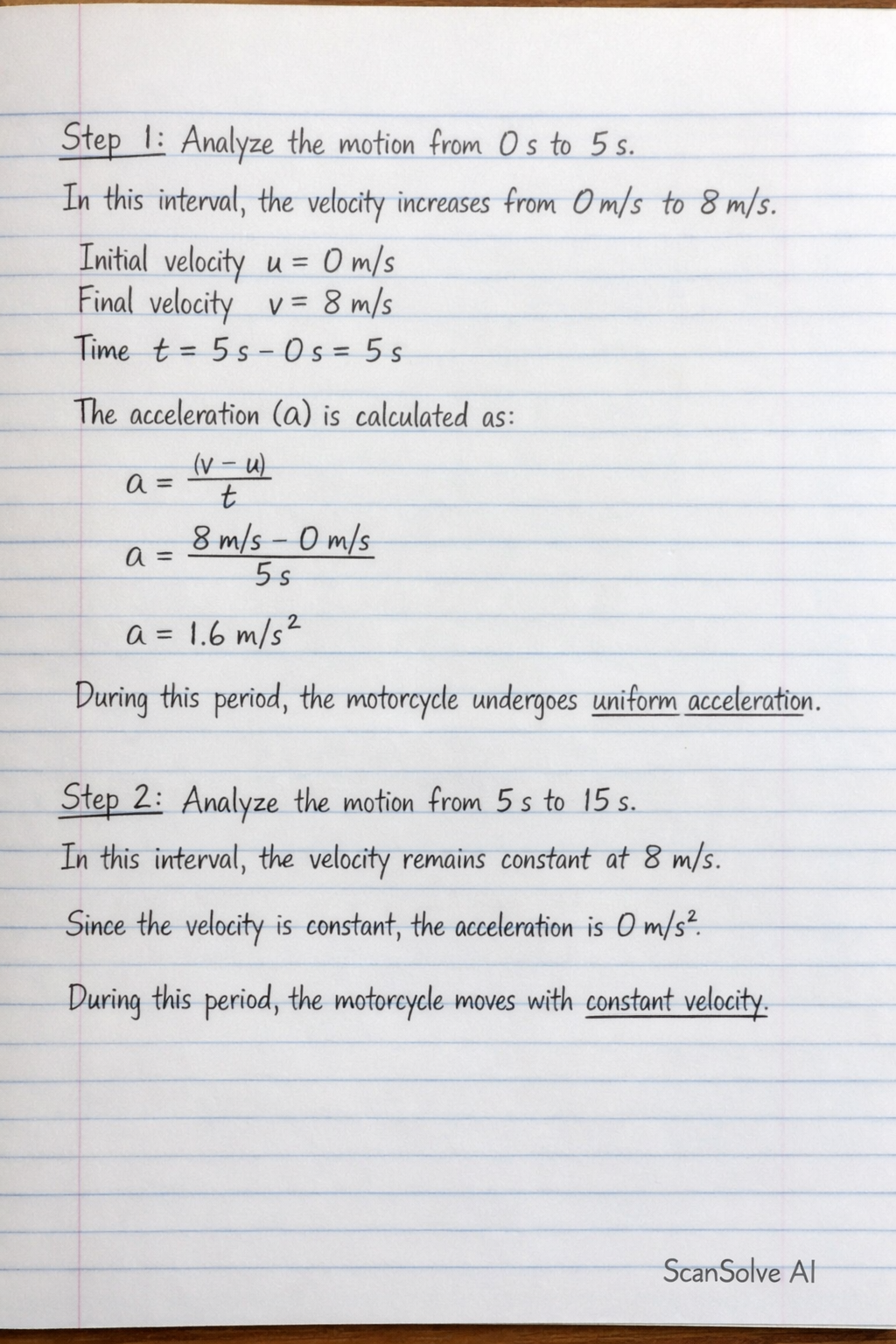
Step 1: Analyze the motion from 0 s to 5 s. In this interval, the velocity increases from 0 m/s to 8 m/s. Initial velocity u = 0 m/s Final velocity v = 8 m/s Time t = 5 s - 0 s = 5 s The acceleration (a) is calculated as: a = (v-u)/(t) a = 8 m/s - 0 m/s5 s a = 1.6 m/s^2 During this period, the motorcycle undergoes uniform acceleration. Step 2: Analyze the motion from 5 s to 15 s. In this interval, the velocity remains constant at 8 m/s. Since the velocity is constant, the acceleration is 0 m/s^2. During this period, the motorcycle moves with constant velocity. Step 3: Analyze the motion from 15 s to 25 s. In this interval, the velocity decreases from 8 m/s to 4 m/s. Initial velocity u = 8 m/s Final velocity v = 4 m/s Time t = 25 s - 15 s = 10 s The acceleration (a) is calculated as: a = (v-u)/(t) a = 4 m/s - 8 m/s10 s a = -4 m/s10 s a = -0.4 m/s^2 During this period, the motorcycle undergoes uniform deceleration. Step 4: Analyze the motion from 25 s to 30 s. In this interval, the velocity remains constant at 4 m/s. Since the velocity is constant, the acceleration is 0 m/s^2. During this period, the motorcycle moves with constant velocity. Step 5: Analyze the motion from 30 s to 40 s. In this interval, the velocity decreases from 4 m/s to 0 m/s. Initial velocity u = 4 m/s Final velocity v = 0 m/s Time t = 40 s - 30 s = 10 s The acceleration (a) is calculated as: a = (v-u)/(t) a = 0 m/s - 4 m/s10 s a = -4 m/s10 s a = -0.4 m/s^2 During this period, the motorcycle undergoes uniform deceleration and comes to a stop. Step 6: Analyze the motion from 40 s to 45 s. In this interval, the velocity remains constant at 0 m/s. Since the velocity is constant and zero, the motorcycle is at rest. Summary of motion: • 0 s to 5 s: Uniform acceleration of 1.6 m/s^2. • 5 s to 15 s: Constant velocity of 8 m/s (acceleration 0 m/s^2). • 15 s to 25 s: Uniform deceleration of -0.4 m/s^2. • 25 s to 30 s: Constant velocity of 4 m/s (acceleration 0 m/s^2). • 30 s to 40 s: Uniform deceleration of -0.4 m/s^2. • 40 s to 45 s: At rest (velocity 0 m/s, acceleration 0 m/s^2). Last free one today — make it count tomorrow, or type /upgrade for unlimited.