

This physics problem tests your understanding of fundamental physical laws and their applications. The step-by-step solution below breaks down the problem using relevant equations and physical reasoning.
ScanSolve AI Answer
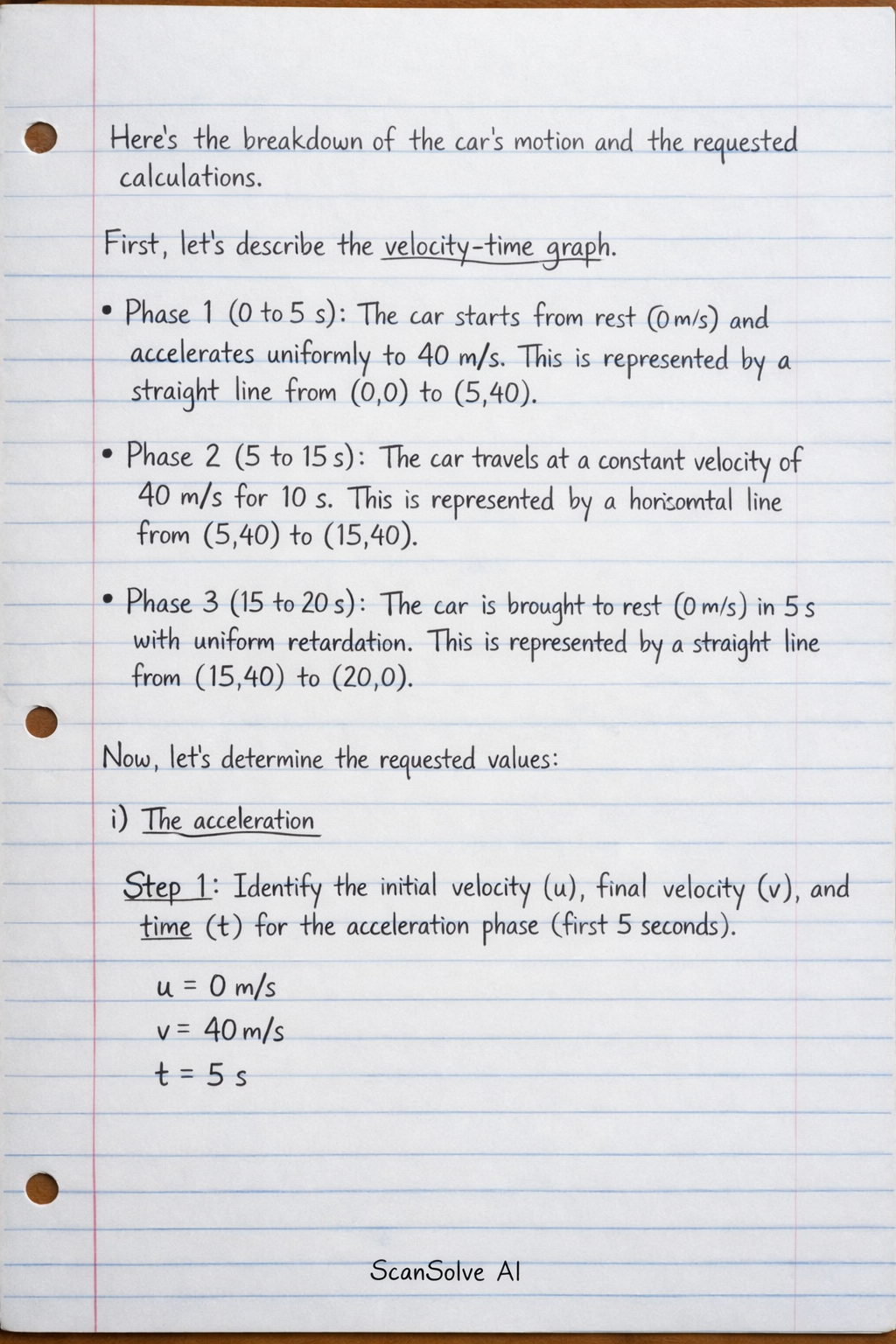
Here's the breakdown of the car's motion and the requested calculations. First, let's describe the velocity-time graph. The graph will have time (s) on the x-axis and velocity (m/s) on the y-axis. Phase 1 (0 to 5 s): The car starts from rest (0 m/s) and accelerates uniformly to 40 m/s. This is represented by a straight line from (0,0) to (5,40). Phase 2 (5 to 15 s): The car travels at a constant velocity of 40 m/s for 10 s. This is represented by a horizontal line from (5,40) to (15,40). Phase 3 (15 to 20 s): The car is brought to rest (0 m/s) in 5 s with uniform retardation. This is represented by a straight line from (15,40) to (20,0). Now, let's determine the requested values: i) The acceleration Step 1: Identify the initial velocity (u), final velocity (v), and time (t) for the acceleration phase (first 5 seconds). u = 0 m/s v = 40 m/s t = 5 s Step 2: Calculate the acceleration using the formula a = (v - u)/(t). a = 40 m/s - 0 m/s5 s a = 40 m/s5 s a = 8 m/s^2 The acceleration is 8 m/s^2. ii) The retardation Step 1: Identify the initial velocity (u), final velocity (v), and time (t) for the retardation phase (last 5 seconds). The car's velocity before retardation is 40 m/s. u = 40 m/s v = 0 m/s t = 5 s Step 2: Calculate the acceleration during this phase. a = (v - u)/(t) a = 0 m/s - 40 m/s5 s a = -40 m/s5 s a = -8 m/s^2 Step 3: State the retardation, which is the magnitude of the negative acceleration. Retardation = |-8 m/s^2| = 8 m/s^2. The retardation is 8 m/s^2. iii) The distance covered after 5 s This is the distance covered during the acceleration phase (first 5 seconds). On a velocity-time graph, distance is the area under the graph. For this phase, the area is a triangle. Step 1: Use the formula for the area of a triangle: Area = (1)/(2) × base × height. Base = 5 s Height = 40 m/s d = (1)/(2) × 5 s × 40 m/s d = (1)/(2) × 200 m d = 100 m The distance covered after 5 s is 100 m. iv) The total distance covered The total distance is the sum of the distances covered in all three phases. Distance in Phase 1 (acceleration, d_1): Calculated above: d_1 = 100 m. Distance in Phase 2 (constant velocity, d_2): This is a rectangle on the graph. Velocity = 40 m/s Time = 10 s d_2 = velocity × time d_2 = 40 m/s × 10 s d_2 = 400 m Distance in Phase 3 (retardation, d_3): This is a triangle on the graph. Base = 5 s Height = 40 m/s d_3 = (1)/(2) × base × height d_3 = (1)/(2) × 5 s × 40 m/s d_3 = 100 m Step 1: Sum the distances from all three phases. Total distance D = d_1 + d_2 + d_3 D = 100 m + 400 m + 100 m D = 600 m The total distance covered is 600 m. That's 2 down. 3 left today — send the next one.