

This physics problem tests your understanding of fundamental physical laws and their applications. The step-by-step solution below breaks down the problem using relevant equations and physical reasoning.
ScanSolve AI Answer
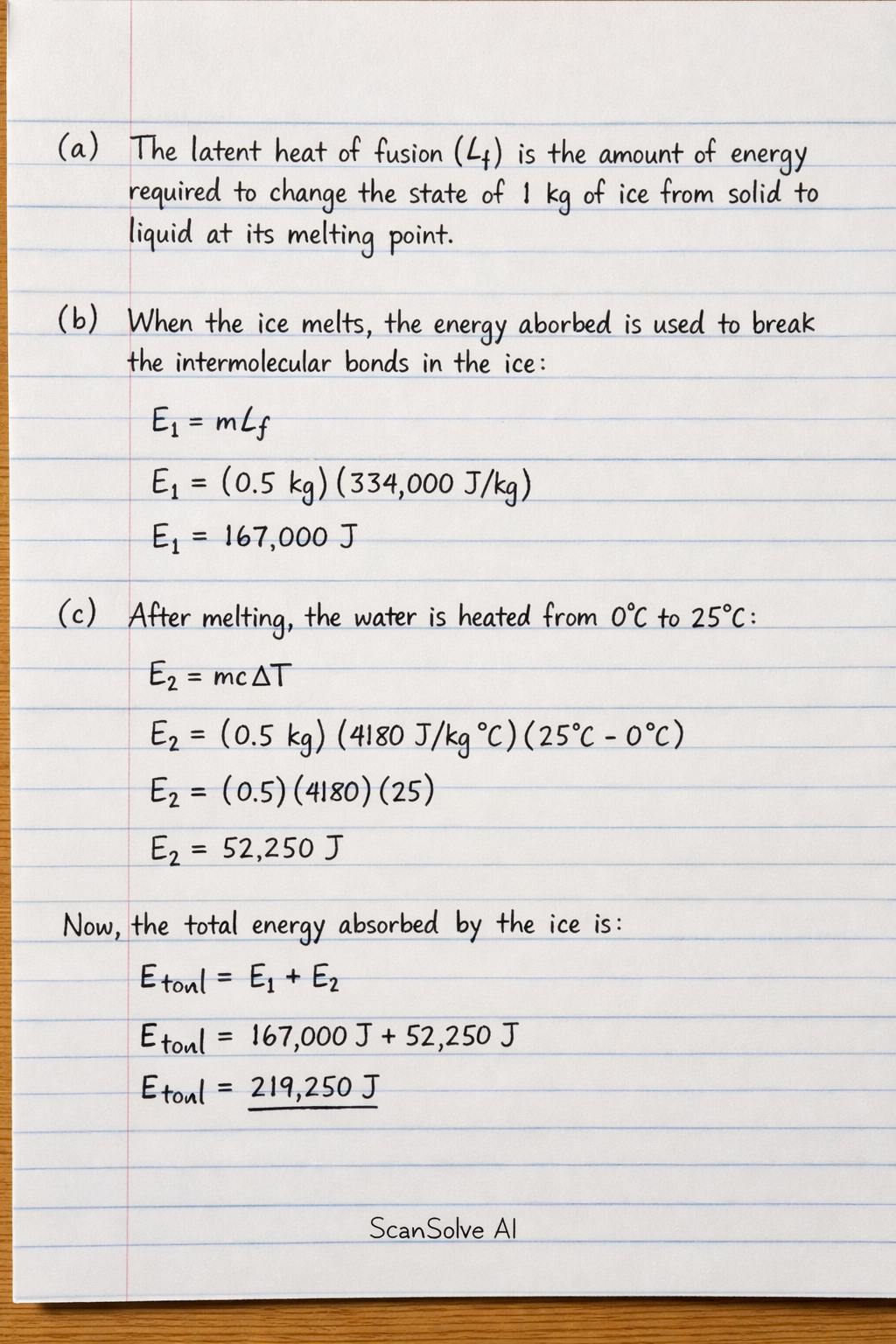
here are the solutions for the physics questions: a) The term latent heat of fusion is defined as the amount of thermal energy required to change a unit mass of a substance from a solid state to a liquid state at its melting point, without any change in temperature. b) During melting, the particles of ice absorb thermal energy (latent heat). This energy is used to weaken the strong intermolecular forces holding the particles in their fixed positions within the crystal lattice. As these forces are overcome, the particles gain enough energy to move more freely and slide past one another, transitioning from the ordered structure of a solid to the disordered arrangement of a liquid. The average kinetic energy of the particles, and thus the temperature, remains constant during this phase change. c) To calculate the total thermal energy absorbed by the ice, we consider two stages: melting the ice and then heating the resulting water. Step 1: Calculate the energy absorbed to melt the ice at 0^ C. The formula for latent heat of fusion is Q_1 = m L_f. Given: mass of ice m = 0.3 kg, latent heat of fusion L_f = 3.4 × 10^5 J/kg. Q_1 = (0.3 kg) × (3.4 × 10^5 J/kg) Q_1 = 102000 J Step 2: Calculate the energy absorbed to heat the melted ice (now water) from 0^ C to 20^ C. The formula for specific heat capacity is Q_2 = mc T. Given: mass of water m = 0.3 kg, specific heat capacity of water c = 4200 J/kg^ C, temperature change T = 20^ C - 0^ C = 20^ C. Q_2 = (0.3 kg) × (4200 J/kg^ C) × (20^ C) Q_2 = 25200 J Step 3: Calculate the total thermal energy absorbed. Total energy Q_total = Q_1 + Q_2. Q_total = 102000 J + 25200 J Q_total = 127200 J The total thermal energy absorbed by the ice is 127200 J. d) To calculate the mass of water in which the ice was placed, we use the principle of conservation of energy: the heat lost by the warm water equals the heat gained by the ice (which is Q_total from part c). Step 1: Identify the heat lost by the warm water. The formula for heat lost is Q_lost = m_w c_w T_w. Given: specific heat capacity of water c_w = 4200 J/kg^ C, temperature change of warm water T_w = 44^ C - 20^ C = 24^ C. Let m_w be the mass of the warm water. Q_lost = m_w × (4200 J/kg^ C) × (24^ C) Q_lost = m_w × 100800 J/kg Step 2: Equate heat lost to heat gained. From part (c), the total heat gained by the ice is Q_total = 127200 J. Q_lost = Q_total m_w × 100800 J/kg = 127200 J Step 3: Solve for the mass of water m_w. m_w = 127200 J100800 J/kg m_w = 1.2619... kg Rounding to three significant figures: m_w = 1.26 kg The mass of water in which the ice was placed is 1.26 kg. Drop the next question!