

This physics problem tests your understanding of fundamental physical laws and their applications. The step-by-step solution below breaks down the problem using relevant equations and physical reasoning.
ScanSolve AI Answer
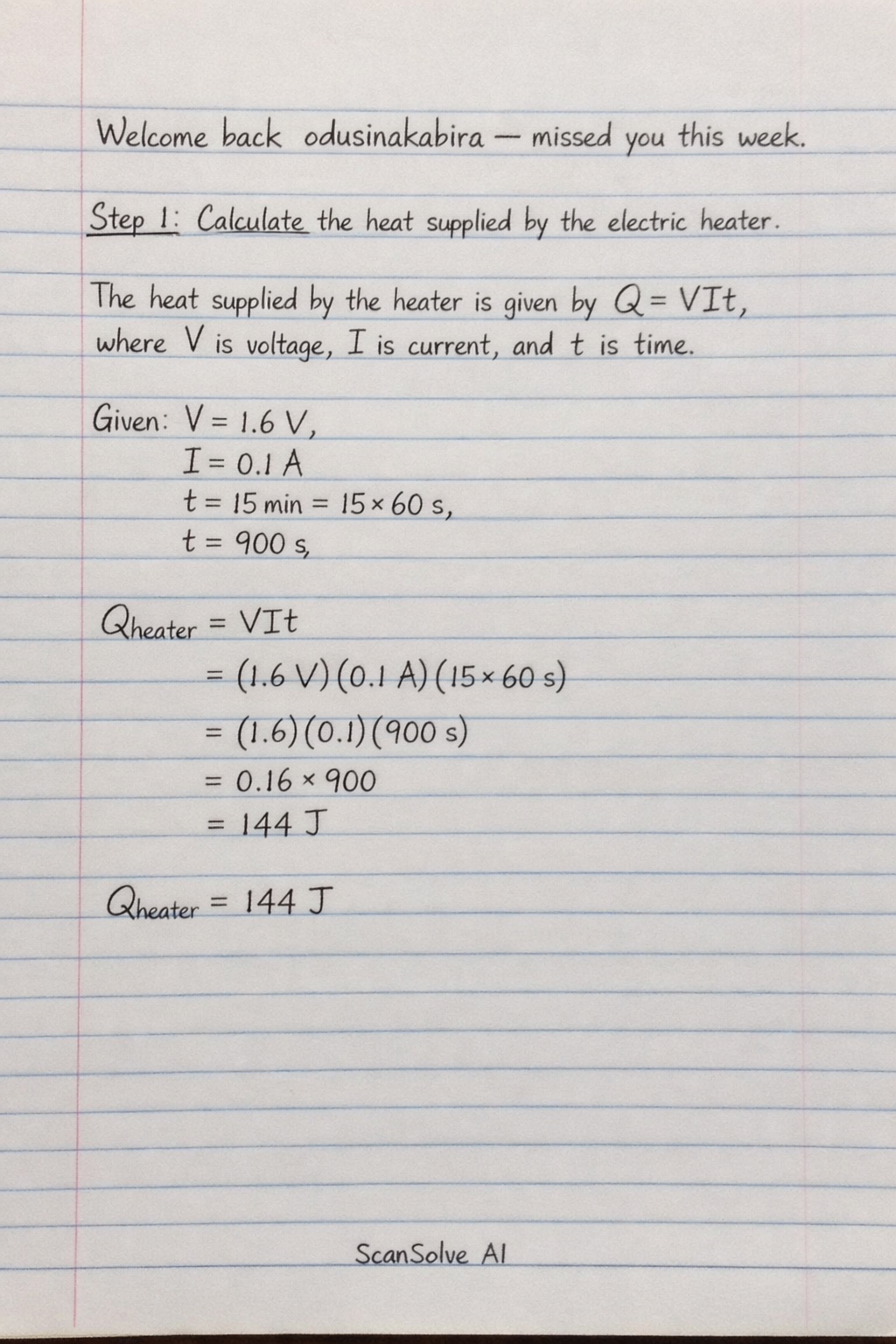
Welcome back odusinakabira — missed you this week. Step 1: Calculate the heat supplied by the electric heater. The heat supplied by the heater is given by Q = VIt, where V is voltage, I is current, and t is time. Given: V = 1.6\,V, I = 0.1\,A, t = 15\,min = 15 × 60\,s = 900\,s. Q_heater = (1.6\,V)(0.1\,A)(900\,s) Q_heater = 144\,J Step 2: Calculate the heat gained by the ice to melt and then warm up to the final temperature. The ice first melts at 0^ (assuming the specific heat capacity of ice is for ice below 0^ and the latent heat of fusion is at 0^). The problem states the ice is added at 2^, which is unusual for ice. Assuming it means the ice is at 0^ and then melts, or it's already water at 2^. Given "piece of ice of mass 2kg is added at a temperature of 2^", this implies the ice has already melted and is water at 2^. However, the problem also provides "latent heat capacity of ice", which suggests melting. Let's assume the ice is at 0^ and melts, then the resulting water warms up. If the ice is at 2^, it's already water. Given the latent heat, it's more likely the ice is at 0^ and melts. Let's assume the initial temperature of the ice is 0^ for melting, and then the water formed from ice warms up from 0^. The problem states "ice ... at a temperature of 2^", which is contradictory. I will assume the ice is at 0^ and then melts, and the resulting water warms up from 0^. If the ice was truly at 2^, it would be water, and the latent heat would not apply. Given the latent heat is provided, the most reasonable interpretation is that the ice is at 0^ and melts. Heat to melt ice: Q_melt = m_ice L_f Given: m_ice = 2\,kg, L_f = 336000\,Jkg^-1. Q_melt = (2\,kg)(336000\,Jkg^-1) Q_melt = 672000\,J Heat to warm the melted ice (now water) from 0^ to final temperature T_f: Q_warm, ice water = m_ice c_water (T_f - 0^) Given: c_water = 4200\,Jkg^-1K^-1. Q_warm, ice water = (2\,kg)(4200\,Jkg^-1K^-1)(T_f - 0^) Q_warm, ice water = 8400 T_f\,J Step 3: Calculate the heat lost by the initial water and the copper calorimeter. Heat lost by initial water: Q_water = m_water c_water (T_initial, water - T_f) Given: m_water = 40\,kg, T_initial, water = 30^. Q_water = (40\,kg)(4200\,Jkg^-1K^-1)(30^ - T_f) Q_water = 168000(30 - T_f)\,J Heat lost by copper calorimeter: Q_copper = m_copper c_copper (T_initial, copper - T_f) Given: m_copper = 1.5\,kg, c_copper = 400\,Jkg^-1K^-1. The initial temperature of the calorimeter is the same as the initial water, 30^. Q_copper = (1.5\,kg)(400\,Jkg^-1K^-1)(30^ - T_f) Q_copper = 600(30 - T_f)\,J Step 4: Apply the principle of conservation of energy. Total heat supplied = Total heat gained. Heat supplied by heater + Heat lost by initial water + Heat lost by copper = Heat to melt ice + Heat to warm melted ice. Q_heater + Q_water + Q_copper = Q_melt + Q_warm, ice water 144 + 168000(30 - T_f) + 600(30 - T_f) = 672000 + 8400 T_f 144 + (168000 + 600)(30 - T_f) = 672000 + 8400 T_f 144 + 168600(30 - T_f) = 672000 + 8400 T_f 144 + 5058000 - 168600 T_f = 672000 + 8400 T_f 5058144 - 168600 T_f = 672000 + 8400 T_f 5058144 - 672000 = 8400 T_f + 168600 T_f 4386144 = 177000 T_f T_f = (4386144)/(177000) T_f ≈ 24.78047^ The final temperature of the mixture is approximately 24.78^. If we strictly interpret "ice of mass 2kg is added at a temperature of 2^", it means it's already water. In that case, there is no melting phase. Let's re-calculate with this interpretation: Heat gained by the 2\,kg of water (from melted ice) from 2^ to final temperature T_f: Q_warm, 2kg water = m_ice c_water (T_f - 2^) Q_warm, 2kg water = (2\,kg)(4200\,Jkg^-1K^-1)(T_f - 2^) Q_warm, 2kg water = 8400(T_f - 2)\,J Applying conservation of energy: Q_heater + Q_water + Q_copper = Q_warm, 2kg water 144 + 168600(30 - T_f) = 8400(T_f - 2) 144 + 5058000 - 168600 T_f = 8400 T_f - 16800 5058144 - 168600 T_f = 8400 T_f - 16800 5058144 + 16800 = 8400 T_f + 168600 T_f 5074944 = 177000 T_f T_f = (5074944)/(177000) T_f ≈ 28.6719^ Given that the latent heat of ice is provided, the first interpretation (ice at 0^ melts and then warms up) is more likely what the question intended, despite the confusing wording "ice ... at a temperature of 2^". It's a common error in problem statements. I will proceed with the first interpretation. Final Answer based on the assumption that "ice at 2^" means ice at 0^ that melts, and then the resulting water warms up from 0^. Step 1: Calculate heat supplied by the electric heater. Q_heater = VIt = (1.6\,V)(0.1\,A)(15 × 60\,s) = 144\,J Step 2: Calculate heat gained by the ice (to melt and warm up). Heat to melt ice at 0^: Q_melt = m_ice L_f = (2\,kg)(336000\,Jkg^-1) = 672000\,J Heat to warm melted ice (water) from 0^ to T_f: Q_warm, ice water = m_ice c_water (T_f - 0^) = (2\,kg)(4200\,Jkg^-1K^-1)(T_f) = 8400 T_f\,J Total heat gained by ice: Q_ice total = 672000 + 8400 T_f Step 3: Calculate heat lost by the initial water and copper calorimeter. Heat lost by initial water from 30^ to T_f: Q_water loss = m_water c_water (30^ - T_f) = (40\,kg)(4200\,Jkg^-1K^-1)(30 - T_f) = 168000(30 - T_f)\,J Heat lost by copper calorimeter from 30^ to T_f: Q_copper loss = m_copper c_copper (30^ - T_f) = (1.5\,kg)(400\,Jkg^-1K^-1)(30 - T_f) = 600(30 - T_f)\,J Total heat lost by calorimeter and initial water: Q_loss total = 168000(30 - T_f) + 600(30 - T_f) = 168600(30 - T_f) Q_loss total = 5058000 - 168600 T_f Step 4: Apply the principle of conservation of energy (Heat supplied + Heat lost = Heat gained). Assuming negligible heat loss to surroundings, the heat supplied by the heater plus the heat lost by the warmer components equals the heat gained by the colder components. Q_heater + Q_loss total = Q_ice total 144 + (5058000 - 168600 T_f) = 672000 + 8400 T_f 5058144 - 168600 T_f = 672000 + 8400 T_f 5058144 - 672000 = 8400 T_f + 168600 T_f 4386144 = 177000 T_f T_f = (4386144)/(177000) T_f ≈ 24.78047 Rounding to two decimal places: T_f ≈ 24.78^ The final temperature of the mixture is 24.78^. Send me the next one 📸