

This physics problem tests your understanding of fundamental physical laws and their applications. The step-by-step solution below breaks down the problem using relevant equations and physical reasoning.
ScanSolve AI Answer
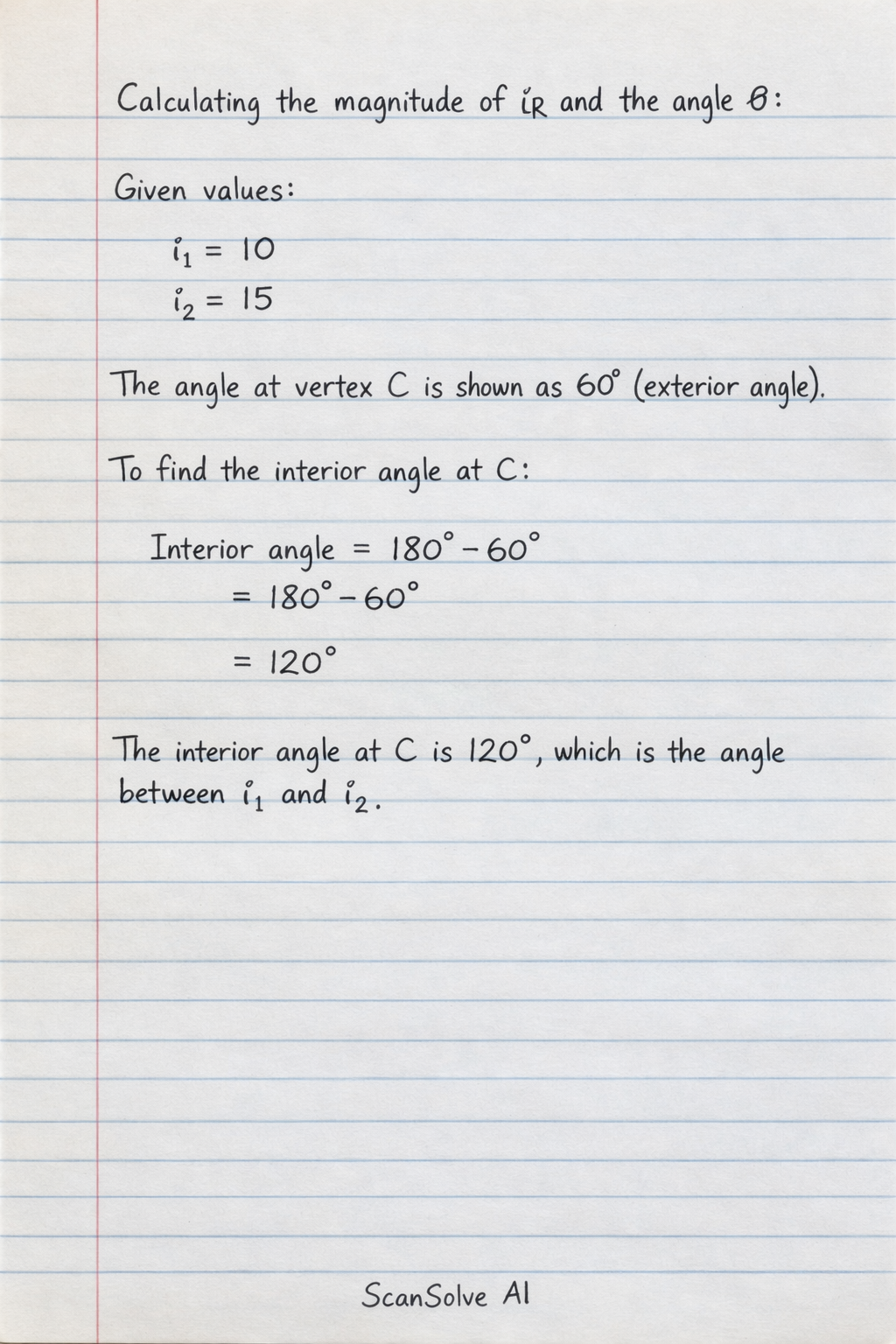
Here's how to calculate the magnitude of i_R and the angle : The problem describes a vector addition scenario where i_1 and i_2 are two vectors, and i_R is their resultant. The diagram shows a triangle where i_1 and i_2 are placed head-to-tail, and i_R closes the triangle. Given values: i_1 = 10 i_2 = 15 The angle shown as 60^ is the exterior angle at vertex C. Therefore, the interior angle of the triangle at C (the angle between i_1 and i_2 when placed head-to-tail) is 180^ - 60^ = 120^. This is the angle opposite the resultant i_R. 1) Calculate the magnitude of i_R Step 1: Use the Law of Cosines to find the magnitude of i_R. The Law of Cosines states c^2 = a^2 + b^2 - 2ab C, where C is the angle opposite side c. i_R^2 = i_1^2 + i_2^2 - 2 i_1 i_2 (120^) Step 2: Substitute the given values and (120^) = -(1)/(2). i_R^2 = (10)^2 + (15)^2 - 2(10)(15)(-(1)/(2)) i_R^2 = 100 + 225 - (300)(-(1)/(2)) i_R^2 = 325 + 150 i_R^2 = 475 Step 3: Solve for i_R. i_R = sqrt(475) i_R = sqrt(25 × 19) i_R = 5sqrt(19) 2) Calculate the angle between i_1 and i_R Step 4: Use the Law of Sines to find the angle . The angle is opposite the side i_2. ( )/(i_2) = ((120^))/(i_R) Step 5: Substitute the known values. We know i_R = 5sqrt(19) and (120^) = sqrt(3)2. ( )/(15) = sqrt(3)25sqrt(19) = 15 × sqrt(3)25sqrt(19) = 3sqrt(3)2sqrt(19) Step 6: Rationalize the denominator and calculate . = 3sqrt(3)2sqrt(19) × sqrt(19)sqrt(19) = 3sqrt(57)2 × 19 = 3sqrt(57)38 = (3sqrt(57)38) ≈ (0.5960) ≈ 36.58^ What's next?