
We read your photo as:
Analyze the circuit shown in the image, identify the components and their values, and determine the currents I1, I2, and I3.
ScanSolve AI Answer
Answer
Step-by-step solution
5 stepsTo solve this circuit, we will use nodal analysis.
Define nodes and assign a reference node.
Let the top horizontal line be Node A with potential .
Let the bottom horizontal line be Node B with potential .
We set Node B as the reference node, so .Apply Kirchhoff's Current Law (KCL) at Node B.
Based on the current arrows in the diagram:
- Current enters Node B.
- Current leaves Node B.
- Current leaves Node B. Therefore, KCL at Node B states that the sum of currents entering the node equals the sum of currents leaving the node:
Express branch currents in terms of node voltages.
We will write expressions for , , and using Ohm's Law and considering the voltage sources in each branch. The current direction is from higher potential to lower potential. Since the arrows for point from Node A towards Node B (or through components to Node B), we assume is higher than .
For the leftmost branch (containing the resistor, source, and resistor):
Current flows from Node A, through the resistor, then through the source (positive terminal up, negative down), then through the resistor, and finally to Node B.
The voltage drop across the resistors and the source in the direction of is:Since :
For the middle branch (containing the resistor and source):
Current flows from Node A, through the resistor, then through the source (positive terminal up, negative down), and finally to Node B.Since :
For the rightmost branch (containing the resistor and source):
Current flows from Node A, through the resistor, then through the source (positive terminal up, negative down), and finally to Node B.Since :
Substitute into KCL and solve for .
Substitute Equations 2, 3, and 4 into Equation 1:
To eliminate the denominators, multiply the entire equation by the least common multiple of 5 and 4, which is 20:
Rearrange the terms to solve for :
Calculate the currents .
Now substitute back into Equations 2, 3, and 4:
For :For :
For :
The negative signs indicate that the actual direction of current flow is opposite to the direction indicated by the arrows in the diagram.
The final answers are:
Try one yourself
A new problem that tests the same skill.
Still stuck on this one?
Ask a follow-up, and the answer starts from this question.
More Physics Questions
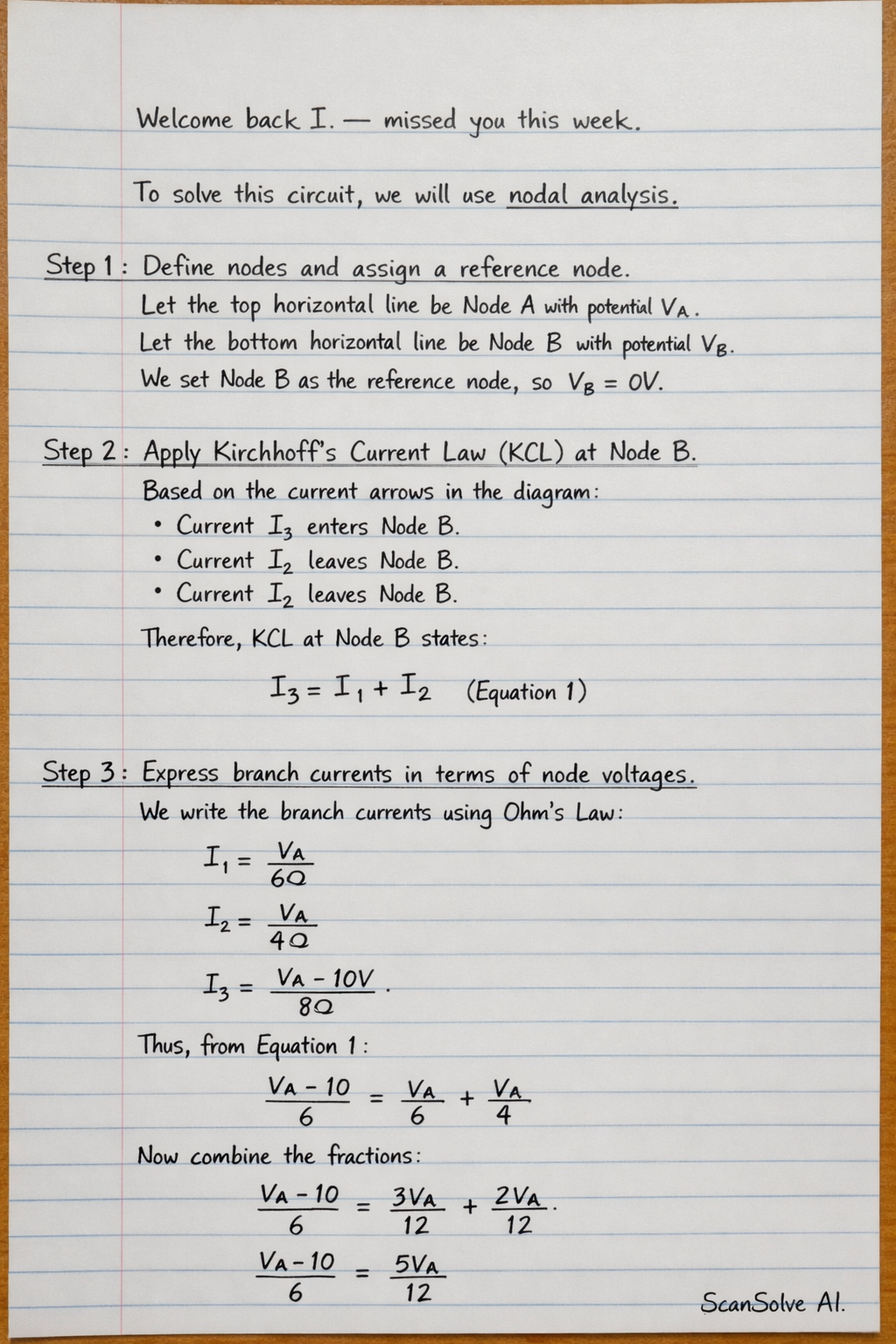
Handwritten Step-by-Step Solution
Get this as a handwritten image on WhatsApp — like a tutor wrote it for you.
Try on WhatsApp