
We read your photo as:
Using Kirchhoff's Current Law, determine the value of current I in the given circuit diagram.
ScanSolve AI Answer
Answer
Step-by-step solution
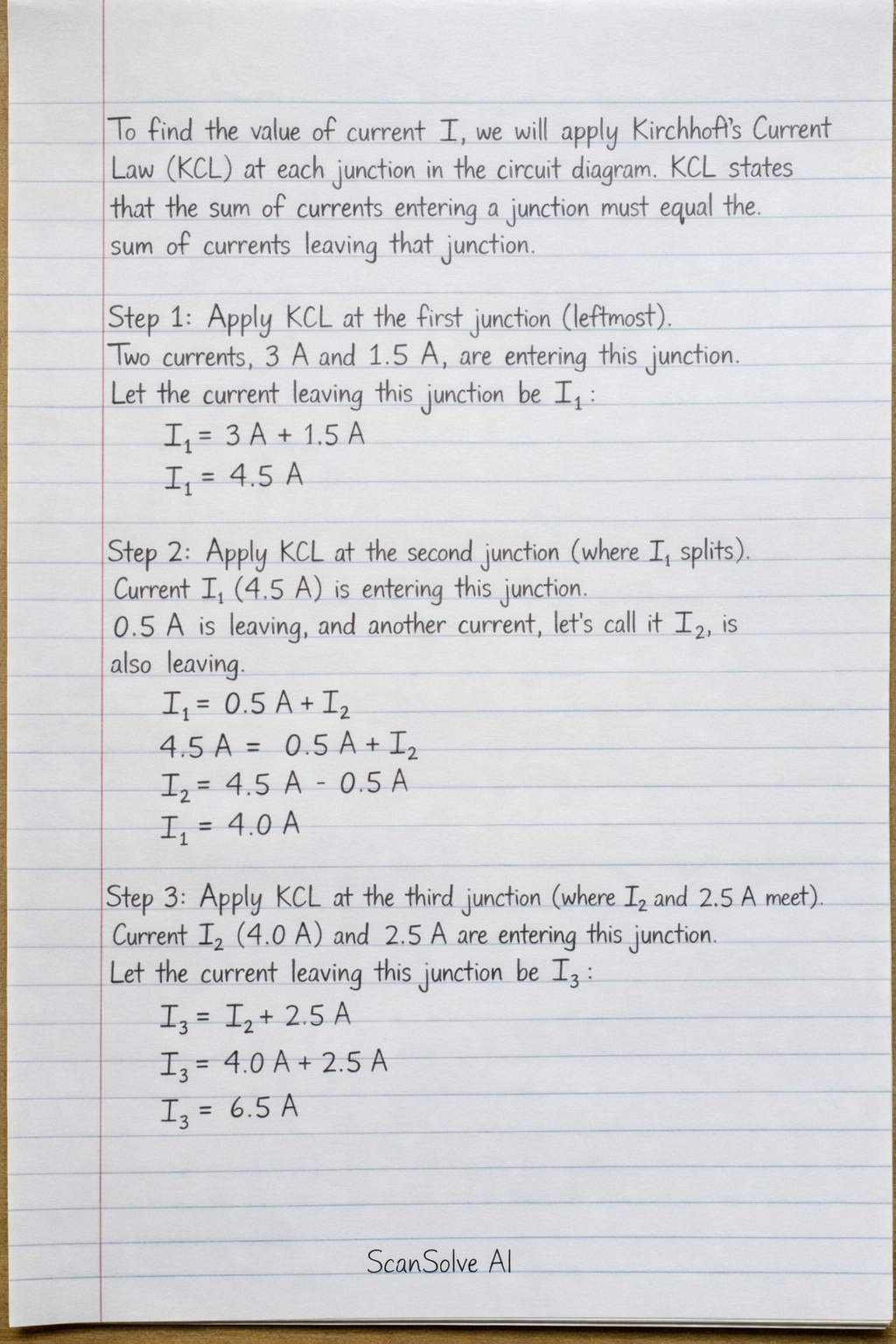
4 stepsTo find the value of current , we will apply Kirchhoff's Current Law (KCL) at each junction in the circuit diagram. KCL states that the sum of currents entering a junction must equal the sum of currents leaving that junction.
Apply KCL at the first junction (leftmost).
Two currents, 3 A and 1.5 A, are entering this junction. Let the current leaving this junction be .
Apply KCL at the second junction (where splits).
Current (4.5 A) is entering this junction. Current 0.5 A is leaving, and another current, let's call it , is also leaving.
Apply KCL at the third junction (where and 2.5 A meet).
Current (4.0 A) and 2.5 A are entering this junction. Let the current leaving this junction be .
Apply KCL at the fourth junction (final junction where splits into and 1.5 A).
Current (6.5 A) is entering this junction. Currents and 1.5 A are leaving this junction.
The calculated value for is 5.0 A.
Comparing this with the given options:
[A] 0.3 A
[B] 0.5 A
[C] 1.3 A
[D] इनमें से कोई नहीं (None of these)Since 5.0 A is not among options A, B, or C, the correct option is [D].
The final answer is .
Try one yourself
A new problem that tests the same skill.
Still stuck on this one?
Ask a follow-up, and the answer starts from this question.
More Physics Questions
Handwritten Step-by-Step Solution
Get this as a handwritten image on WhatsApp — like a tutor wrote it for you.
Try on WhatsApp