
We read your photo as:
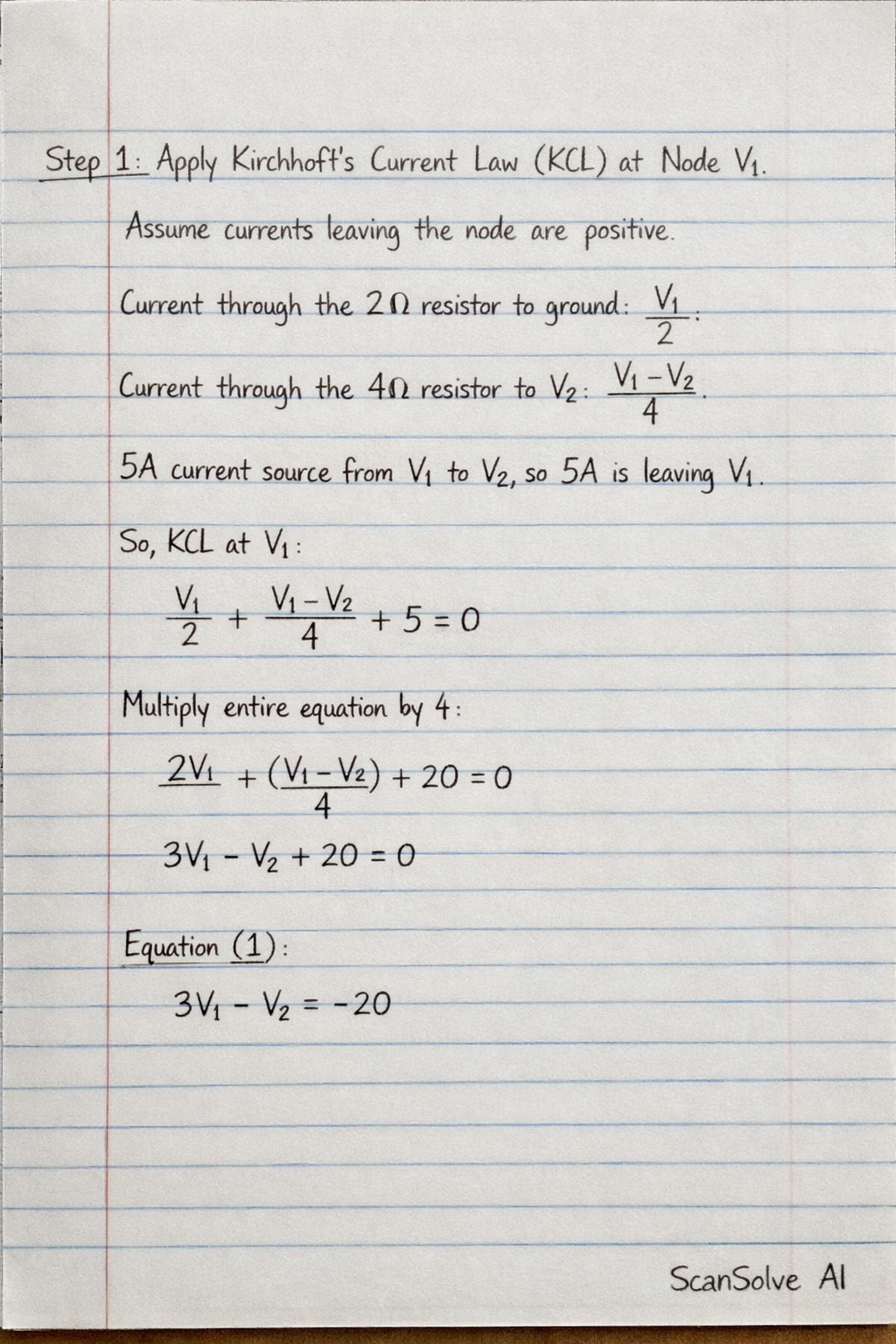
Apply Kirchhoff's Current Law (KCL) at Node V₁.
ScanSolve AI Answer
Answer
Step-by-step solution
3 stepsApply Kirchhoff's Current Law (KCL) at Node .
Assume currents leaving the node are positive.
The current through the resistor to ground is .
The current through the resistor to is .
The current source is directed from to , meaning is leaving .
So, KCL at :Multiply the entire equation by 4 to eliminate denominators:
Equation (1):
Apply Kirchhoff's Current Law (KCL) at Node .
Assume currents leaving the node are positive.
The current through the resistor to is .
The current through the resistor to ground is .
The current source is directed from to , meaning is entering . So, the current leaving due to this source is .
The current source is directed upwards into , meaning is entering . So, the current leaving due to this source is .
So, KCL at :Multiply the entire equation by 12 (the least common multiple of 4 and 6) to eliminate denominators:
Equation (2):
Solve the system of linear equations.
We have two equations:
Add Equation (1) and Equation (2):
Substitute the value of into Equation (1):
The node voltages are:
Try one yourself
A new problem that tests the same skill.
Still stuck on this one?
Ask a follow-up, and the answer starts from this question.
More Physics Questions
Handwritten Step-by-Step Solution
Get this as a handwritten image on WhatsApp — like a tutor wrote it for you.
Try on WhatsApp