
We read your photo as:
Apply Kirchhoffs law to FIGURE 1 below, and determine the value of the current in each branch of the circuit. Using Norton's theorem, calculate the current flowing through the 11.2 Q resistor in FIGURE 2. Also calculate the voltage drop across this resistor.
ScanSolve AI Answer
Step-by-step solution
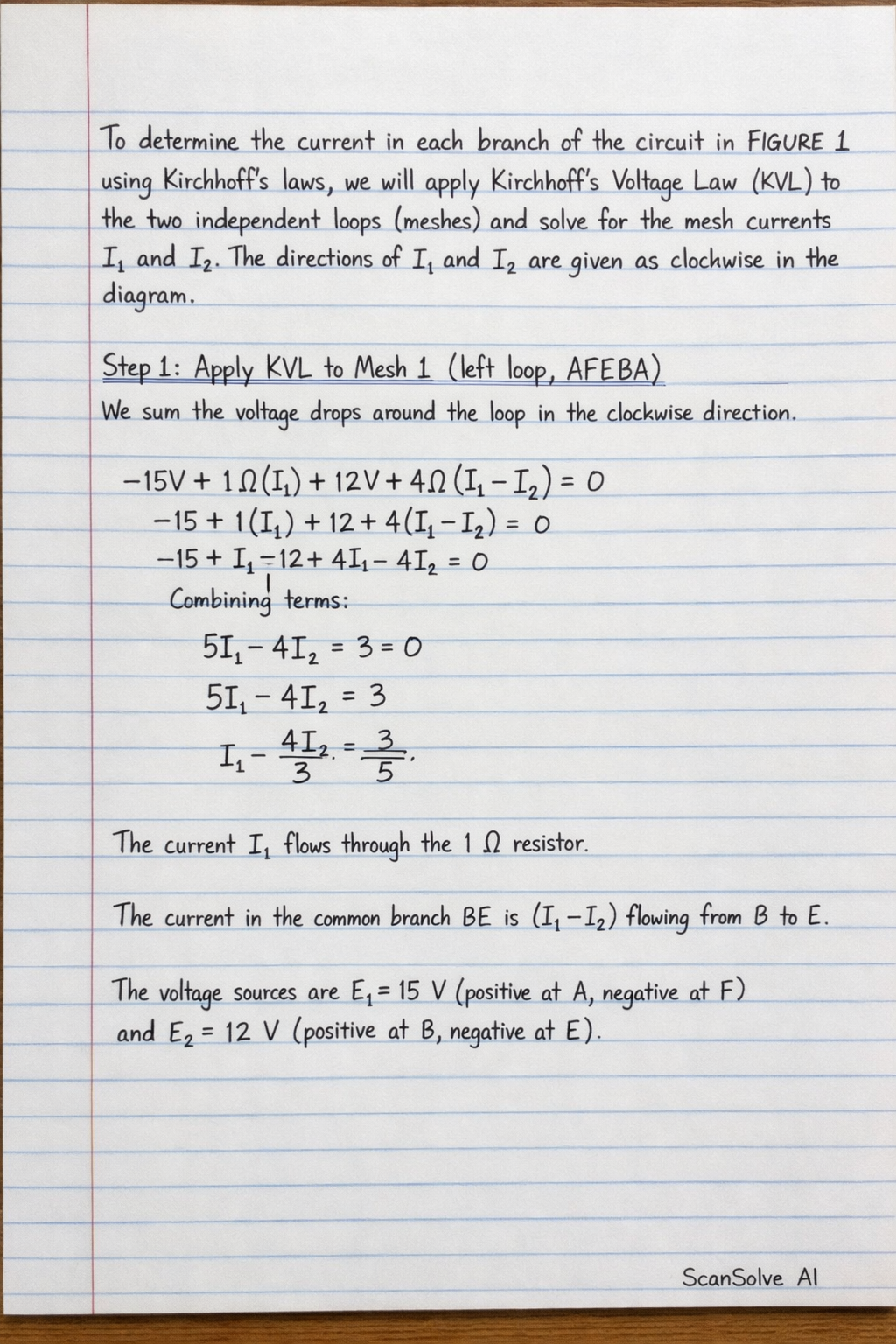
4 stepsTo determine the current in each branch of the circuit in FIGURE 1 using Kirchhoff's laws, we will apply Kirchhoff's Voltage Law (KVL) to the two independent loops (meshes) and solve for the mesh currents and . The directions of and are given as clockwise in the diagram.
Apply KVL to Mesh 1 (left loop, AFEBA)
We sum the voltage drops around the loop in the clockwise direction.
The current flows through the resistor.
The current in the common branch BE is flowing from B to E.
The voltage sources are (positive at A, negative at F) and (positive at B, negative at E).Starting from point A and moving clockwise:
- Voltage drop across resistor (AF): .
- Voltage source : Moving from A to F, we go from the positive terminal to the negative terminal of . This is a voltage drop, so .
- Voltage drop across resistor (BE): We are moving from E to B. The current flows from B to E. So, moving from E to B, we are going against . This results in a voltage rise, so .
- Voltage source : Moving from E to B, we go from the negative terminal to the positive terminal of . This is a voltage rise, so .
Summing these voltages to zero:
Multiplying by 10 to clear decimals:
Dividing by 2:
Apply KVL to Mesh 2 (right loop, BCDEB)
We sum the voltage drops around the loop in the clockwise direction.
The current flows through the resistor in branch CD.
The current in the common branch BE is flowing from B to E.
The voltage sources are (positive at B, negative at E) and (positive at C, negative at D).Starting from point B and moving clockwise:
- Voltage drop across resistor (BE): We are moving from B to E. The current flows from B to E. This is a voltage drop, so .
- Voltage source : Moving from B to E, we go from the positive terminal to the negative terminal of . This is a voltage drop, so .
- Voltage drop across resistor (CD): .
- Voltage source : Moving from C to D, we go from the positive terminal to the negative terminal of . This is a voltage drop, so .
Summing these voltages to zero:
Solve the system of equations
We already found from Equation 2. Now substitute into Equation 1:
Determine the current in each branch
The currents in the branches are:
- Current in branch AF (and FE, ED): This is the mesh current .
- Current in branch BE: This is the difference between the mesh currents, , flowing from B to E.
- Current in branch CD (and BC): This is the mesh current . The negative sign indicates that the actual current flows in the opposite direction to the assumed clockwise direction for , i.e., from D to C.
Still stuck on this one?
Ask a follow-up, and the answer starts from this question.
More Physics Questions
Handwritten Step-by-Step Solution
Get this as a handwritten image on WhatsApp — like a tutor wrote it for you.
Try on WhatsApp