
We read your photo as:
Using Norton's theorem, calculate the current flowing through the 11.2 Ω resistor in FIGURE 2. Also calculate the voltage drop across this resistor.
ScanSolve AI Answer
Answer
Step-by-step solution
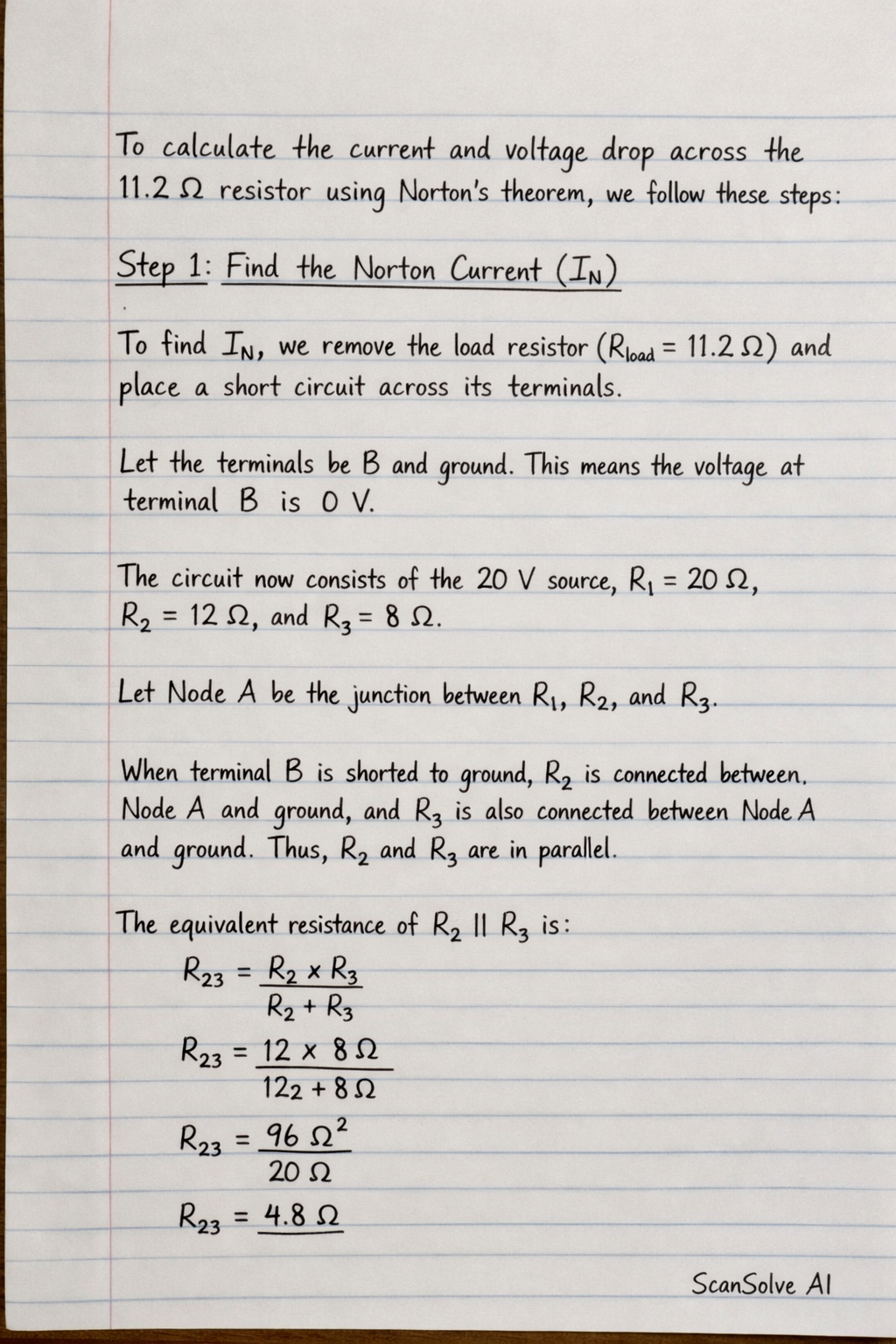
4 stepsTo calculate the current and voltage drop across the resistor using Norton's theorem, we follow these steps:
Find the Norton Current ()
To find , we remove the load resistor () and place a short circuit across its terminals. Let the terminals be B and ground. This means the voltage at terminal B is .
The circuit now consists of the source, , , and .
Let Node A be the junction between , , and .
When terminal B is shorted to ground, is connected between Node A and ground, and is also connected between Node A and ground. Thus, and are in parallel.
The equivalent resistance of is:The total current () flowing from the source is through and then through the parallel combination of and :
This current reaches Node A and splits between and . The Norton current is the current flowing through the short circuit, which is the current that would flow through in this configuration (since the short is across the terminals where was, and is connected to that node). Using the current divider rule:
Find the Norton Resistance ()
To find , we turn off the independent voltage source (replace it with a short circuit) and look into the terminals where the load resistor was connected (terminals B and ground).
With the voltage source shorted, is connected from Node A to ground. is also connected from Node A to ground. So, and are in parallel.Now, looking from terminals B to ground, is in series with the parallel combination of and .
Calculate the current through the load resistor ()
Now we connect the load resistor in parallel with the Norton equivalent circuit ( in parallel with ). We use the current divider rule:
Convert to a fraction: .
Calculate the voltage drop across the load resistor ()
Using Ohm's Law:
Try one yourself
A new problem that tests the same skill.
Still stuck on this one?
Ask a follow-up, and the answer starts from this question.
More Physics Questions
Handwritten Step-by-Step Solution
Get this as a handwritten image on WhatsApp — like a tutor wrote it for you.
Try on WhatsApp