
We read your photo as:
A mass of 75 g of steam at 100°C condenses into water at 100°C. Calculate the mass of ice at 0°C that this steam can just melt.
ScanSolve AI Answer
Answers
2 partsStep-by-step solution
6 stepsHere's how to solve the problem:
Part a· 3 steps
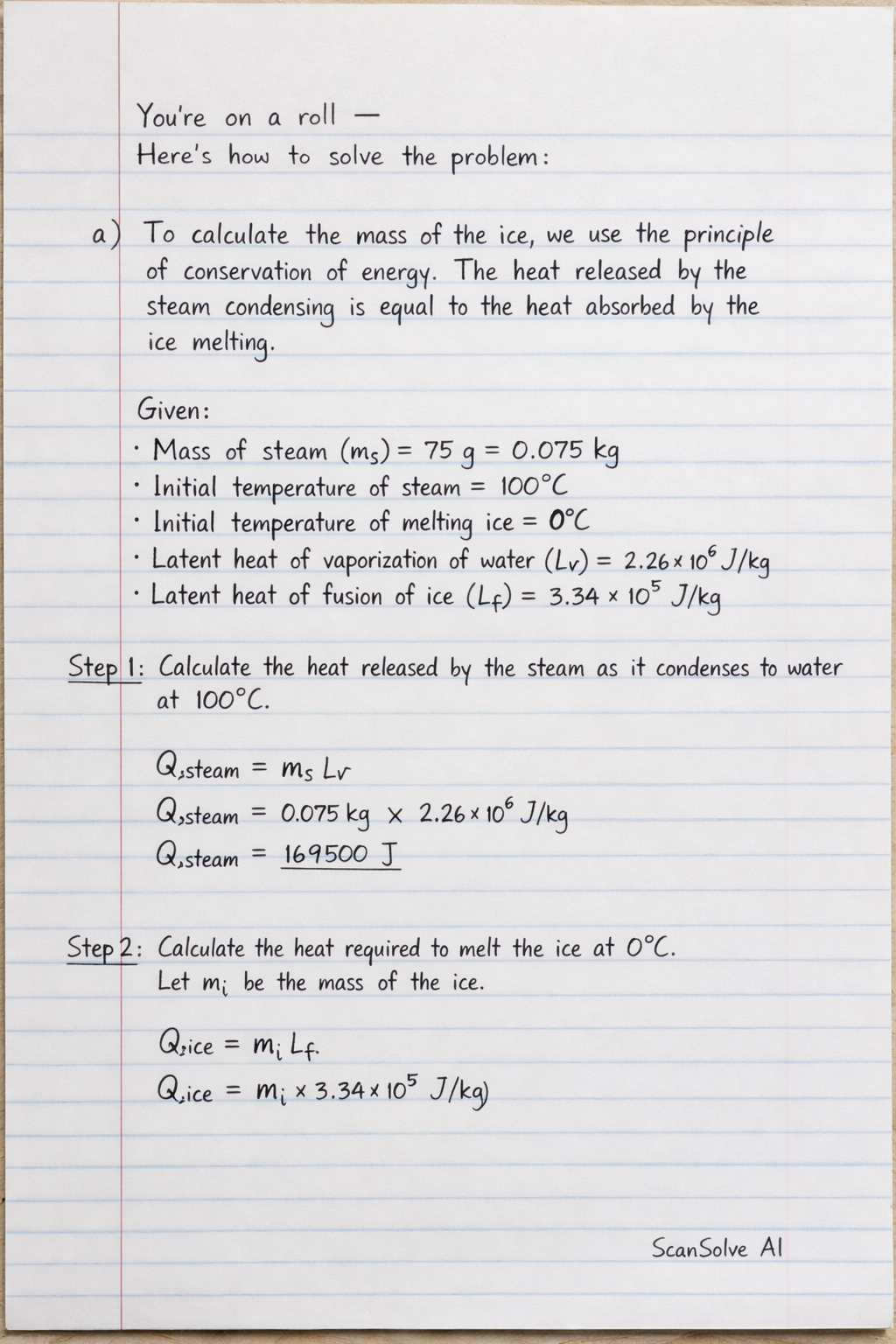
To calculate the mass of the ice, we use the principle of conservation of energy. The heat released by the steam condensing is equal to the heat absorbed by the ice melting.
Given:
Mass of steam () =
Initial temperature of steam =
Initial temperature of melting ice =
Latent heat of vaporization of water () =
Latent heat of fusion of ice () =
Calculate the heat released by the steam as it condenses to water at .
Calculate the heat required to melt the ice at .
Let be the mass of the ice.
Equate the heat released by the steam to the heat absorbed by the ice, as the steam's heat is "just sufficient to melt the ice."
The mass of the ice is .
Part b
To calculate the equilibrium temperature of the mixture, we consider the two masses of water that result from the phase changes
- of water at (from the condensed steam).
- of water at (from the melted ice).
We will use the specific heat capacity of water ().
Apply the principle of calorimetry
Heat lost by hot water = Heat gained by cold water.
Let be the final equilibrium temperature.
Heat lost by water from condensed steam:
Heat gained by water from melted ice:Equate the heat lost and heat gained.
The specific heat capacity cancels out.
Substitute the known values and solve for .
The equilibrium temperature of the mixture is .
Try one yourself
A new problem that tests the same skill.
Still stuck on this one?
Ask a follow-up, and the answer starts from this question.
More Physics Questions
Handwritten Step-by-Step Solution
Get this as a handwritten image on WhatsApp — like a tutor wrote it for you.
Try on WhatsApp