
We read your photo as:
2 The voltage supplied to a circuit is 240 V and the resistance is 60 Ω. Calculate the current flowing in the circuit.
ScanSolve AI Answer
Step-by-step solution
12 stepsHere are the solutions to the problems using Ohm's Law, .
3.2
The voltage supplied to a circuit is 240 V and the resistance is . Calculate the current flowing in the circuit.
State the formula for current.
Ohm's Law states that , where is voltage, is current, and is resistance. To find the current, we rearrange the formula to:
Substitute the given values.
Given V and .
Calculate the current.
The current flowing in the circuit is .
3.3
A kettle operates at 12 A when connected to a 240 V supply. Calculate the resistance of the kettle.State the formula for resistance.
Using Ohm's Law, , we can rearrange to find resistance:
Substitute the given values.
Given V and A.
Calculate the resistance.
The resistance of the kettle is .
QUESTION 4: REASONING AND INTERPRETATION
4.1 A resistor has a constant resistance of .
4.1.1 Calculate the current when the voltage is 20 V.
State the formula for current.
Substitute the given values.
Given V and .
Calculate the current.
The current is .
4.1.2 Calculate the current when the voltage is increased to 40 V.
State the formula for current.
Substitute the given values.
Given V and .
Calculate the current.
The current is .
4.1.3 What happens to the current when the voltage is doubled?
From 4.1.1, when V, A. From 4.1.2, when V (which is double 20 V), A (which is double 2 A).
When the voltage is doubled, the current also doubles. This is because current is directly proportional to voltage when resistance is constant.
Still stuck on this one?
Ask a follow-up, and the answer starts from this question.
More Physics Questions
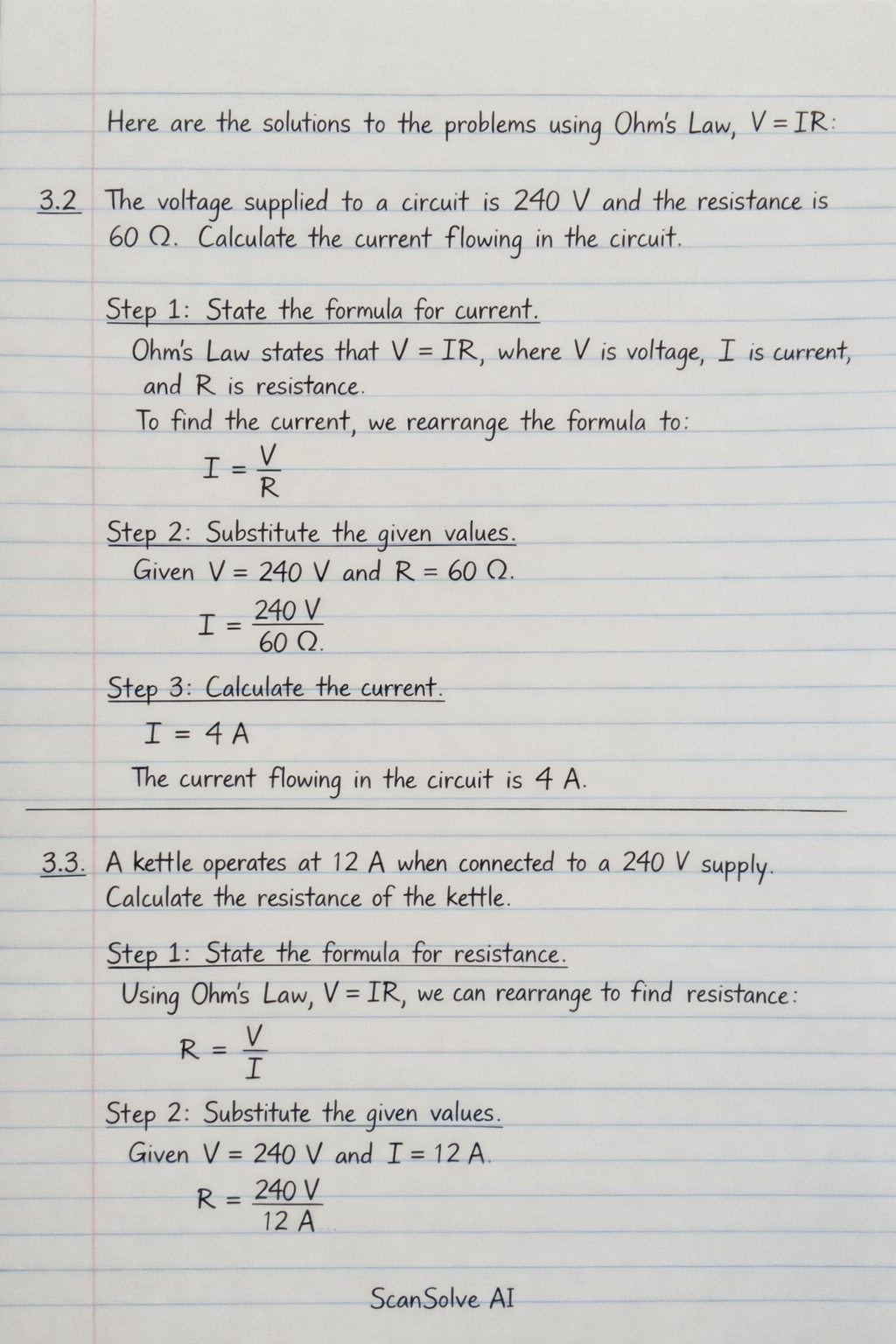
Handwritten Step-by-Step Solution
Get this as a handwritten image on WhatsApp — like a tutor wrote it for you.
Try on WhatsApp