

This physics problem tests your understanding of fundamental physical laws and their applications. The step-by-step solution below breaks down the problem using relevant equations and physical reasoning.
ScanSolve AI Answer
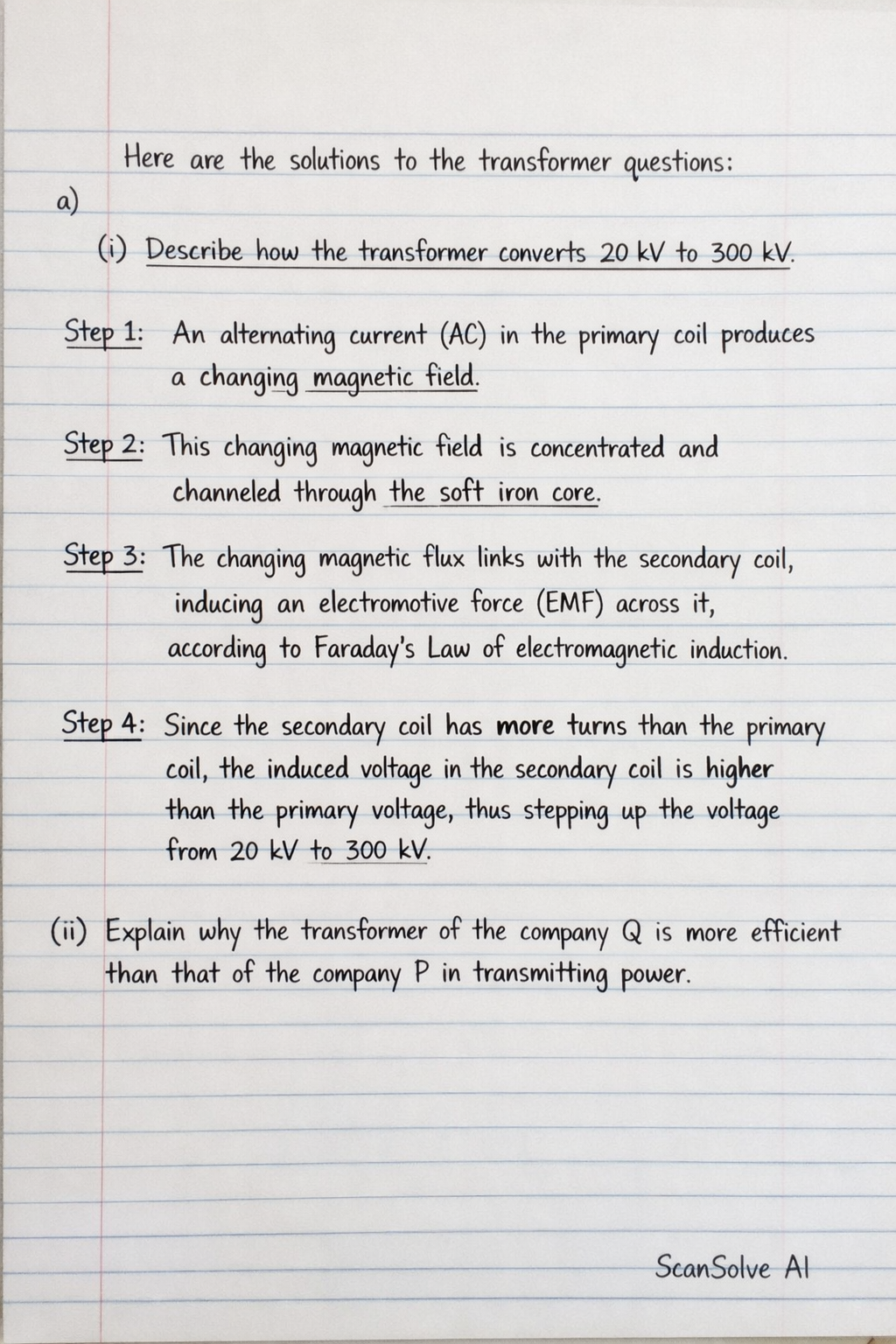
Here are the solutions to the transformer questions: a) (i) Describe how the transformer converts 20 kV to 300 kV. Step 1: An alternating current (AC) in the primary coil produces a changing magnetic field. Step 2: This changing magnetic field is concentrated and channeled through the soft iron core. Step 3: The changing magnetic flux links with the secondary coil, inducing an electromotive force (EMF) across it, according to Faraday's Law of electromagnetic induction. Step 4: Since the secondary coil has more turns than the primary coil, the induced voltage in the secondary coil is higher than the primary voltage, thus stepping up the voltage from 20 kV to 300 kV. (ii) Explain why the transformer of the company Q is more efficient than that of the company P in transmitting power. Company Q transmits power at a higher voltage (300 kV) compared to company P (100 kV). For the same amount of power transmitted, a higher voltage means a lower current (P = VI). Power loss in transmission cables is primarily due to the resistance of the wires and is given by the formula P_loss = I^2 R. Since the current (I) is significantly lower at higher transmission voltages, the power lost as heat in the cables (I^2 R) is greatly reduced, making the transmission more efficient for company Q. Last free one today — make it count tomorrow, or type /upgrade for unlimited.