
We read your photo as:
A transformer has an input Voltage of 400kV. If the Output Voltage is 100kV and number of turns in the out puts is 5000, with Current output of 20A determine the i. Number of turns in the output. ii. The current in the input.
ScanSolve AI Answer
Answers
2 partsStep-by-step solution
4 stepsHere are the given values:
Input Voltage,
Output Voltage,
Number of turns in the input, turns (assuming "out puts" is a typo for input, as output turns are requested)
Current in the output,
Part i· 2 steps
Number of turns in the output
Use the transformer turns ratio formula.
The relationship between voltage and turns in an ideal transformer is given by:
Rearrange the formula to solve for :
Substitute the given values and calculate .
The number of turns in the output is .
Part ii
The current in the input
Use the transformer voltage and current ratio formula.
For an ideal transformer, the power in the primary coil equals the power in the secondary coil (). This leads to the relationship:
Rearrange the formula to solve for :
Substitute the given values and calculate .
The current in the input is .
Try one yourself
A new problem that tests the same skill.
Still stuck on this one?
Ask a follow-up, and the answer starts from this question.
More Physics Questions
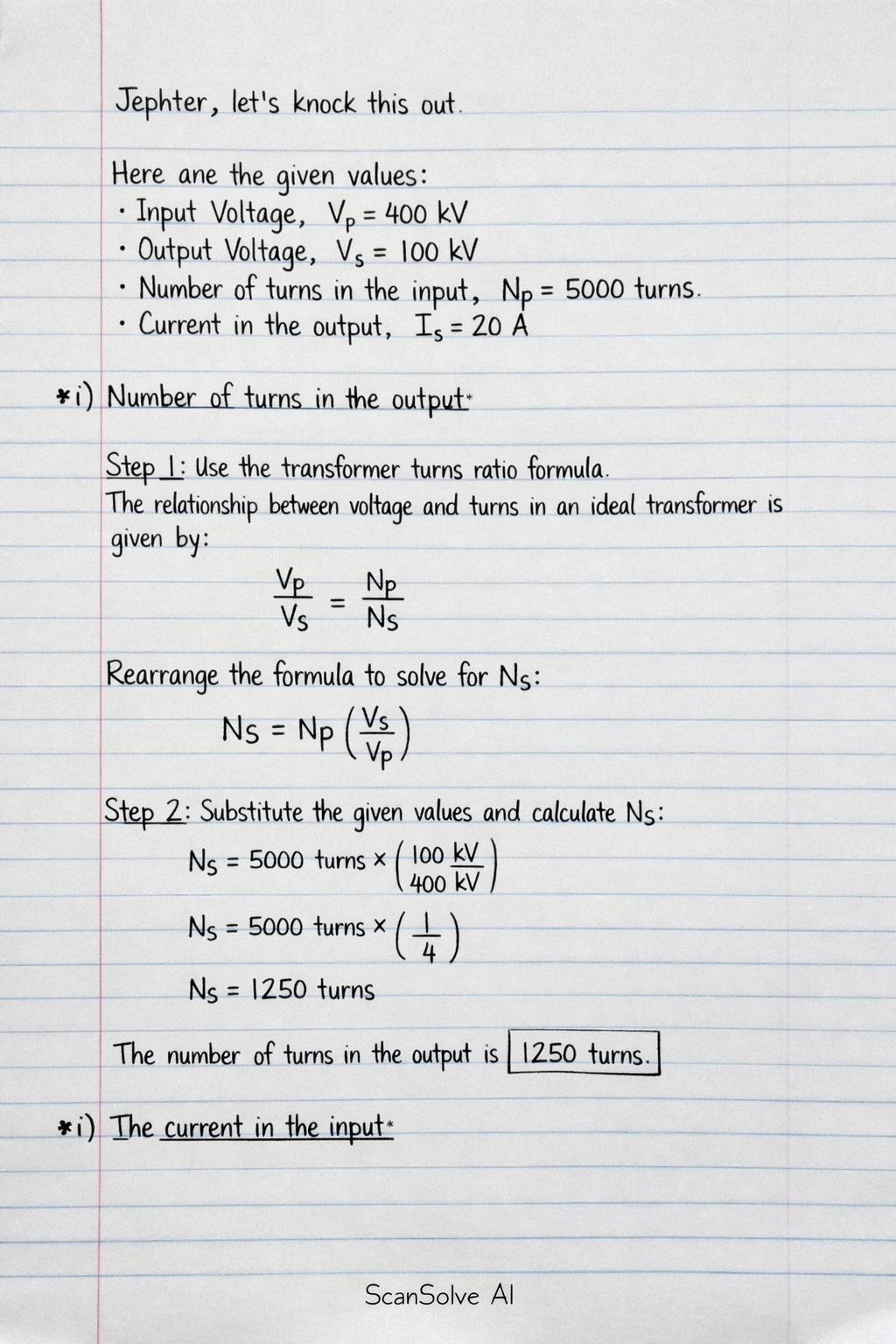
Handwritten Step-by-Step Solution
Get this as a handwritten image on WhatsApp — like a tutor wrote it for you.
Try on WhatsApp