

This physics problem tests your understanding of fundamental physical laws and their applications. The step-by-step solution below breaks down the problem using relevant equations and physical reasoning.
ScanSolve AI Answer
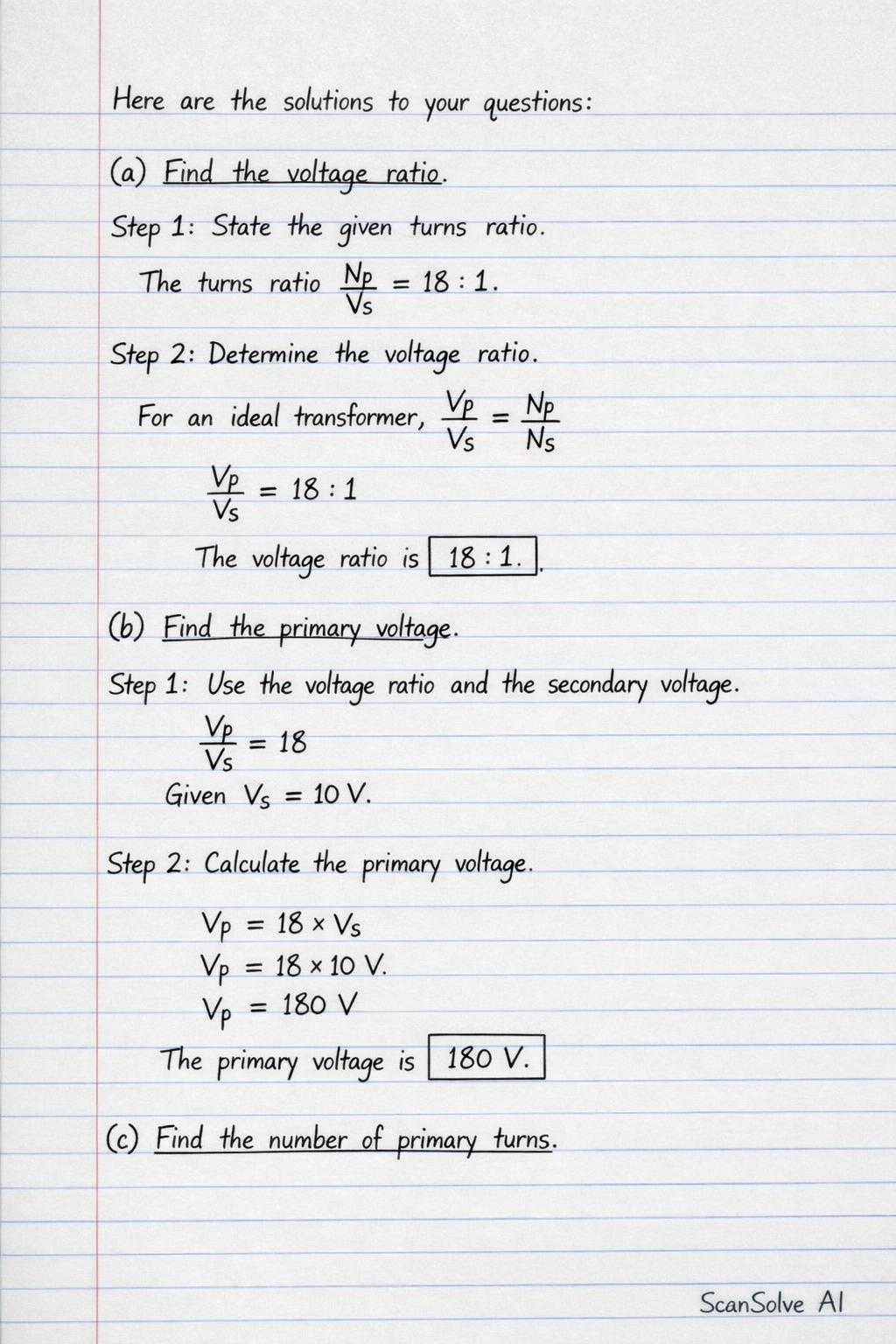
Here are the solutions to your questions: 5. A transformer's secondary coil contains 100 turns and operates at 10 volts. If the turns ratio is 18:1, find (a) the voltage ratio, (b) the primary voltage, and (c) the number of primary turns. The turns ratio of a transformer is given by (N_p)/(N_s), and for an ideal transformer, this is equal to the voltage ratio (V_p)/(V_s). a) Find the voltage ratio. Step 1: State the given turns ratio. The turns ratio (N_p)/(N_s) is 18:1. Step 2: Determine the voltage ratio. For an ideal transformer, the voltage ratio is equal to the turns ratio. (V_p)/(V_s) = (N_p)/(N_s) = 18:1 The voltage ratio is 18:1. b) Find the primary voltage. Step 1: Use the voltage ratio and the secondary voltage. (V_p)/(V_s) = 18 Given V_s = 10 V. Step 2: Calculate the primary voltage. V_p = 18 × V_s = 18 × 10 V = 180 V The primary voltage is 180 V. c) Find the number of primary turns. Step 1: Use the turns ratio and the secondary turns. (N_p)/(N_s) = 18 Given N_s = 100 turns. Step 2: Calculate the number of primary turns. N_p = 18 × N_s = 18 × 100 turns = 1800 turns The number of primary turns is 1800 turns. 6. A 110-volt alternating current line is fed through a 55-turn step-down autotransformer. If you want a 28-volt output, find the secondary turns and the turn number to tap. For an autotransformer, the ratio of voltages is equal to the ratio of the number of turns. Step 1: Identify the given values. V_p = 110 V N_p = 55 turns V_s = 28 V Step 2: Calculate the number of secondary turns (N_s). (V_p)/(V_s) = (N_p)/(N_s) 110 V28 V = 55 turnsN_s N_s = 28 V × 55 turns110 V N_s = (1540)/(110) turns = 14 turns Step 3: Determine the turn number to tap. For a step-down autotransformer, the secondary turns represent the tap point from the common end. The secondary turns are 14 turns and the turn number to tap is 14. 7. When two coils are put near together, a changing current in the first coil induces a voltage in the second. This phenomenon is called: This phenomenon is called mutual induction. 8. Two inductive coils near each other have a mutual inductance of 0.6H. Current across one coil is boosted from 1A to 6A in 0.03 seconds. The voltage induced in the other coil is: The magnitude of the induced voltage (E) in the second coil due to a changing current in the first coil is given by E = M ( I)/( t). Step 1: Identify the given values and calculate the change in current. M = 0.6 H I = 6 A - 1 A = 5 A t = 0.03 s Step 2: Substitute the values into the formula. E = (0.6 H) 5 A0.03 s Step 3: Calculate the induced voltage. E = (3)/(0.03) V = 100 V The voltage induced in the other coil is 100 V. 9. Two identical coils, A and B, with 400 turns set so that 60% of the flux produced by one coil connects to the other. Calculate the mutual inductance between coils A and B if a current of 10A runs through coil A, producing a flux of 20mWb. Mutual inductance (M) is defined as M = N_B _BAI_A, where N_B is the number of turns in coil B, _BA is the flux linked with coil B due to current I_A in coil A. Step 1: Identify the given values and calculate the flux linked with coil B. N_A = N_B = 400 turns I_A = 10 A _A = 20 mWb = 20 × 10^-3 Wb The flux linked with coil B is 60% of the flux produced by coil A: _BA = 0.60 × _A = 0.60 × (20 × 10^-3 Wb) = 12 × 10^-3 Wb Step 2: Substitute the values into the mutual inductance formula. M = (400 turns) (12 × 10^-3 Wb)10 A Step 3: Calculate the mutual inductance. M = 4.8 Wb10 A = 0.48 H The mutual inductance between coils A and B is 0.48 H. 3 done, 2 left today. You're making progress.