
We read your photo as:
Calculate the efficiency of the transformer using the provided power and current values.
ScanSolve AI Answer
Step-by-step solution
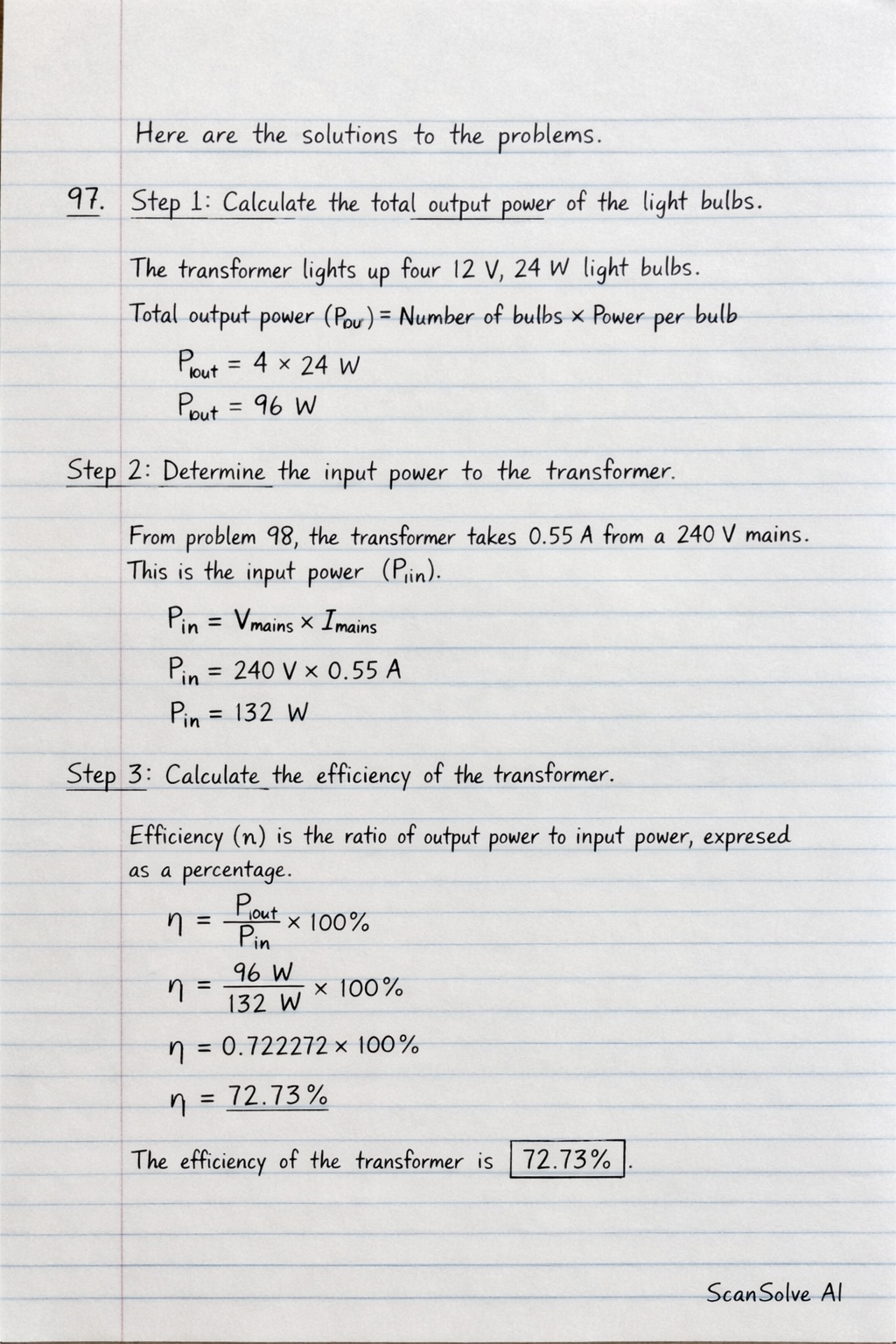
8 stepsHere are the solutions to the problems.
97.
Calculate the total output power of the light bulbs.
The transformer lights up four 12 V, 24 W light bulbs.
Total output power () = Number of bulbs Power per bulbDetermine the input power to the transformer.
From , the transformer takes from a mains. This is the input power ().
Calculate the efficiency of the transformer.
Efficiency () is the ratio of output power to input power, expressed as a percentage.
The efficiency of the transformer is .
98.
Identify the given input voltage and input current.
The transformer supplies (output) from a mains (input voltage, ).
It takes from the mains (input current, ).Calculate the power delivered to the transformer (input power).
The power delivered to the transformer () is the product of the input voltage and input current.
The power delivered to the transformer is .
99.
Identify the given values.
Resistance of the cable () = .
Electricity generated () = .
Transmission voltage () = .Calculate the current flowing through the cable during transmission.
The current () can be found using the formula .
Calculate the power wasted in the cable.
The power wasted () due to the resistance of the cable is given by .
To express in kilowatts:
The power wasted in the cable is .
Still stuck on this one?
Ask a follow-up, and the answer starts from this question.
More Physics Questions
Handwritten Step-by-Step Solution
Get this as a handwritten image on WhatsApp — like a tutor wrote it for you.
Try on WhatsApp