
We read your photo as:
Analyze the results of a practical experiment involving voltage measurements and transformer characteristics, filling in missing table values and drawing conclusions.
ScanSolve AI Answer
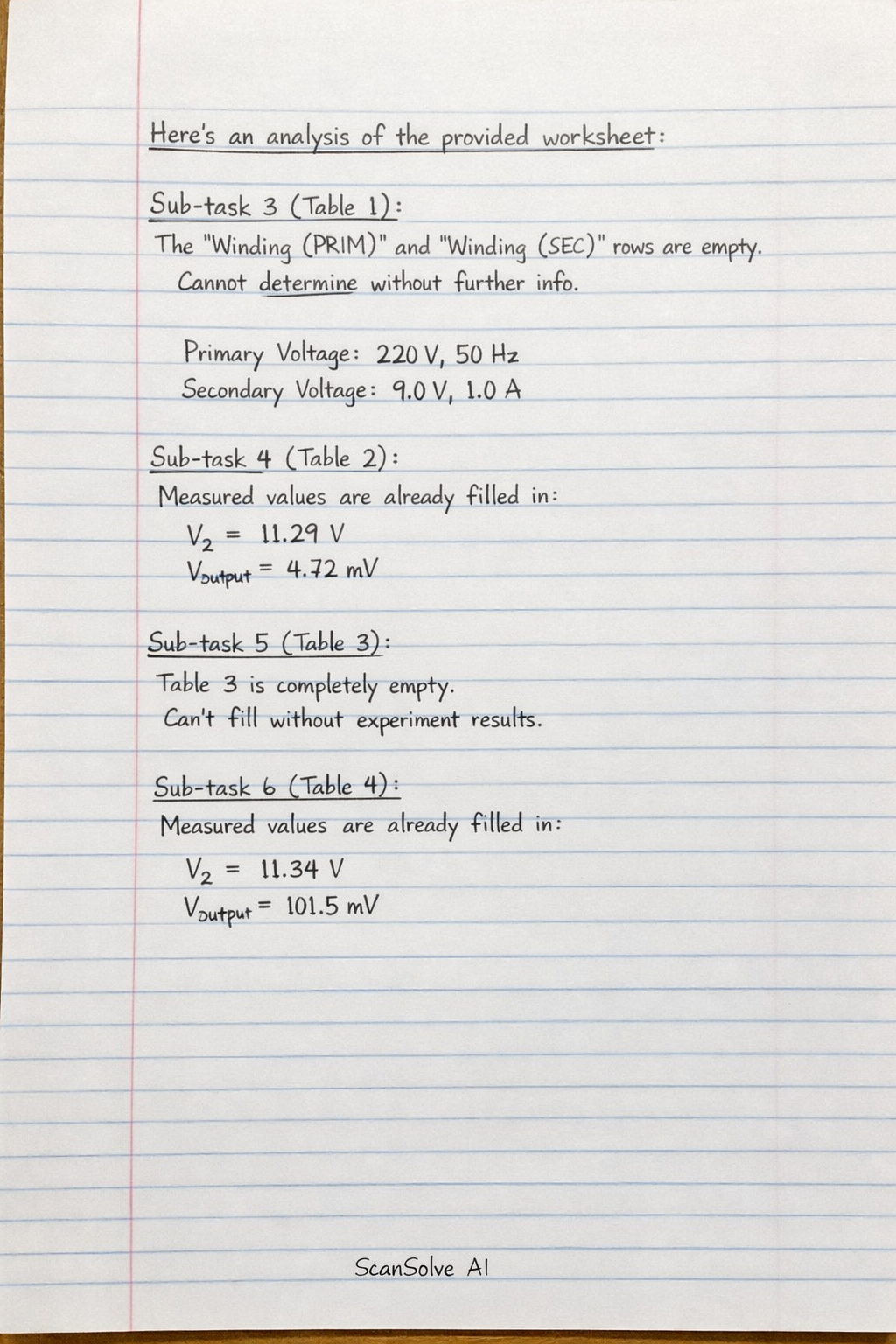
Here's an analysis of the provided worksheet:
Sub-task 3 (Table 1):
The "Winding (PRIM)" and "Winding (SEC)" rows are empty. These typically refer to the number of turns or specific winding configurations. Without additional information or context from the practical instructions, these values cannot be determined or filled.
The provided values are:
- Primary voltage:
- Secondary voltage:
Sub-task 4 (Table 2):
This table is already filled with the measured values:
- :
- :
Sub-task 5 (Table 3):
This table is completely empty. As these are "Measured values," they cannot be filled without performing the experiment or having access to the experimental results for Sub-task 5.
Sub-task 6 (Table 4):
This table is already filled with the measured values:
- :
- :
Sub-task 7 (Conclusion):
Based on the available data from Sub-tasks 3, 4, and 6:
The practical involves analyzing voltage characteristics. Sub-task 3 describes a power source or transformer providing a step-down from to . In Sub-task 4, an input voltage of resulted in an output voltage of . In contrast, Sub-task 6, with a very similar input voltage of , yielded a significantly higher output voltage of . This substantial increase in for a nearly identical suggests that the circuit configuration, gain settings, or load conditions were altered between Sub-task 4 and Sub-task 6, leading to a different voltage transfer characteristic.
Still stuck on this one?
Ask a follow-up, and the answer starts from this question.
More Physics Questions
Handwritten Step-by-Step Solution
Get this as a handwritten image on WhatsApp — like a tutor wrote it for you.
Try on WhatsApp