
We read your photo as:
Analyze the provided experimental data for a transformer/power supply experiment, focusing on voltage measurements and identifying missing information.
ScanSolve AI Answer
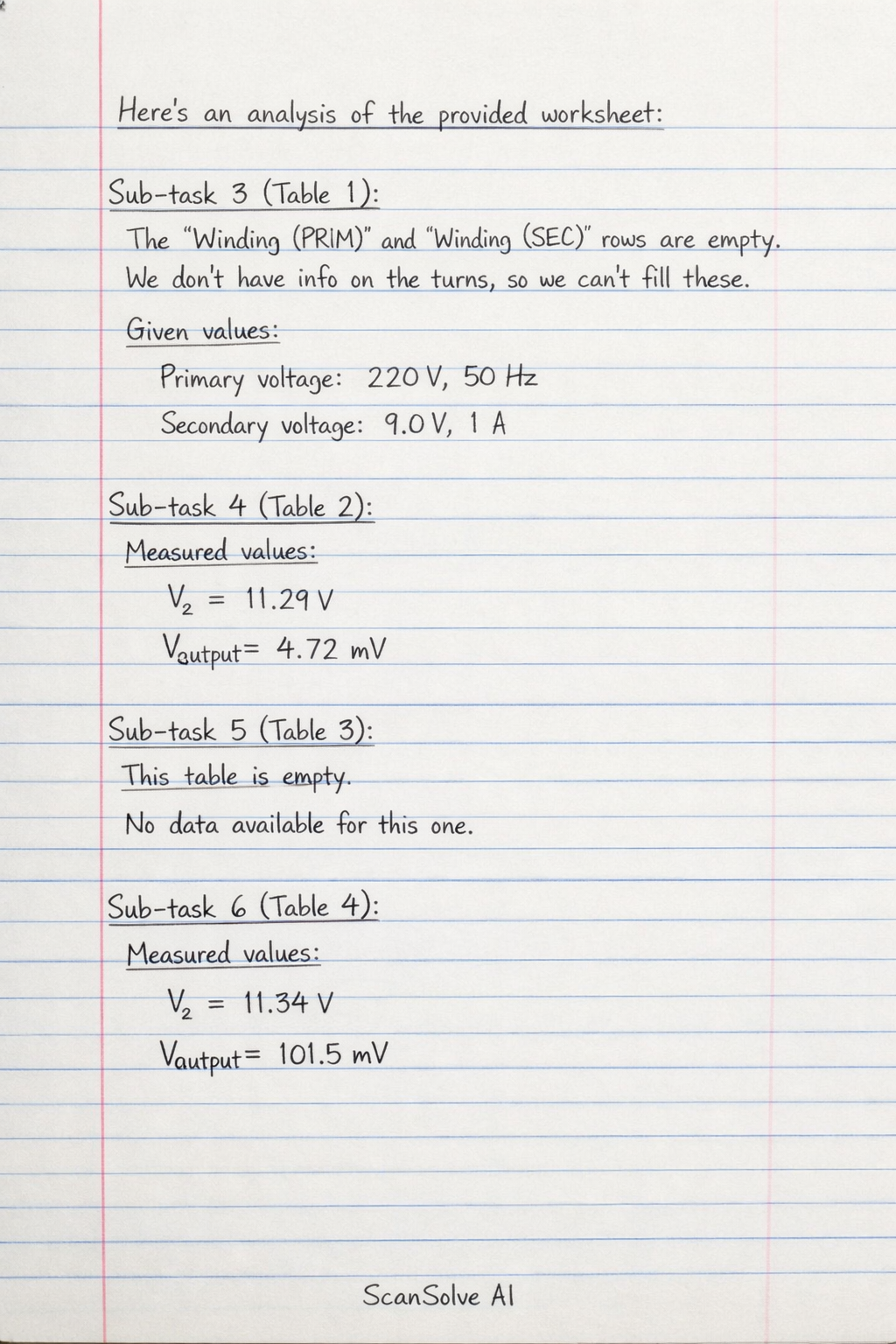
Here's an analysis of the provided worksheet:
Sub-task 3 (Table 1):
The "Winding (PRIM)" and "Winding (SEC)" rows are empty. These typically refer to the number of turns or specific winding configurations of a transformer. Without additional information or context from the practical instructions, these values cannot be determined or filled.
The provided values are:
- Primary voltage:
- Secondary voltage:
Sub-task 4 (Table 2):
This table is already filled with the measured values:
- :
- :
Sub-task 5 (Table 3):
This table is completely empty. As these are "Measured values," they cannot be filled without performing the experiment or having access to the experimental results for Sub-task 5.
Sub-task 6 (Table 4):
This table is already filled with the measured values:
- :
- :
Sub-task 7 (Conclusion):
Based on the available data from Sub-tasks 3, 4, and 6:
The practical involves analyzing voltage characteristics. Sub-task 3 describes a power source or transformer providing a step-down from to . In Sub-task 4, an input voltage of resulted in an output voltage of . In contrast, Sub-task 6, with a very similar input voltage of , yielded a significantly higher output voltage of . This substantial increase in for a nearly identical suggests that the circuit configuration, gain settings, or load conditions were altered between Sub-task 4 and Sub-task 6, leading to a different voltage transfer characteristic.
Still stuck on this one?
Ask a follow-up, and the answer starts from this question.
More Physics Questions
Handwritten Step-by-Step Solution
Get this as a handwritten image on WhatsApp — like a tutor wrote it for you.
Try on WhatsApp