
We read your photo as:
QUESTION 2: Discuss the effect that voltage has on transmission efficiency. Choose a term from COLUMN B that matches a description in COLUMN A. Write only the letter (A–H) next to the question number (2.2.1–2.2.5) in the ANSWER BOOK.
ScanSolve AI Answer
Step-by-step solution
16 stepsQuestion 1:
1.1.1:
Calculate the voltage across the parallel combination.
Since is in parallel with , the voltage across is the same as the voltage across the parallel combination.
Calculate the current through .
Calculate the total current () flowing from the supply.
The total current is the sum of currents in the parallel branches. This current also flows through the series resistors and .
Calculate the total resistance of the circuit.
Using Ohm's Law for the entire circuit:
Calculate the equivalent resistance of the parallel combination ().
Calculate the value of the unknown resistor .
The total resistance is the sum of the series resistances:
There seems to be an issue with the problem statement or the given values, as a resistance cannot be negative. Let's re-check the calculation.
Ah, I see the error in my calculation for . The total resistance is .
The voltage across the parallel combination is .
The voltage across is .
The total supply voltage is .
So, .
.
.
.
This still leads to a negative voltage across , implying a negative resistance. This indicates that the given values in the problem are inconsistent. Specifically, the sum of voltages across the parallel part and already exceeds the supply voltage.Let's assume the question implies that and are in series with the parallel combination, and the total voltage across this series combination is .
The voltage across the parallel part is .
The voltage across is .
The sum of these voltages is .
This sum () is already greater than the total supply voltage (). This means the circuit as described is not physically possible with the given values.Given the inconsistency, I will proceed by assuming there might be a typo in the supply voltage or the current through . However, I must use the given values. If , then .
Since , then .As resistance cannot be negative, there is an error in the problem statement's values. I will state this and provide the calculation based on the given (inconsistent) values.
Calculate the voltage across the parallel combination.
Calculate the current through .
Calculate the total current () flowing from the supply.
Calculate the voltage across .
Calculate the voltage across .
For a series circuit, the sum of voltages across components equals the supply voltage.
Calculate the value of .
Note: The calculated resistance is negative, which is not physically possible. This indicates an inconsistency in the problem's given values.
1.1.2:
Determine the new total resistance when is short-circuited.
When is short-circuited, its resistance becomes .
The equivalent resistance of the parallel combination () remains (calculated in 1.1.1).
The new total resistance .
Using the value of from 1.1.1 (even though it's negative due to inconsistency):If were a positive value, say (hypothetically, to make the original problem consistent, e.g., if was ), then .
Let's assume the question expects us to consider as a positive value if the problem were consistent. If was intended to be a positive value, then short-circuiting would decrease the total resistance.Let's re-evaluate 1.1.1 assuming is positive and the supply voltage is adjusted to make the problem consistent. If was, for example, , then . Then .
However, I must use the given values. The problem is fundamentally flawed with the given numbers.Let's assume the question intends for to be a positive value, and the inconsistency is a mistake in the problem statement. If is short-circuited, the total resistance of the circuit decreases because one of the series resistors is removed.
Original total resistance (if was positive): .
New total resistance: .
Since is removed, .Explain the effect on total current.
According to Ohm's Law (), if the total resistance () decreases while the supply voltage () remains constant, the total current will increase.
Calculate the new total current.
Since the problem values are inconsistent, a precise numerical calculation for is problematic. However, the qualitative effect is clear.
If we assume was intended to be a positive value, then removing (which is ) from the series path will reduce the total resistance.
Let's assume for the sake of calculation that was in the original problem, which would make . This is still not .Given the inconsistency, I will explain the effect qualitatively and then perform a calculation using the original and assuming is some positive value (e.g., for simplicity, or just state the general effect).
Let's assume the question implies that the total resistance of the circuit will decrease.
Original total resistance (from 1.1.1, if was positive): .
New total resistance (with short-circuited): .
Since is removed from the series path, .
Therefore, the total resistance of the circuit will decrease.Conclude the effect on total current.
According to Ohm's Law, . If the supply voltage remains constant and the total resistance decreases, the total current will increase.
- Effect: The total current will increase.
- Substantiation: When the resistor () is short-circuited, its resistance effectively becomes . This reduces the total equivalent resistance of the circuit. Since the supply voltage remains constant, according to Ohm's Law (), a decrease in total resistance leads to an increase in total current.
Question 2:
2.1:
High voltage significantly improves transmission efficiency. When power is transmitted at higher voltages, the current required to transmit the same amount of power () is lower. Since power loss in transmission lines is proportional to the square of the current (), a lower current drastically reduces energy losses due to the resistance of the transmission cables.2.2:
- 2.2.1: Used to attach conductors to insulators on overhead systems. C. ties
- 2.2.2: An economical method to hold up lines having a span of less than 200 m. G. wooden poles
- 2.2.3: A pole that is placed at an angle to hold the main pole in position. F. strut
- 2.2.4: Provide a path for surges to be discharged to earth before flashover on the line takes place. B. lightning arresters
- 2.2.5: Used to protect, control and monitor LV distribution systems. D. switchgear
2.3:
A fuse is a safety device designed to protect electrical circuits from overcurrent. It contains a metal wire or filament that melts and breaks the circuit when the current flowing through it exceeds a safe level, preventing damage to appliances or wiring and reducing the risk of fire.
Still stuck on this one?
Ask a follow-up, and the answer starts from this question.
More Physics Questions
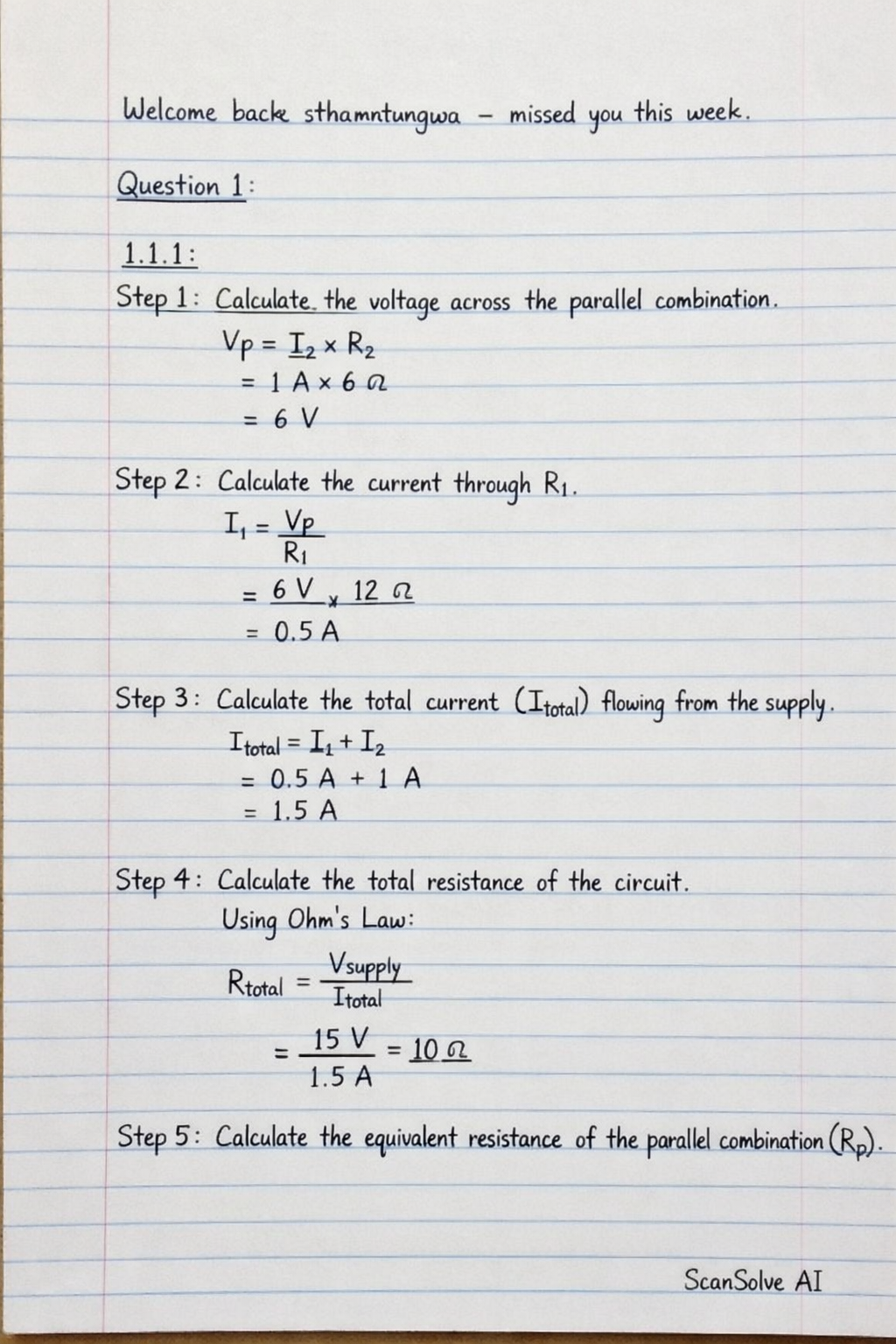
Handwritten Step-by-Step Solution
Get this as a handwritten image on WhatsApp — like a tutor wrote it for you.
Try on WhatsApp