
We read your photo as:
Give two differences between conduction and radiation. 2. Potassium permanganate crystals are dropped into a beaker of water and warmed: a. State what would be observed; B. State the phenomenon demonstrated in (a) 3. Give two reasons why convection doesn't occur in solids.
Physics
ScanSolve AI Answer
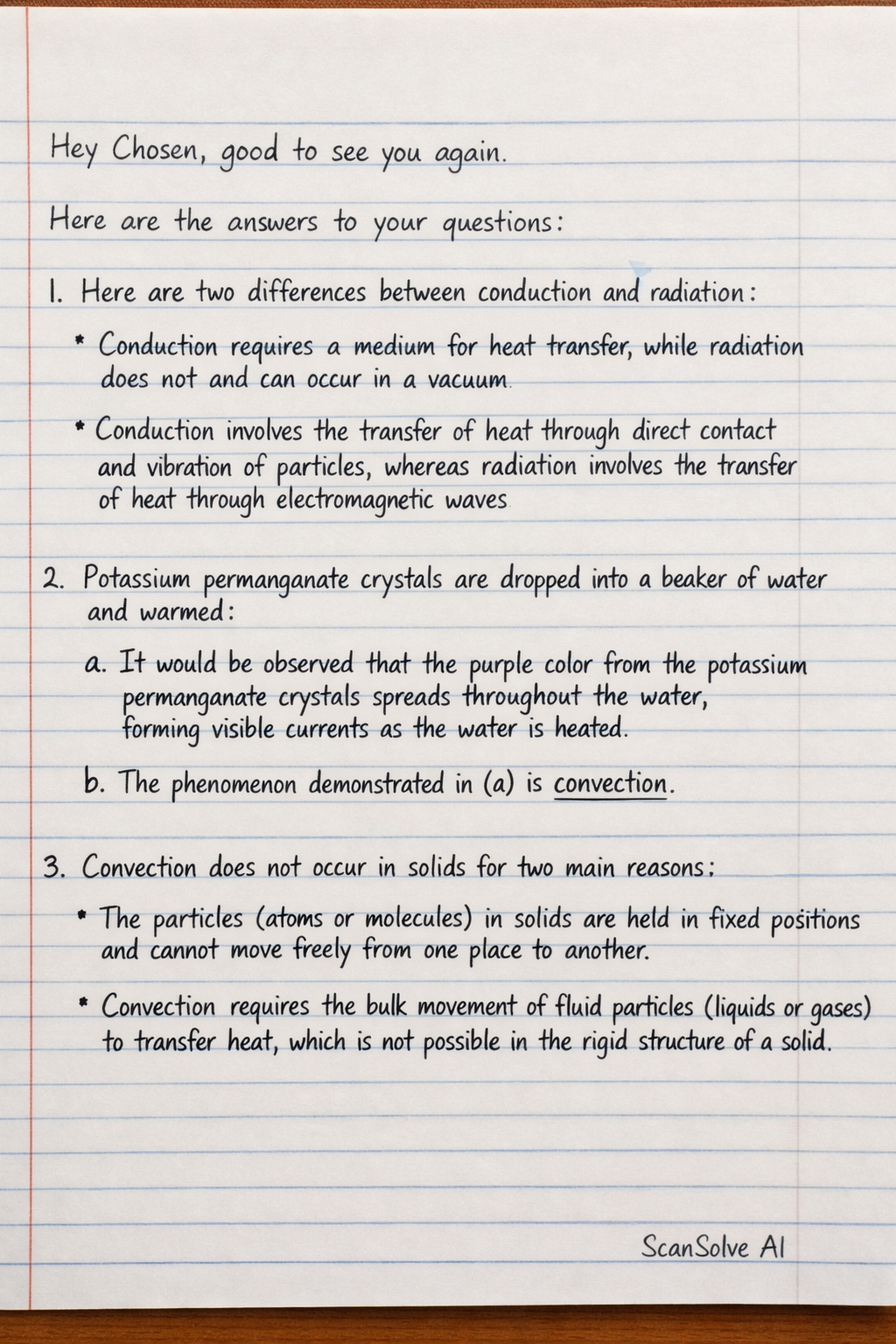
Here are the answers to your questions:
-
Here are two differences between conduction and radiation:
- Conduction requires a medium for heat transfer, while radiation does not and can occur in a vacuum.
- Conduction involves the transfer of heat through direct contact and vibration of particles, whereas radiation involves the transfer of heat through electromagnetic waves.
-
Potassium permanganate crystals are dropped into a beaker of water and warmed:
- a. It would be observed that the purple color from the potassium permanganate crystals spreads throughout the water, forming visible currents as the water is heated.
- b. The phenomenon demonstrated in (a) is convection.
-
Convection does not occur in solids for two main reasons:
- The particles (atoms or molecules) in solids are held in fixed positions and cannot move freely from one place to another.
- Convection requires the bulk movement of fluid particles (liquids or gases) to transfer heat, which is not possible in the rigid structure of a solid.
Was this helpful?
Still stuck on this one?
Ask a follow-up, and the answer starts from this question.
Got a different question?Ask your own question
More Physics Questions
QDescribe the experiment demonstrating diffusion in liquids using a potassium permanganate crystal…QExplain briefly each of the following observations: Ammonium trioxocarbonate(IV) leaves no residue…QState two differences between heat and temperature, and two effects of heat on matter.QState the difference between temporary and permanent changes. Describe how you can demonstrate…QExplain the differences in observations when magnesium ribbon and potassium manganate (VII) are…
Browse by topic:Thermodynamics
Handwritten Step-by-Step Solution
Get this as a handwritten image on WhatsApp — like a tutor wrote it for you.
Try on WhatsApp