
We read your photo as:
Explain briefly each of the following observations: Ammonium trioxocarbonate(IV) leaves no residue when heated strongly. (ii) Solid ionic compounds do not conduct electric current. (iii) The melting point of sodium chloride crystals is higher than that of paraffin wax.
ScanSolve AI Answer
Step-by-step solution
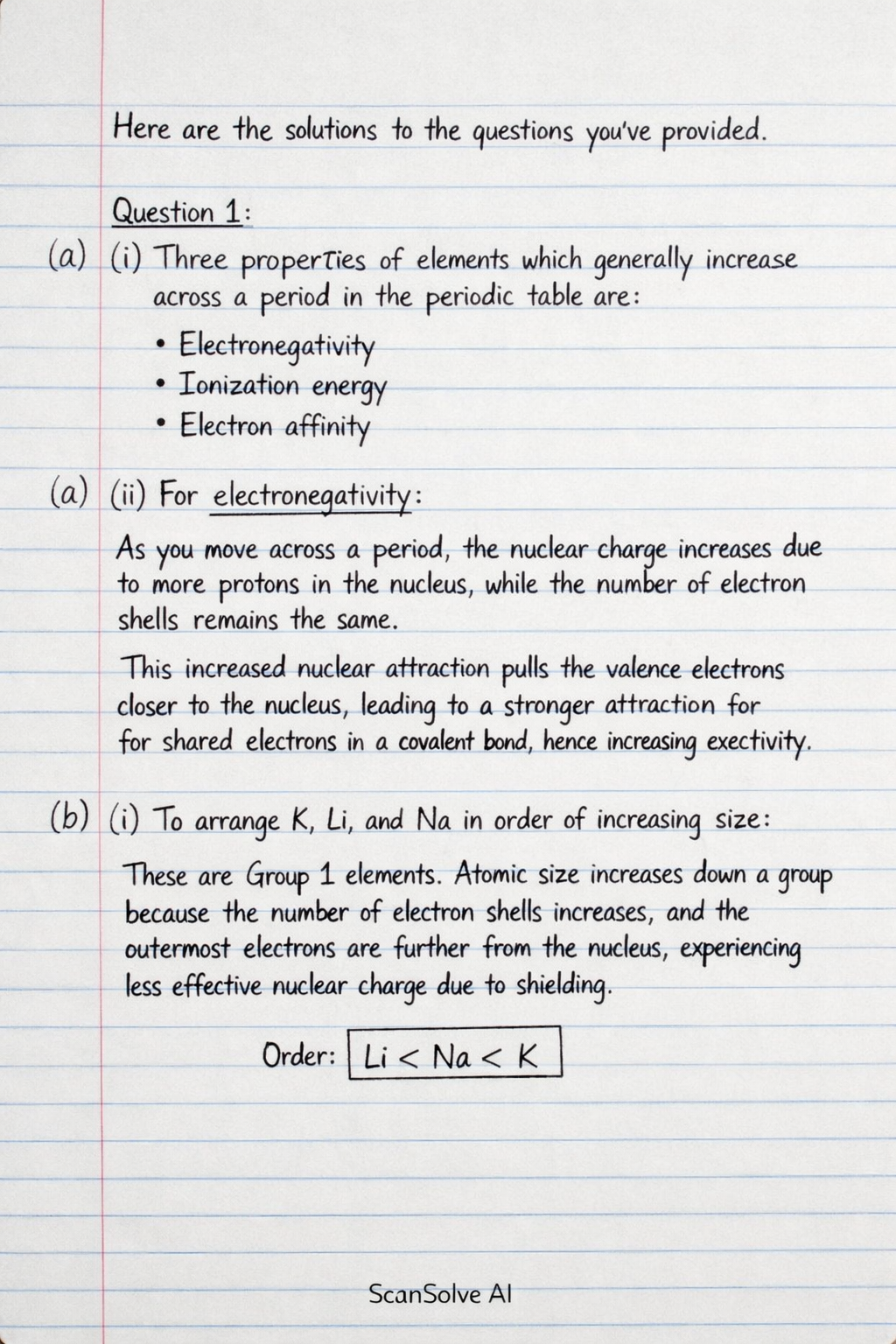
6 stepsHere are the solutions to the questions you've provided.
Question 1:
a) (i) Three properties of elements which generally increase across a period in the periodic table are:
- Electronegativity
- Ionization energy
- Electron affinity
a) (ii) For electronegativity:
As you move across a period, the nuclear charge increases due to more protons in the nucleus, while the number of electron shells remains the same. This increased nuclear attraction pulls the valence electrons closer to the nucleus, leading to a stronger attraction for shared electrons in a covalent bond, hence increasing electronegativity.
b) (i) To arrange K, Li, and Na in order of increasing size:
These are Group 1 elements. Atomic size increases down a group because the number of electron shells increases, and the outermost electrons are further from the nucleus, experiencing less effective nuclear charge due to shielding.
Order:
b) (ii) To arrange , , and in order of increasing size:
These are isoelectronic species, meaning they all have the same number of electrons (18 electrons, like Argon). For isoelectronic species, the size decreases as the nuclear charge (number of protons) increases, because a greater positive charge pulls the same number of electrons more strongly.
- : 17 protons, 18 electrons
- : 19 protons, 18 electrons
- : 20 protons, 18 electrons Order:
c) Three characteristic properties of transition metals are:
- They exhibit variable oxidation states.
- They form colored compounds (or ions) in solution and in solid state.
- They can act as catalysts.
- They form complex ions.
d) (i) An alpha particle:
- Mass: 4 atomic mass units (approximately)
- Charge: +2
d) (ii) Gamma rays are more injurious to health than alpha particles because:
Gamma rays are high-energy electromagnetic radiation with very high penetrating power, meaning they can pass through significant amounts of matter and cause damage deep within tissues and organs. Alpha particles, while highly ionizing, have very low penetrating power and can be stopped by a sheet of paper or the outer layer of skin, making them less harmful unless ingested or inhaled.
Question 2:
a) (i) A mole is the amount of substance that contains as many elementary entities (atoms, molecules, ions, etc.) as there are atoms in 12 grams of carbon-12. This number is Avogadro's constant, approximately .
a) (ii) A standard solution is a solution of accurately known concentration. It is typically prepared by dissolving a precisely weighed amount of a primary standard substance in a known volume of solvent.
b) Hydrogen chloride gas dissolved in:
- (i) Water: Forms hydrochloric acid (), which is a strong acid and dissociates completely into and ions. These mobile ions allow the solution to conduct electricity.
- (ii) Benzene: remains as covalent molecules in benzene and does not ionize. Therefore, the solution will not conduct electricity. The solution in water will conduct electricity.
c) (i) To arrange equimolar solutions of sodium chloride, sucrose, and ethanoic acid in their increasing ability to conduct electricity:
- Sucrose (): A non-electrolyte; it dissolves but does not ionize, so it has no ability to conduct electricity.
- Ethanoic acid (): A weak electrolyte; it partially ionizes in water, producing a low concentration of ions and thus has a poor ability to conduct electricity.
- Sodium chloride (): A strong electrolyte; it completely dissociates into and ions in water, producing a high concentration of ions and thus has a strong ability to conduct electricity. Order:
c) (ii) The solution with the lowest pH is ethanoic acid.
- Ethanoic acid is a weak acid, so its solution will be acidic (pH < 7).
- Sodium chloride is a salt of a strong acid and a strong base, so its solution is neutral (pH = 7).
- Sucrose is a non-ionic molecular compound, so its solution is neutral (pH = 7).
d) To calculate the atomic mass of zinc:
Calculate initial moles of .
Calculate moles of used in neutralization.
Determine moles of excess .
From the neutralization reaction , the mole ratio of to is 1:1.
Calculate moles of reacted with .
Calculate moles of reacted.
The reaction is .
From the stoichiometry, 1 mole of reacts with 2 moles of .Calculate the atomic mass of .
The atomic mass of zinc is .
Question 3:
a) (i) Ammonium trioxocarbonate(IV) (ammonium carbonate, ) leaves no residue when heated strongly because it decomposes completely into gaseous products: ammonia (), carbon dioxide (), and water ().
a) (ii) Solid ionic compounds do not conduct electric current because their ions are held in fixed positions within a crystal lattice by strong electrostatic forces. These ions are not free to move and carry charge. However, when melted or dissolved in a suitable solvent, the ions become mobile and can conduct electricity.
a) (iii) The melting point of sodium chloride crystals is higher than that of paraffin wax because:
- Sodium chloride () is an ionic compound with strong electrostatic forces of attraction between positively charged sodium ions () and negatively charged chloride ions () in a crystal lattice. A large amount of energy is required to overcome these strong forces.
- Paraffin wax is a molecular compound (a mixture of hydrocarbons) held together by weak intermolecular forces (van der Waals forces). Much less energy is needed to overcome these weak forces, resulting in a lower melting point.
b) (i) Distinguishing between the solid, liquid, and gaseous states of naphthalene:
- Solid naphthalene: Particles are closely packed in a fixed, ordered lattice arrangement. They vibrate about fixed positions but cannot move past each other. It has a definite shape and volume.
- Liquid naphthalene: Particles are closely packed but randomly arranged. They can move past each other, allowing the liquid to flow and take the shape of its container, but it has a definite volume.
- Gaseous naphthalene: Particles are far apart and move randomly and rapidly. There are very weak forces between particles. It has no definite shape or volume and will fill any container.
b) (ii) What happens as solid naphthalene changes to the liquid state and from the liquid state to the gaseous state as it is heated:
- Solid to liquid (melting): As solid naphthalene is heated, the particles gain kinetic energy and vibrate more vigorously. At the melting point, the particles have enough energy to overcome the strong intermolecular forces holding them in fixed positions in the crystal lattice. The ordered structure breaks down, and particles can move past each other, forming a liquid. The absorbed heat energy (latent heat of fusion) is used to overcome these forces, not to increase temperature.
- Liquid to gaseous (boiling/sublimation): As liquid naphthalene is heated further, the particles gain more kinetic energy. At the boiling point, particles have enough energy to completely overcome the intermolecular forces and escape from the liquid phase into the gaseous phase. If heated in an open container, naphthalene can also sublime directly from solid to gas without passing through the liquid state, as its vapor pressure becomes equal to the external pressure at a temperature below its melting point. The absorbed heat energy (latent heat of vaporization or sublimation) is used to separate the particles completely.
Still stuck on this one?
Ask a follow-up, and the answer starts from this question.
More Chemistry Questions
Handwritten Step-by-Step Solution
Get this as a handwritten image on WhatsApp — like a tutor wrote it for you.
Try on WhatsApp