
We read your photo as:
Balance each of the equations below, and identify the type of reaction in each case:
ScanSolve AI Answer
Step-by-step solution
20 stepshere are the balanced equations and their reaction types:
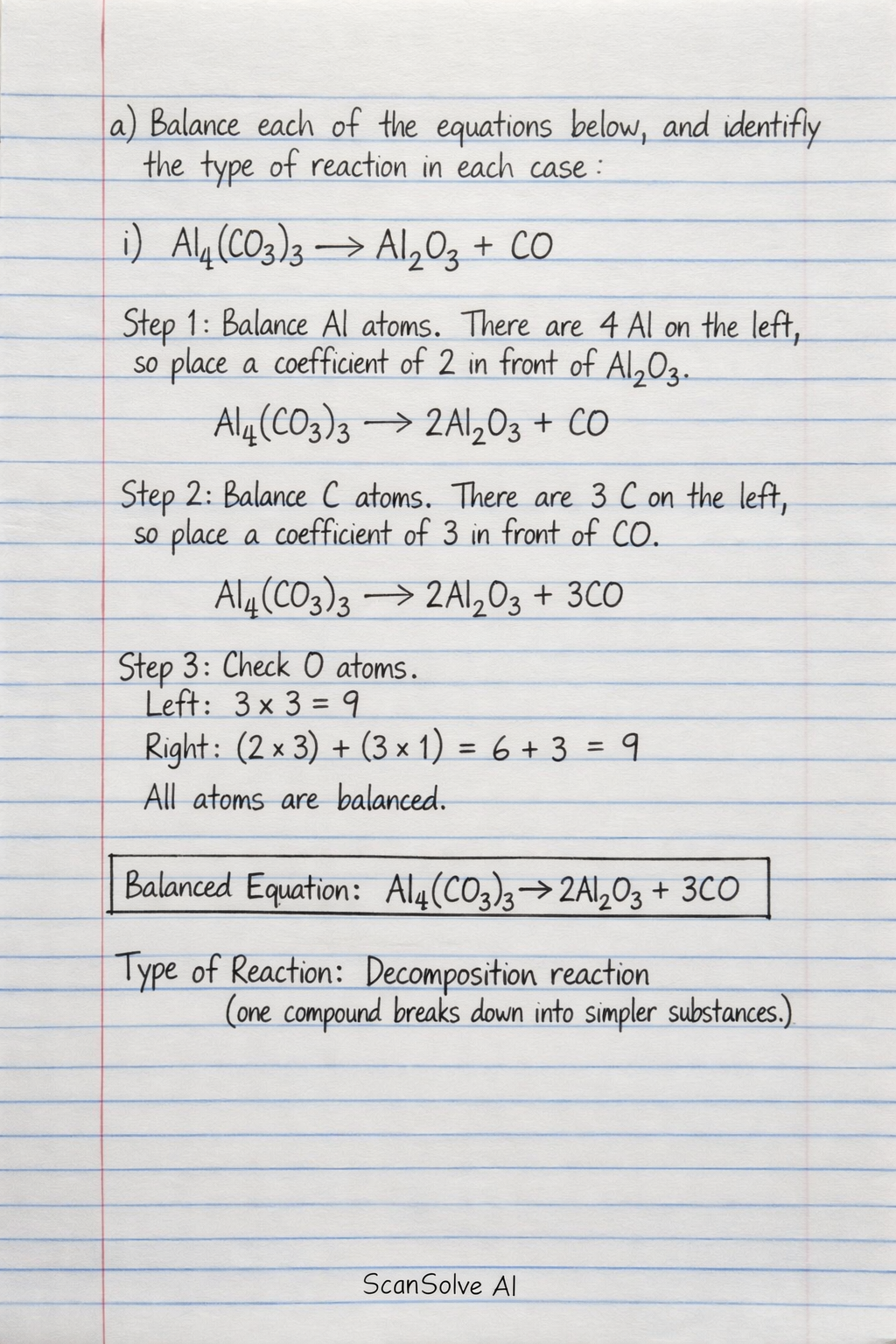
Part a(i)· 3 steps
Balance each of the equations below, and identify the type of reaction in each case
Balance Al atoms.
There are 4 Al on the left, so place a coefficient of 2 in front of .
Balance C atoms.
There are 3 C on the left, so place a coefficient of 3 in front of .
Check O atoms.
Left: . Right: . All atoms are balanced.
Balanced Equation:
Type of Reaction: Decomposition reaction (one compound breaks down into simpler substances).
Part a(ii)· 1 step
Assumption: Based on common chemical reactions, the product is likely a typo and should be (hydrogen peroxide), as barium peroxide reacts with sulfuric acid to produce barium sulfate and hydrogen peroxide. The equation does not balance with as a product.
Assuming the product is , let's check the atoms.
Reactants: Ba: 1, O: , H: 2, S: 1
Products: Ba: 1, O: , H: 2, S: 1
All atoms are already balanced.
Balanced Equation:
Type of Reaction: Double displacement reaction (ions are exchanged between two compounds).
Part a(iii)· 2 steps
Balance O atoms.
There are 6 O on the left, so place a coefficient of 3 in front of .
Check Ba and Cl atoms.
Ba: 1 on both sides. Cl: 2 on both sides. All atoms are balanced.
Balanced Equation:
Type of Reaction: Decomposition reaction (one compound breaks down into simpler substances).
Part a(iv)· 5 steps
This is a redox reaction.
Balance the oxidation and reduction changes. Cu goes from 0 to +2 (oxidized, change of +2). N goes from +5 in to +2 in (reduced, change of -3). To balance electrons, we need 3 Cu and 2 NO.
Start by placing coefficients for Cu and NO
Balance N atoms.
On the right, there are N in and 2 N in , totaling 8 N. So, place a coefficient of 8 in front of .
Balance H atoms.
There are 8 H on the left. On the right, we need 8 H, so place a coefficient of 4 in front of .
Check O atoms.
Left: . Right: . All atoms are balanced.
Balanced Equation:
Type of Reaction: Redox reaction (oxidation states of elements change).
Part a(v)· 3 steps
Balance B atoms.
There is 1 B on the left and 3 B on the right, so place a coefficient of 3 in front of .
Balance H and O atoms.
Reactants: H: , O: .
Products: H: 3 (from ) + 2 (from ) = 5. O: 6 (from ) + 1 (from ) = 7.
We need more H and more O on the product side. This corresponds to 3 molecules of . So, change the coefficient of to 3.Check all atoms.
Reactants: H: 9, B: 3, O: 9.
Products: H: , B: 3, O: . All atoms are balanced.
Balanced Equation:
Type of Reaction: Decomposition reaction (specifically, a dehydration reaction where water is removed).
Part a(vi)· 6 steps
Assumption: The reactant is likely a typo for (iodine), as is not a common stable reactant and the product contains iodine. We will balance the reaction: . This is a disproportionation reaction of phosphorus.
Balance P, I, H, and O atoms using a system of equations or by inspection.
Let the coefficients be .
P:
I:
H:
O:From , substitute into the H equation
.
To find integer coefficients, let and .
The smallest integers for and that satisfy are and .
Substitute and into the other equations.
From I: .
From P: .To get whole numbers, multiply all coefficients by 4 (the least common multiple of the denominators for and ).
Calculate using
.
Balanced Equation:
Type of Reaction: Redox reaction (specifically, a disproportionation reaction where phosphorus is both oxidized and reduced).
Still stuck on this one?
Ask a follow-up, and the answer starts from this question.
More Chemistry Questions
Handwritten Step-by-Step Solution
Get this as a handwritten image on WhatsApp — like a tutor wrote it for you.
Try on WhatsApp