
We read your photo as:
State the differences between Gaseous fuels and solid fuels. A gaseous fuel has the following composition: CH 4 = 38%, H 2 = 26%, N 2 = 6%, CO = 26% and CO 2 = 4%. Find the stoichiometric air/fuel ratio by volume.
ScanSolve AI Answer
Step-by-step solution
9 stepsHere are the solutions to your questions.
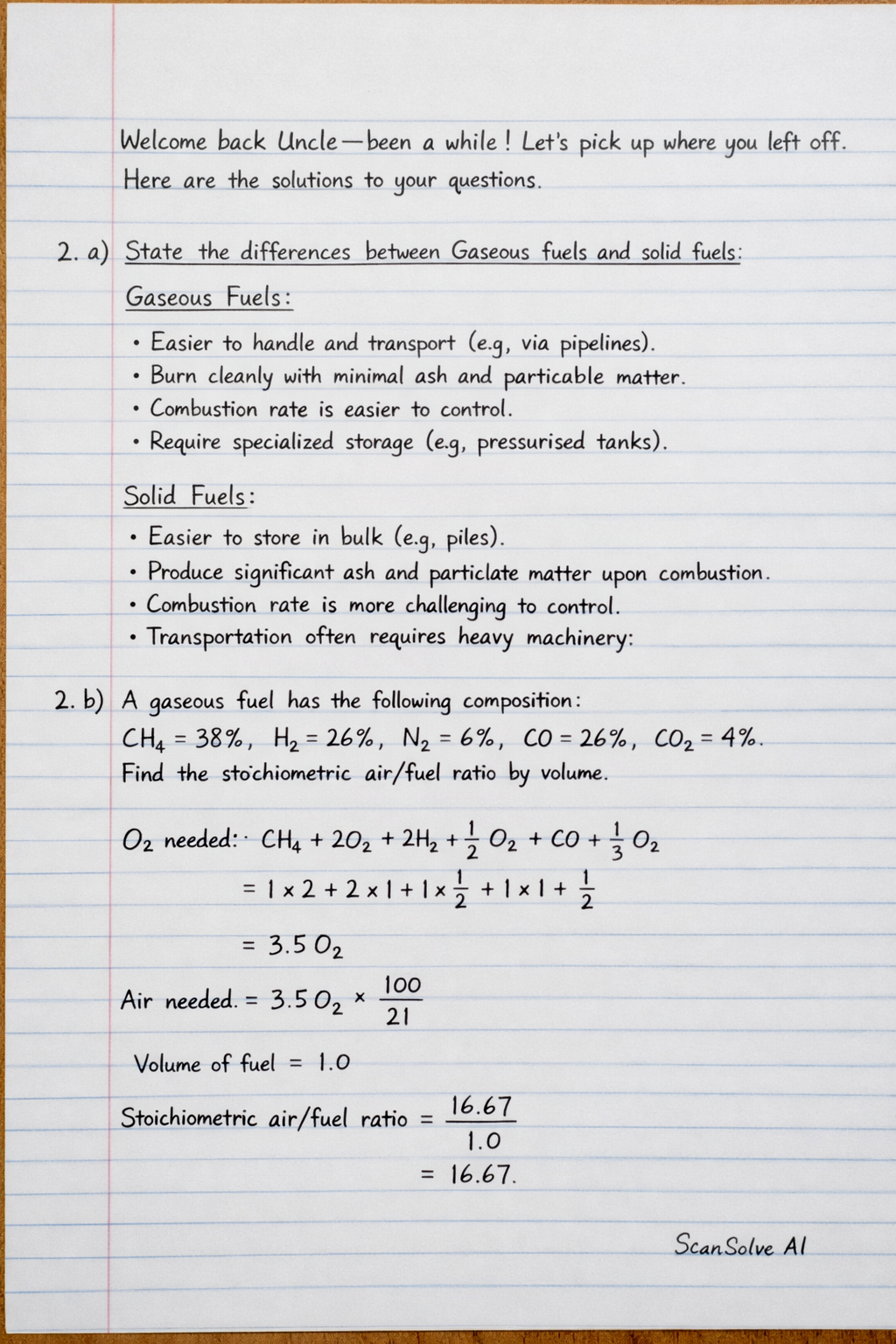
2. a) State the differences between Gaseous fuels and solid fuels.
- Gaseous Fuels:
- Easier to handle and transport (e.g., via pipelines).
- Burn cleanly with minimal ash and particulate matter.
- Combustion rate is easier to control.
- Require specialized storage (e.g., pressurized tanks).
- Solid Fuels:
- Easier to store in bulk (e.g., piles).
- Produce significant ash and particulate matter upon combustion.
- Combustion rate is more challenging to control.
- Transportation often requires heavy machinery.
2. b) A gaseous fuel has the following composition: , , , and . Find the stoichiometric air/fuel ratio by volume.
Write the balanced combustion equations for each combustible component and determine the oxygen required.
Assume 100 volumes of fuel.
- For (38 volumes): Oxygen required: volumes of .
- For (26 volumes): Oxygen required: volumes of .
- For (26 volumes): Oxygen required: volumes of .
- (6 volumes) and (4 volumes) are inert and do not require oxygen for combustion.
Calculate the total oxygen required.
Total oxygen required per 100 volumes of fuel = volumes of .
Calculate the volume of air required.
Air is approximately 21% oxygen by volume.
Volume of air required =Calculate the stoichiometric air/fuel ratio by volume.
Air/fuel ratio by volume =
The stoichiometric air/fuel ratio by volume is .
3. a) State the steady flow energy equation.
The Steady Flow Energy Equation (SFEE) for a single inlet and single outlet system is given by:
where:
- is the rate of heat transfer to the system.
- is the rate of work done by the system.
- is the mass flow rate.
- is the specific enthalpy ().
- is the velocity.
- is the acceleration due to gravity.
- is the elevation.
- Subscripts 1 and 2 denote inlet and outlet conditions, respectively.
3. b) In a steady flow system, a substance flows at a rate of . It enters at a pressure of , a velocity of , internal energy , and specific volume . It leaves at a pressure of , a velocity of , internal energy , and specific volume . During its passage through the system, the substance rejects of heat. Determine the work done per kg of the substance.
Given data:
- Mass flow rate
- Inlet (State 1): , , ,
- Exit (State 2): , , ,
- Heat rejected . Therefore, heat added to the system .
- Assume negligible change in potential energy ().
The SFEE per unit mass is:
We need to find , the work done per kg. So, .
Calculate the specific heat transfer .
Calculate the specific enthalpy at the inlet () and outlet ().
Specific enthalpy .
Calculate the change in specific enthalpy ().
Calculate the change in kinetic energy.
Calculate the work done per kg ().
The work done per kg of the substance is .
Still stuck on this one?
Ask a follow-up, and the answer starts from this question.
More Chemistry Questions
Handwritten Step-by-Step Solution
Get this as a handwritten image on WhatsApp — like a tutor wrote it for you.
Try on WhatsApp