
We read your photo as:
The following are ways of ensuring crystal formation from a solution except:
ScanSolve AI Answer
Here are the solutions to the questions:
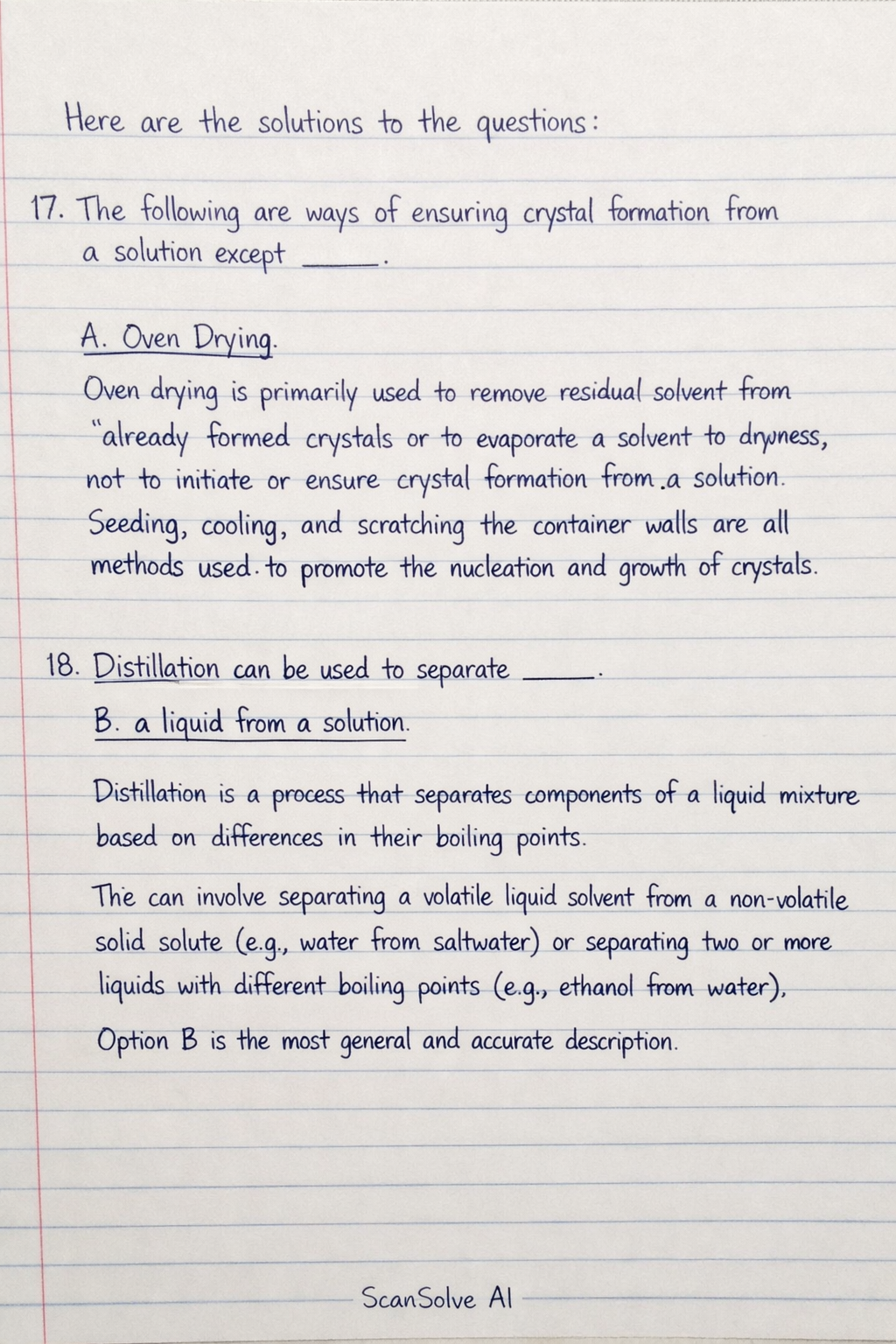
17. The following are ways of ensuring crystal formation from a solution except _____
A. Oven Drying
Oven drying is primarily used to remove residual solvent from already formed crystals or to evaporate a solvent to dryness, not to initiate or ensure crystal formation from a solution. Seeding, cooling, and scratching the container walls are all methods used to promote the nucleation and growth of crystals.
18. Distillation can be used to separate _____
B. a liquid from a solution
Distillation is a process that separates components of a liquid mixture based on differences in their boiling points. This can involve separating a volatile liquid solvent from a non-volatile solid solute (e.g., water from saltwater) or separating two or more liquids with different boiling points (e.g., ethanol from water). Option B is the most general and accurate description.
19. The four main steps in using a fire extinguisher are _____
C. Pull, Aim, Squeeze, & Sweep
This sequence is commonly known by the acronym P.A.S.S.:
- Pull the pin.
- Aim the nozzle at the base of the fire.
- Squeeze the handle.
- Sweep the nozzle from side to side.
20. The principal glassware used in the liquid-liquid extraction is _____
D. Separatory funnel
A separatory funnel is specifically designed for liquid-liquid extraction. It allows two immiscible liquid phases to be thoroughly mixed and then cleanly separated by draining the lower layer through a stopcock.
Still stuck on this one?
Ask a follow-up, and the answer starts from this question.
More Chemistry Questions
Handwritten Step-by-Step Solution
Get this as a handwritten image on WhatsApp — like a tutor wrote it for you.
Try on WhatsApp