
We read your photo as:
Which of the following will form a giant ionic crystal?
ScanSolve AI Answer
Answer
here are the solutions to the multiple-choice questions:
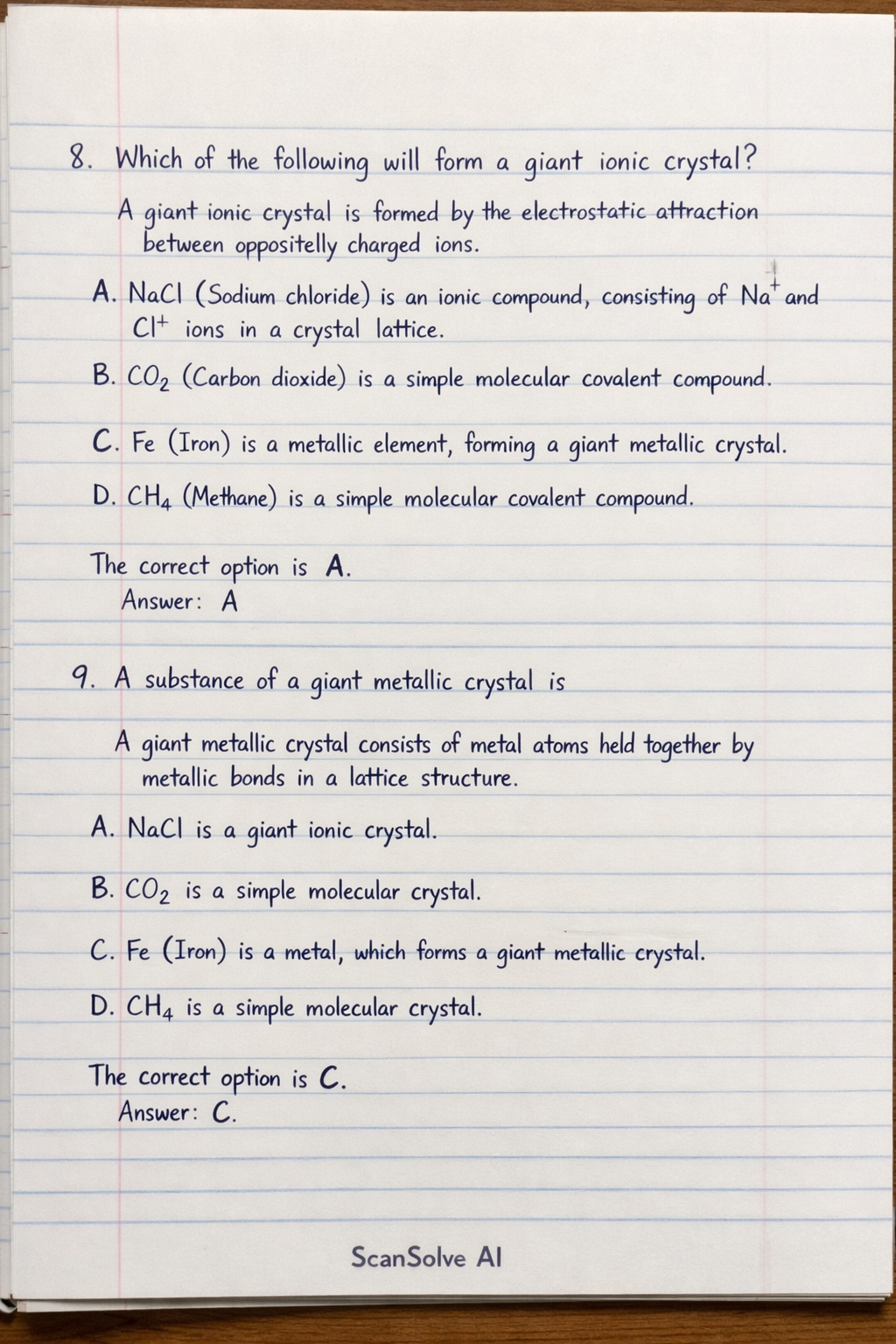
8. Which of the following will form a giant ionic crystal?
A giant ionic crystal is formed by the electrostatic attraction between oppositely charged ions.
- A. NaCl (Sodium chloride) is an ionic compound, consisting of Na and Cl ions arranged in a crystal lattice.
- B. CO (Carbon dioxide) is a simple molecular covalent compound.
- C. Fe (Iron) is a metallic element, forming a giant metallic crystal.
- D. CH (Methane) is a simple molecular covalent compound.
The correct option is A.
Answer: A
9. A substance of a giant metallic crystal is
A giant metallic crystal consists of metal atoms held together by metallic bonds in a lattice structure.
- A. NaCl is a giant ionic crystal.
- B. CO is a simple molecular crystal.
- C. Fe (Iron) is a metal, which forms a giant metallic crystal.
- D. CH is a simple molecular crystal.
The correct option is C.
Answer: C
10. Choose a giant molecular crystal from the following.
A giant molecular crystal (also known as a giant covalent crystal or network solid) consists of atoms held together by strong covalent bonds in a continuous, extended network (e.g., diamond, silicon dioxide).
- A. NaCl is a giant ionic crystal.
- B. CO (Carbon dioxide) is a simple molecular substance, forming a simple molecular crystal (dry ice) where discrete CO molecules are held by weak intermolecular forces. It is not a "giant molecular" crystal.
- C. Fe is a giant metallic crystal.
- D. Cu (Copper) is a giant metallic crystal.
Based on the strict definition, none of the options are examples of a "giant molecular crystal". However, if the question intended to ask for a simple molecular crystal, then CO would be the only molecular substance among the choices. Given the options, and assuming there might be a slight imprecision in the term "giant molecular" in this context, CO is the only molecular substance listed.
The most appropriate option, if we consider the possibility of a misphrased question aiming for a molecular substance, is B.
Answer: B
11. Which of the following is an example of an atomic crystal?
An atomic crystal (or giant atomic crystal, or giant covalent crystal) consists of atoms held together by covalent bonds in a continuous network.
- A. MgCl (Magnesium chloride) is an ionic crystal.
- B. Diamond is a form of carbon where each carbon atom is covalently bonded to four other carbon atoms in a continuous three-dimensional network, making it a classic example of an atomic crystal.
- C. Ice (HO) is a simple molecular crystal, where water molecules are held together by hydrogen bonds.
- D. CH (Methane) is a simple molecular crystal.
The correct option is B.
Answer: B
12. The force holding ionic crystals together is called
Ionic crystals are formed by the attraction between positively and negatively charged ions. This attraction is fundamentally an electrostatic force.
- A. a covalent bond force - This holds atoms together in covalent compounds.
- B. Van der Waals' forces - These are weak intermolecular forces.
- C. Electrostatic forces - These are the attractive forces between oppositely charged ions, which constitute an ionic bond.
- D. ionic bond forces - This is the specific name for the bond itself, which is a type of electrostatic force. While "ionic bond forces" is also correct, "electrostatic forces" describes the fundamental nature of that force. In many contexts, "electrostatic forces" is considered the more fundamental and accurate description of the force.
The correct option is C.
Answer: C
Try one yourself
A new problem that tests the same skill.
Still stuck on this one?
Ask a follow-up, and the answer starts from this question.
More Chemistry Questions
Handwritten Step-by-Step Solution
Get this as a handwritten image on WhatsApp — like a tutor wrote it for you.
Try on WhatsApp