
We read your photo as:
CHM 102: GENERAL CHEMISTRY II SECOND SEMESTER TEST, CHM 102 TEST
ScanSolve AI Answer
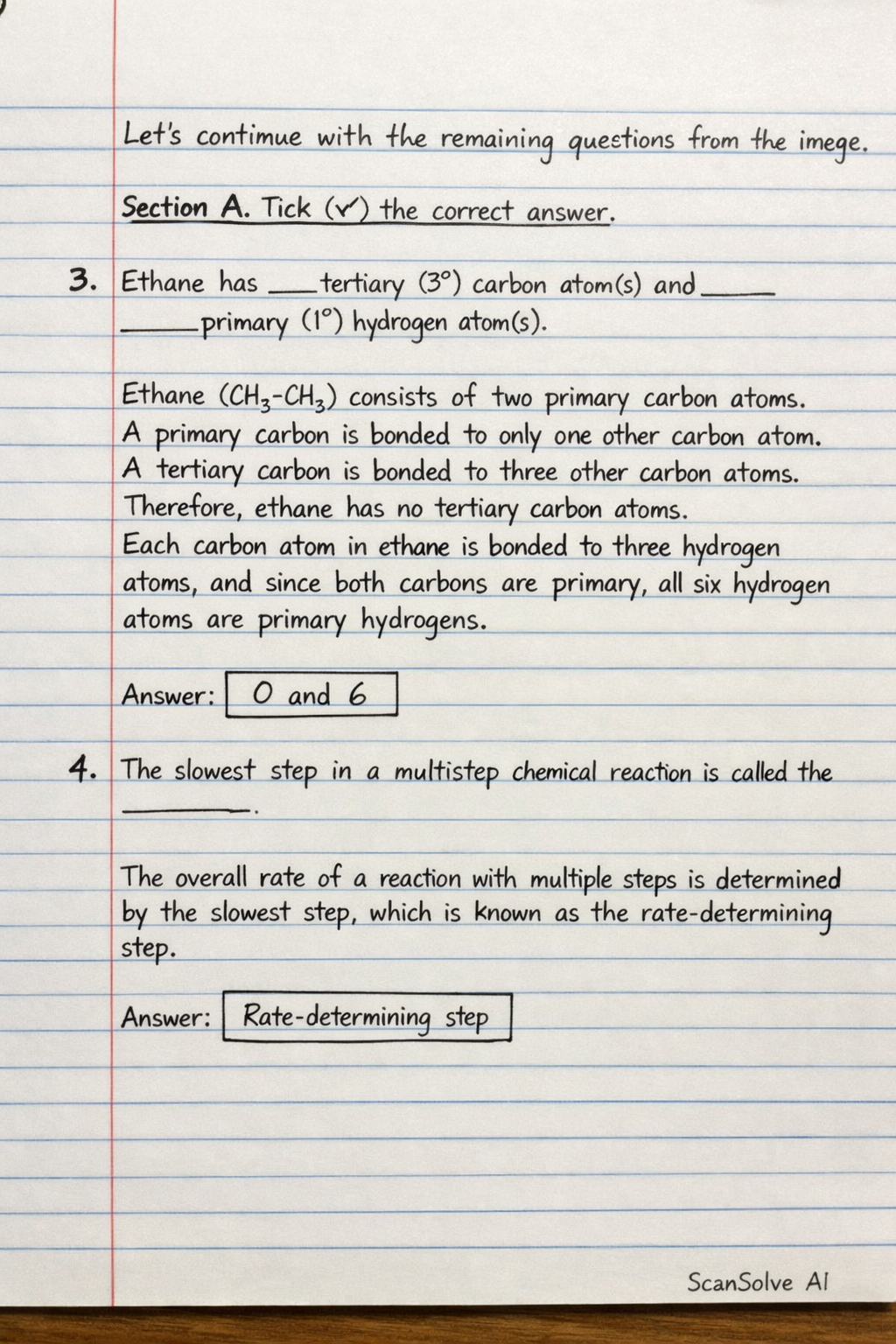
Let's continue with the remaining questions from the image.
Section A. Tick (✓) the correct answer.
3. Ethane has ______ tertiary (3°) carbon atom(s) and ______ primary (1°) hydrogen atom(s).
Ethane () consists of two primary carbon atoms. A primary carbon is bonded to only one other carbon atom. A tertiary carbon is bonded to three other carbon atoms. Therefore, ethane has no tertiary carbon atoms. Each carbon atom in ethane is bonded to three hydrogen atoms, and since both carbons are primary, all six hydrogen atoms are primary hydrogens.
Answer:
4. The slowest step in a multistep chemical reaction is called the ______.
The overall rate of a reaction with multiple steps is determined by the slowest step, which is known as the rate-determining step.
Answer:
5. The reaction of a secondary amine with an alkanol or alkanone yields ______.
Secondary amines () react with aldehydes (alkanals) or ketones (alkanones) to form enamines. Imines are formed from primary amines.
Answer:
6. Which of the following groups has the lowest priority in the Cahn-Ingold-Prelog sequence?
The Cahn-Ingold-Prelog (CIP) priority rules assign priority based on the atomic number of the atoms directly attached to the chiral center.
- : Atomic number 17
- : Oxygen (atomic number 8)
- : Nitrogen (atomic number 7)
- : Carbon (atomic number 6) Comparing the atomic numbers, carbon has the lowest atomic number among the first atoms of these groups. Answer:
7. According to Markovnikov's rule, what would be the major product obtained from the acid-catalyzed addition of to ?
Markovnikov's rule states that in the addition of to an unsymmetrical alkene, the hydrogen atom adds to the carbon atom of the double bond that already has more hydrogen atoms, and the hydroxyl () group adds to the carbon atom with fewer hydrogen atoms. For propene (), the hydrogen adds to the terminal and the adds to the central .
The product is 2-propanol.
Answer:
8. The reaction of an alkylhalide with ammonia produces a/an ______.
When an alkyl halide undergoes nucleophilic substitution with ammonia, the initial product is a primary amine. Further reactions can occur if excess alkyl halide is present, leading to secondary, tertiary, and quaternary ammonium salts, but the first product is a primary amine.
Answer:
9. Ethers are considered as good solvents in organic reactions because they are ______.
Ethers are generally unreactive towards most common reagents (like acids, bases, oxidizing, or reducing agents under mild conditions). This inertness makes them excellent solvents for many organic reactions, as they do not interfere with the reaction itself.
Answer:
10. Indicate whether the following species are primary, secondary or tertiary.
-
The carbon atom bearing the hydroxyl () group is bonded to two other carbon atoms ( groups). Therefore, this is a secondary alcohol.
-
The nitrogen atom of the amine group is bonded to only one alkyl group (a tert-butyl group). Therefore, this is a primary amine.
Section B (Use the space provided to write the correct answer)
11. What is the IUPAC name of each of the following compounds?
- : Fluoromethane
- : Propanenitrile
- : Ethoxyethane (or Diethyl ether)
- : Propyne
- : Ethanamine (or Ethylamine)
- Structure 1 ( on adjacent carbons): : Propane-1,2-diol
- Structure 2 (alkene with methyl): A three-carbon chain with a double bond and a methyl group on the middle carbon: 2-Methylpropene
- Structure 3 (five-membered ring): A five-membered saturated carbon ring: Cyclopentane
- Structure 4 (alkane with methyl): A four-carbon chain with a methyl group on the second carbon: 2-Methylbutane
- Structure 5 (cyclohexane with bromine): A six-membered saturated carbon ring with a bromine atom: Bromocyclohexane
12. Give the structures of the following compounds:
-
Methylcyclopropane
\begin{tikzpicture}[scale=0.7] \draw (0,0) -- (1,0) -- (0.5,0.866) -- cycle; \draw (0.5,0.866) -- (0.5,1.5); \node at (0.5,1.7) {$\text{CH}_3$}; \end{tikzpicture} -
N-Methylpentan-2-amine
-
Hexan-3-ol
-
2,3-Dimethylpenta-1,3-diene
-
Ethoxypropane
-
Propenenitrile
-
2-Ethyl-3-methylbutane (Note: This name is not standard IUPAC. The longest chain is 5 carbons, making it 2,3-dimethylpentane. The structure implied by the given name is shown below.)
-
But-2-yne
-
2-Bromopropane
-
Cyclopentanol
\begin{tikzpicture}[scale=0.7]
\draw (0,0) -- (1,0) -- (1.5,0.866) -- (0.5,1.732) -- (-0.5,0.866) -- cycle;
\draw (0.5,1.732) -- (0.5,2.2);
\node at (0.5,2.4) {$\text{OH}$};
\end{tikzpicture}
Still stuck on this one?
Ask a follow-up, and the answer starts from this question.
More Chemistry Questions
Handwritten Step-by-Step Solution
Get this as a handwritten image on WhatsApp — like a tutor wrote it for you.
Try on WhatsApp