
We read your photo as:
CHM 122: GENERAL CHEMISTRY. Answer question ONE and any other TWO.
ScanSolve AI Answer
Step-by-step solution
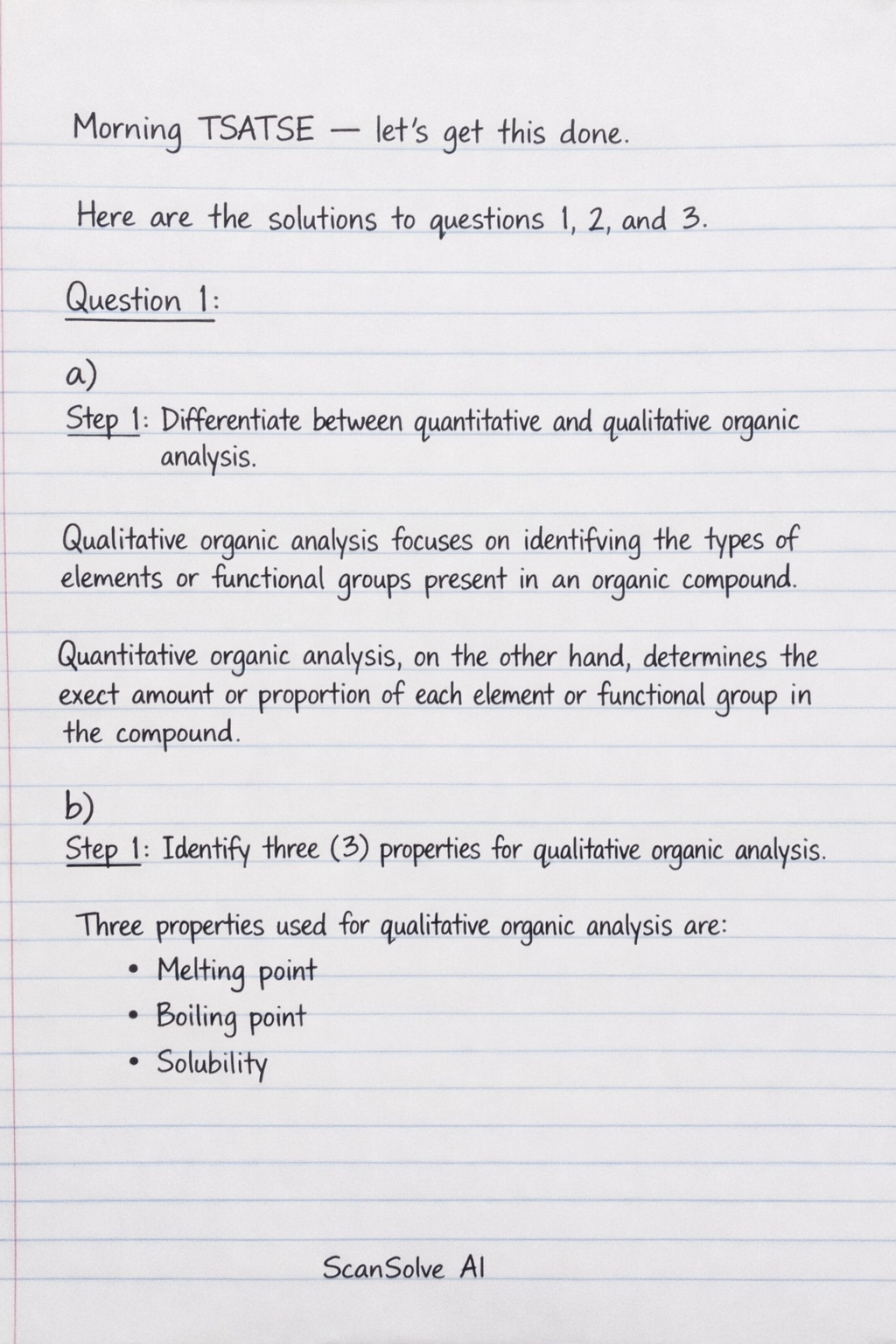
9 stepsHere are the solutions to questions 1, 2, and 3.
Question 1:
a)
Differentiate between quantitative and qualitative organic analysis.
Qualitative organic analysis focuses on identifying the types of elements or functional groups present in an organic compound. Quantitative organic analysis, on the other hand, determines the exact amount or proportion of each element or functional group in the compound.
b)
Identify three (3) properties for qualitative organic analysis.
Three properties used for qualitative organic analysis are:
- Melting point
- Boiling point
- Solubility
c)
Explain in details, two (2) properties of an organic substance.
- Melting Point: This is the specific temperature at which a solid organic compound transitions into a liquid state. It is a characteristic physical property used to identify a substance and assess its purity; pure compounds typically have a sharp, narrow melting point range.
- Boiling Point: This is the temperature at which a liquid organic compound's vapor pressure equals the surrounding atmospheric pressure, causing it to change into a gas. Like melting point, it is a characteristic physical property used for identification and purity assessment.
d)
State three (3) each of the physical and chemical properties of elements in the periodic table.
Three physical properties of elements:
- Atomic radius
- Ionization energy
- Electronegativity
Three chemical properties of elements:
- Reactivity
- Valency
- Tendency to form ions
Question 2:
a)
State the Modern periodic Law.
The Modern Periodic Law states that the physical and chemical properties of elements are periodic functions of their atomic numbers.
b)
Explain the following terms
i) Ionization energy: This is the minimum amount of energy required to remove one electron from a gaseous atom or ion in its ground state. It is an endothermic process, meaning energy must be supplied.
ii) Electronegativity: This is a measure of the tendency of an atom to attract a shared pair of electrons towards itself in a chemical bond. It is a relative scale, with fluorine being the most electronegative element.
iii) Electron Affinity: This is the energy change that occurs when an electron is added to a neutral gaseous atom to form a negative ion. It can be exothermic (energy released) or endothermic (energy absorbed) depending on the element.
Question 3:
a)
Discuss on IUPAC and Identify three (3) parts of IUPAC name for all organic compounds.
The International Union of Pure and Applied Chemistry (IUPAC) is an organization that sets standards for chemical nomenclature. Its systematic naming conventions ensure that every unique organic compound has a distinct and unambiguous name, facilitating global communication among chemists.
Identify three (3) parts of IUPAC name for all organic compounds.
The three main parts of an IUPAC name for organic compounds are:
- Prefix: Indicates the type and position of substituents (branches or functional groups of lower priority) attached to the main carbon chain.
- Parent Chain (Root Word): Specifies the number of carbon atoms in the longest continuous carbon chain or ring, forming the basic skeleton of the molecule.
- Suffix: Denotes the primary functional group present in the molecule and its position, indicating the compound's class (e.g., -ane for alkanes, -ol for alcohols).
b)
Distinguish between atomic and ionic radii and also their parameters of measurement.
Atomic Radius: This is defined as the distance from the center of the nucleus to the outermost electron shell of an atom. For non-metals, it's often measured as half the distance between the nuclei of two identical atoms covalently bonded together (covalent radius). For metals, it's half the distance between the nuclei of adjacent atoms in a metallic crystal (metallic radius).
Ionic Radius: This is the distance from the center of the nucleus to the outermost electron shell of an ion. Cations (positive ions) are generally smaller than their parent atoms because they have lost electrons, leading to a stronger pull from the nucleus on the remaining electrons. Anions (negative ions) are generally larger than their parent atoms due to the addition of electrons, which increases electron-electron repulsion and expands the electron cloud. Ionic radii are typically determined from X-ray diffraction studies of ionic crystals.
Still stuck on this one?
Ask a follow-up, and the answer starts from this question.
More Chemistry Questions
Handwritten Step-by-Step Solution
Get this as a handwritten image on WhatsApp — like a tutor wrote it for you.
Try on WhatsApp