
We read your photo as:
Instruction: Attempt Question ONE and any other TWO.
ScanSolve AI Answer
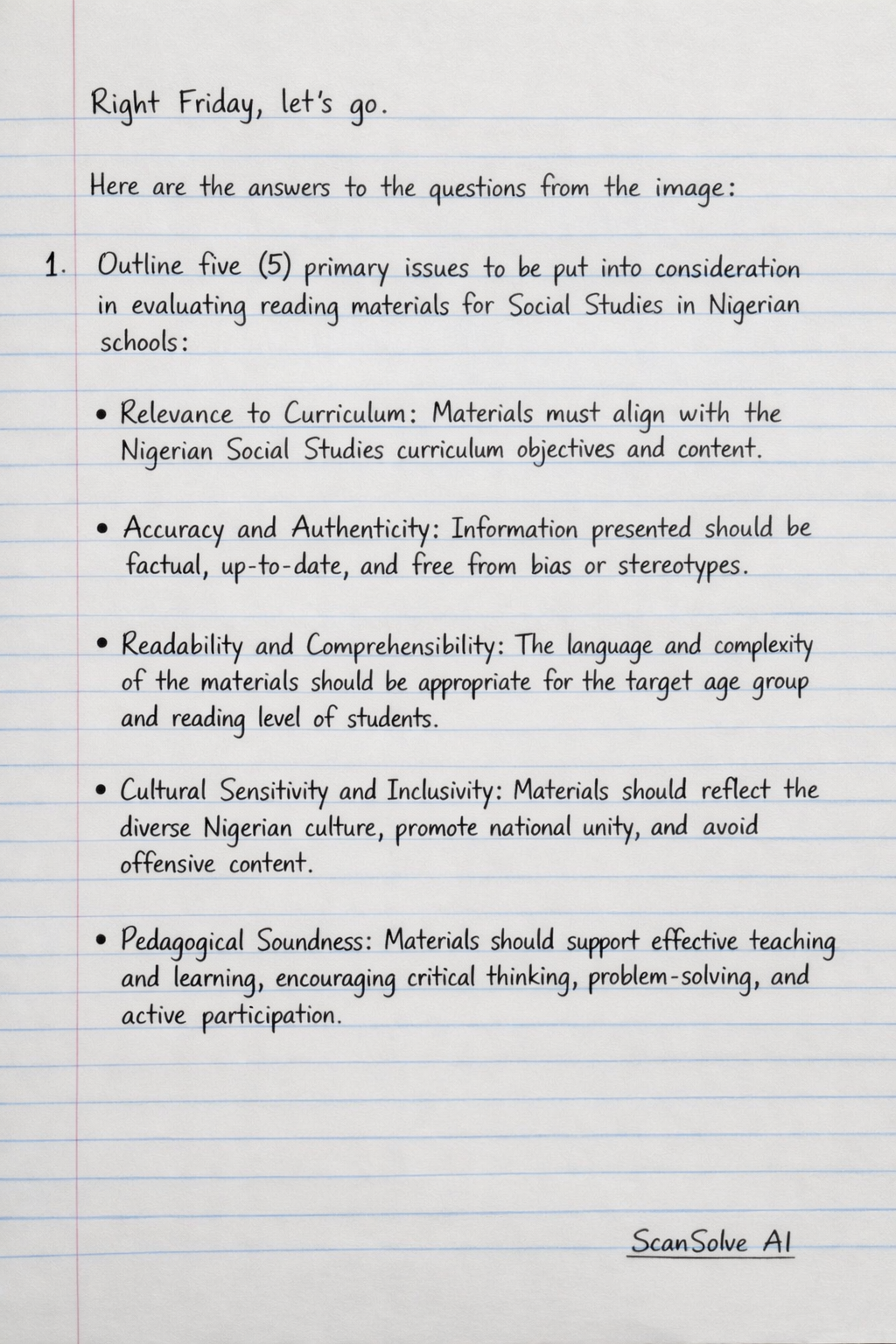
Here are the answers to the questions from the image:
-
Outline five (5) primary issues to be put into consideration in evaluating reading materials for Social Studies in Nigerian schools.
- Relevance to Curriculum: Materials must align with the Nigerian Social Studies curriculum objectives and content.
- Accuracy and Authenticity: Information presented should be factual, up-to-date, and free from bias or stereotypes.
- Readability and Comprehensibility: The language and complexity of the materials should be appropriate for the target age group and reading level of students.
- Cultural Sensitivity and Inclusivity: Materials should reflect the diverse Nigerian culture, promote national unity, and avoid offensive content.
- Pedagogical Soundness: Materials should support effective teaching and learning, encouraging critical thinking, problem-solving, and active participation.
-
Discuss four (4) techniques a Social Studies teacher can utilize under the inquiry-oriented teaching methods.
- Questioning: Teachers pose open-ended questions that stimulate curiosity and encourage students to investigate topics, rather than just memorizing facts. This technique guides students to formulate their own questions and seek answers.
- Problem-Based Learning (PBL): Students are presented with real-world problems or scenarios that require them to research, analyze, and propose solutions. This fosters critical thinking and collaborative skills.
- Case Studies: Students analyze specific historical or contemporary events, individuals, or situations to understand complex issues, identify causes and effects, and evaluate different perspectives.
- Debates and Discussions: Students engage in structured arguments or open conversations about controversial or multifaceted Social Studies topics. This promotes critical analysis, articulation of viewpoints, and respectful engagement with differing opinions.
-
Analyze six (6) ways of improvising learning resources to adopt by teachers in Nigerian schools.
- Utilizing Local Environment: Teachers can use natural resources, historical sites, community structures, and local events as direct learning aids.
- Recycling and Repurposing Materials: Everyday waste items like plastic bottles, cardboard, newspapers, and fabric scraps can be transformed into visual aids, models, or game components.
- Creating Charts and Posters: Teachers can hand-draw or print charts, maps, and diagrams using readily available paper, markers, and other stationery.
- Developing Storytelling and Role-Playing Scenarios: Teachers can create narratives or role-play activities based on local folklore, historical events, or social issues, using minimal props.
- Leveraging Human Resources: Inviting community members with relevant expertise (e.g., local historians, artisans, farmers) to share their knowledge with students.
- Adapting Existing Textbooks/Materials: Modifying or supplementing existing, often outdated, textbooks with current information, local examples, or simplified explanations.
-
With the aid of a diagram, describe the components of a computer device. A computer device consists of several interconnected components that work together to process data.
- Central Processing Unit (CPU): The "brain" of the computer, responsible for executing instructions and performing calculations.
- Memory (RAM): Short-term storage that the CPU uses to hold data and instructions currently being processed, allowing for quick access.
- Storage Device (HDD/SSD): Long-term storage for operating systems, applications, and user data, retaining information even when the computer is off.
- Input Devices: Peripherals used to send data and commands to the computer (e.g., keyboard, mouse, microphone).
- Output Devices: Peripherals used to display or present processed data from the computer (e.g., monitor, printer, speakers).
- Motherboard: The main circuit board that connects all the components of the computer, allowing them to communicate with each other. (A diagram would typically show these components connected, illustrating the flow of data between them.)
-
Examine five (5) possible limitations of using computers in Nigerian schools for the students.
- Lack of Access and Equity: Many Nigerian schools, especially in rural areas, lack sufficient computers or reliable internet access, creating a digital divide among students.
- Inadequate Infrastructure: Frequent power outages, poor internet connectivity, and lack of suitable computer labs hinder consistent and effective computer use.
- Limited Teacher Training: Many teachers lack the necessary skills and training to effectively integrate computers into their teaching methods, limiting student exposure and learning.
- Maintenance and Repair Challenges: High cost of maintenance, lack of spare parts, and scarcity of qualified technicians make it difficult to keep computers in working condition.
- Distraction and Misuse: Without proper supervision and guidance, students may use computers for non-educational purposes, leading to distractions and reduced learning outcomes.
-
Highlight five (5) common elements of a Social Studies curriculum in the Nigerian education system.
- History: Covers Nigerian history, pre-colonial, colonial, and post-colonial eras, as well as significant global historical events.
- Geography: Focuses on the physical and human geography of Nigeria, including climate, landforms, population distribution, and economic activities.
- Civic Education: Teaches students about citizenship, government structures, human rights, responsibilities, and democratic values in Nigeria.
- Economics: Introduces basic economic concepts, resource management, production, consumption, and the Nigerian economy.
- Culture and Society: Explores the diverse cultures, traditions, social structures, and values within Nigeria and their impact on national identity.
-
Assess five (5) relevance of a curriculum in the teaching of Social Studies in Nigeria.
- Provides Structure and Direction: A curriculum offers a clear framework for teachers, outlining learning objectives, content areas, and expected outcomes, ensuring consistency in teaching.
- Ensures Comprehensive Coverage: It guarantees that all essential aspects of Social Studies, from history to civics, are covered systematically, preventing omissions.
- Promotes National Unity and Identity: The curriculum is designed to instill patriotic values, an understanding of Nigerian heritage, and appreciation for diversity, fostering national cohesion.
- Guides Assessment and Evaluation: It provides benchmarks for assessing student learning and teacher effectiveness, ensuring that evaluations are fair and aligned with educational goals.
- Facilitates Resource Development: The curriculum serves as a guide for developing relevant textbooks, teaching aids, and other learning materials tailored to the Nigerian context.
-
Outline five (5) guidelines to be followed in the development of resources for Social Studies in Nigeria.
- Curriculum Alignment: Resources must directly support the objectives and content specified in the Nigerian Social Studies curriculum.
- Cultural Relevance and Sensitivity: Materials should reflect Nigerian cultural contexts, values, and diversity, avoiding foreign biases or stereotypes.
- Accuracy and Authenticity: Information presented must be factually correct, up-to-date, and sourced from credible references.
- Age Appropriateness: The language, complexity, and presentation style of resources should match the cognitive and developmental level of the target student group.
- Promote Critical Thinking: Resources should encourage inquiry, analysis, problem-solving, and multiple perspectives rather than rote memorization.
-
Explain with five (5) reasons for the improvisation of teaching resources in Nigeria schools. Improvisation of teaching resources in Nigerian schools refers to the creative use of readily available, often inexpensive, materials to create effective learning aids.
- Scarcity of Standard Resources: Many schools lack adequate funding to purchase commercially produced textbooks, charts, and scientific equipment.
- Cost-Effectiveness: Improvisation allows teachers to create necessary teaching aids at little to no cost, making education more accessible despite budget constraints.
- Relevance to Local Context: Improvised materials can be tailored to reflect local environments, cultures, and experiences, making learning more relatable and meaningful for students.
- Enhances Creativity and Practical Skills: The process of improvising resources encourages teachers and students to be innovative, fostering practical skills and a deeper understanding of concepts.
- Promotes Active Learning: Hands-on, improvised materials often engage students more effectively than abstract concepts, leading to better comprehension and retention of knowledge.
Still stuck on this one?
Ask a follow-up, and the answer starts from this question.
More Geography Questions
Handwritten Step-by-Step Solution
Get this as a handwritten image on WhatsApp — like a tutor wrote it for you.
Try on WhatsApp