

This physics problem tests your understanding of fundamental physical laws and their applications. The step-by-step solution below breaks down the problem using relevant equations and physical reasoning.
ScanSolve AI Answer
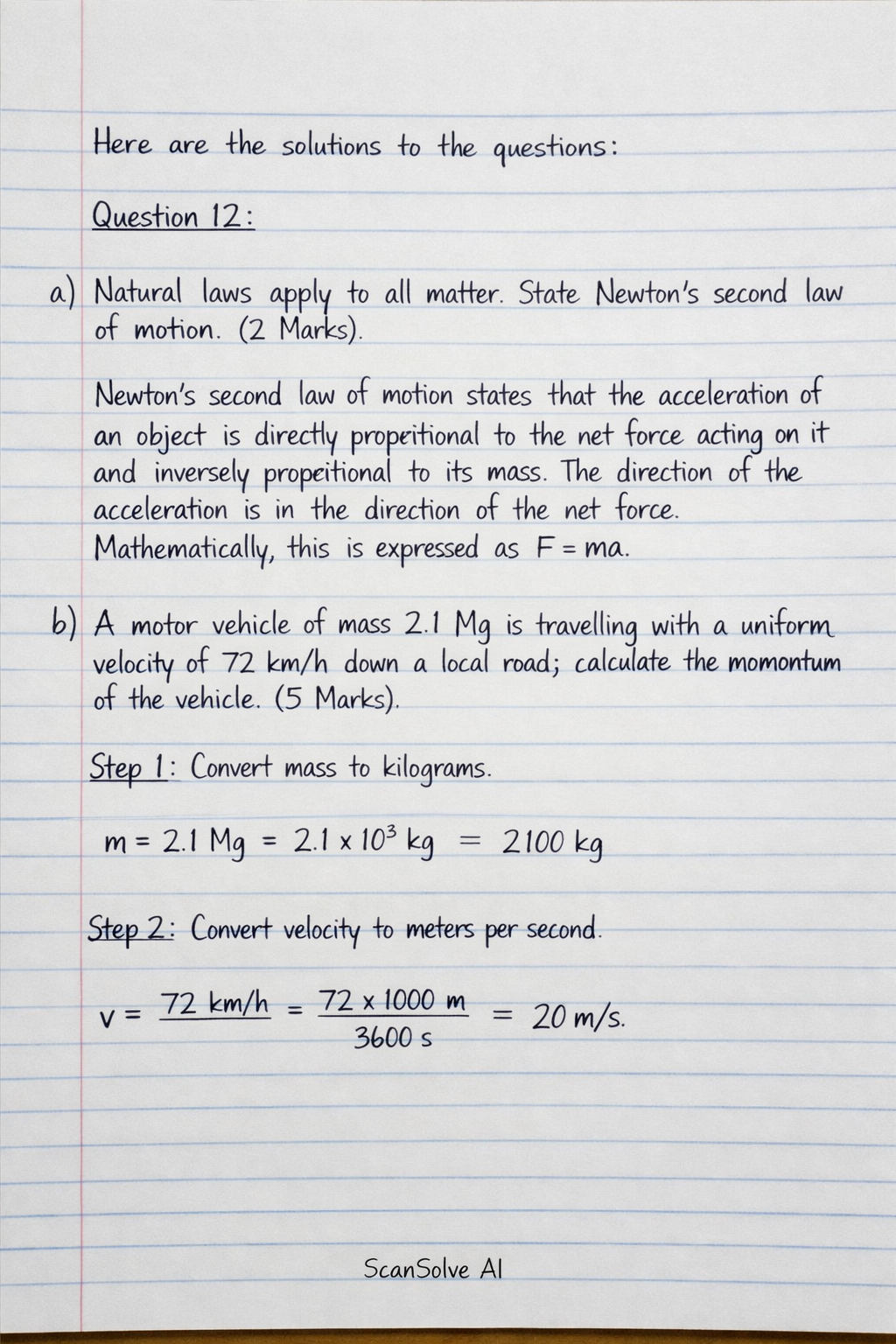
Here are the solutions to the questions: Question 12: a) Natural laws apply to all matter. State Newton's second law of motion. (2 Marks) Newton's second law of motion states that the acceleration of an object is directly proportional to the net force acting on it and inversely proportional to its mass. The direction of the acceleration is in the direction of the net force. Mathematically, this is expressed as F = ma. b) A motor vehicle of mass 2.1 Mg is travelling with a uniform velocity of 72 km/h down a local road; calculate the momentum of the vehicle. (5 Marks) Step 1: Convert mass to kilograms. m = 2.1 Mg = 2.1 × 10^3 kg = 2100 kg Step 2: Convert velocity to meters per second. v = 72 km/h = 72 × 1000 m3600 s = 20 m/s Step 3: Calculate the momentum. Momentum (p) is the product of mass (m) and velocity (v). p = m × v p = 2100 kg × 20 m/s p = 42000 kg m/s The momentum of the vehicle is 42000 kg m/s. c) A vehicle has a force of 1.5 KN acting on it due to the engine, and the acceleration produced is 1.2 m/s^2. Calculate the mass of the vehicle. (7 Marks) Step 1: Convert force to Newtons. F = 1.5 KN = 1.5 × 10^3 N = 1500 N Step 2: Use Newton's second law to calculate mass. Newton's second law states F = ma. Rearranging for mass: m = (F)/(a) m = 1500 N1.2 m/s^2 m = 1250 kg The mass of the vehicle is 1250 kg. d) Determine the gravitational force acting on an engine block of mass 200 kg assuming g=9.81 m/s. (6 Marks) Step 1: Identify the formula for gravitational force (weight). Gravitational force (F_g) is the product of mass (m) and acceleration due to gravity (g). F_g = m × g Step 2: Substitute the given values and calculate. F_g = 200 kg × 9.81 m/s^2 F_g = 1962 N The gravitational force acting on the engine block is 1962 N. Question 13: A hammer of mass 2.4 kg is raised to a height of 2 m and then left to drop to hit a nail fixed on a wooden block. If the nail moved a distance of 30 mm, find: a) The potential energy possessed by the hammer. (4 Marks) Step 1: Identify the formula for potential energy. Potential energy (PE) is given by PE = mgh. We will use g = 9.81 m/s^2 for consistency with Q12d. PE = m × g × h Step 2: Substitute the given values and calculate. PE = 2.4 kg × 9.81 m/s^2 × 2 m PE = 47.088 J The potential energy possessed by the hammer is 47.088 J. b) The resistance offered by the wooden block. (6 Marks) Step 1: Convert the distance the nail moved to meters. d = 30 mm = 30 × 10^-3 m = 0.03 m Step 2: Apply the work-energy theorem. The potential energy of the hammer is converted into work done against the resistance force (F_R) offered by the wooden block. PE = Work done by resistance Work done by resistance = F_R × d 47.088 J = F_R × 0.03 m Step 3: Calculate the resistance force. F_R = 47.088 J0.03 m F_R = 1569.6 N The resistance offered by the wooden block is 1569.6 N. c) The velocity of the hammer. (10 Marks) This refers to the velocity of the hammer just before impact with the nail, where all its potential energy has been converted into kinetic energy. Step 1: Equate potential energy to kinetic energy. PE = KE KE = (1)/(2)mv^2 47.088 J = (1)/(2) × 2.4 kg × v^2 Step 2: Solve for velocity (v). 47.088 = 1.2 × v^2 v^2 = (47.088)/(1.2) v^2 = 39.24 v = sqrt(39.24) v ≈ 6.264 m/s The velocity of the hammer just before impact is 6.264 m/s. Question 14: a) State the principle of moments (2 Marks) The principle of moments states that for an object to be in rotational equilibrium, the sum of the clockwise moments about any point must be equal to the sum of the anticlockwise moments about the same point. b) A uniform horizontal structure is supported on a fulcrum and loaded as shown below i) Calculate the magnitude of the load W required to maintain equilibrium (Ignoring the mass of the lever). (8 Marks) Step 1: Identify forces and their distances from the fulcrum. The fulcrum is the pivot point. Anticlockwise moments: • Force 200 N at 0.3 m from the fulcrum. • Force 300 N at 0.1 m from the fulcrum. Clockwise moments: • Force W at 0.25 m from the fulcrum. • Force 100 N at 0.4 m from the fulcrum (assuming the 0.4M indicates the distance from the fulcrum to the 100N force). Step 2: Apply the principle of moments. Sum of anticlockwise moments = Sum of clockwise moments (200 N × 0.3 m) + (300 N × 0.1 m) = (W × 0.25 m) + (100 N × 0.4 m) 60 Nm + 30 Nm = 0.25W Nm + 40 Nm 90 Nm = 0.25W Nm + 40 Nm Step 3: Solve for W. 90 - 40 = 0.25W 50 = 0.25W W = (50)/(0.25) W = 200 N The magnitude of the load W is 200 N. ii) The magnitude of the reaction R at the support (3 Marks) Step 1: Apply the principle of vertical equilibrium. For vertical equilibrium, the sum of upward forces must equal the sum of downward forces. Upward force: R Downward forces: 200 N, 300 N, W, 100 N Step 2: Calculate R. R = 200 N + 300 N + W + 100 N Substitute W = 200 N (from part i). R = 200 N + 300 N + 200 N + 100 N R = 800 N The magnitude of the reaction R at the support is 800 N. c) Now assuming the mass of the lever is equivalent to a load of 100 N, what would be the magnitude of load W required for the lever to remain horizontal (4 Marks) Step 1: Determine the position of the center of mass of the lever. Assuming the beam is uniform and the 100 N force is at 0.4 m from the fulcrum on the right side, the total length of the beam is 0.3 m + 0.4 m = 0.7 m. The center of mass for a uniform beam is at its midpoint, 0.7 m / 2 = 0.35 m from the left end. The fulcrum is at 0.3 m from the left end. Therefore, the center of mass is at 0.35 m - 0.3 m = 0.05 m to the right of the fulcrum. The weight of the lever (100 N) creates a clockwise moment about the fulcrum. Step 2: Apply the principle of moments with the lever's weight. Sum of anticlockwise moments = Sum of clockwise moments (200 N × 0.3 m) + (300 N × 0.1 m) = (W × 0.25 m) + (100 N × 0.4 m) + (100 N × 0.05 m) 60 Nm + 30 Nm = 0.25W Nm + 40 Nm + 5 Nm 90 Nm = 0.25W Nm + 45 Nm Step 3: Solve for W. 90 - 45 = 0.25W 45 = 0.25W W = (45)/(0.25) W = 180 N The new magnitude of load W required is 180 N. d) Determine also the new reaction R at the support (3 Marks) Step 1: Apply the principle of vertical equilibrium. The total downward forces now include the weight of the lever. Upward force: R Downward forces: 200 N, 300 N, W (new value), 100 N (force at end), 100 N (weight of lever). Step 2: Calculate the new R. R = 200 N + 300 N + W + 100 N + 100 N (lever weight) Substitute W = 180 N (from part c). R = 200 N + 300 N + 180 N + 100 N + 100 N R = 880 N The new reaction R at the support is 880 N. Question 15: a) State Hooke's law (2 Marks) Hooke's law states that the extension of a spring is directly proportional to the force applied to it, provided the elastic limit is not exceeded. Mathematically, this is expressed as F = kx, where F is the force, k is the spring constant, and x is the extension.