
We read your photo as:
Answer question ONE and any other TWO.
ScanSolve AI Answer
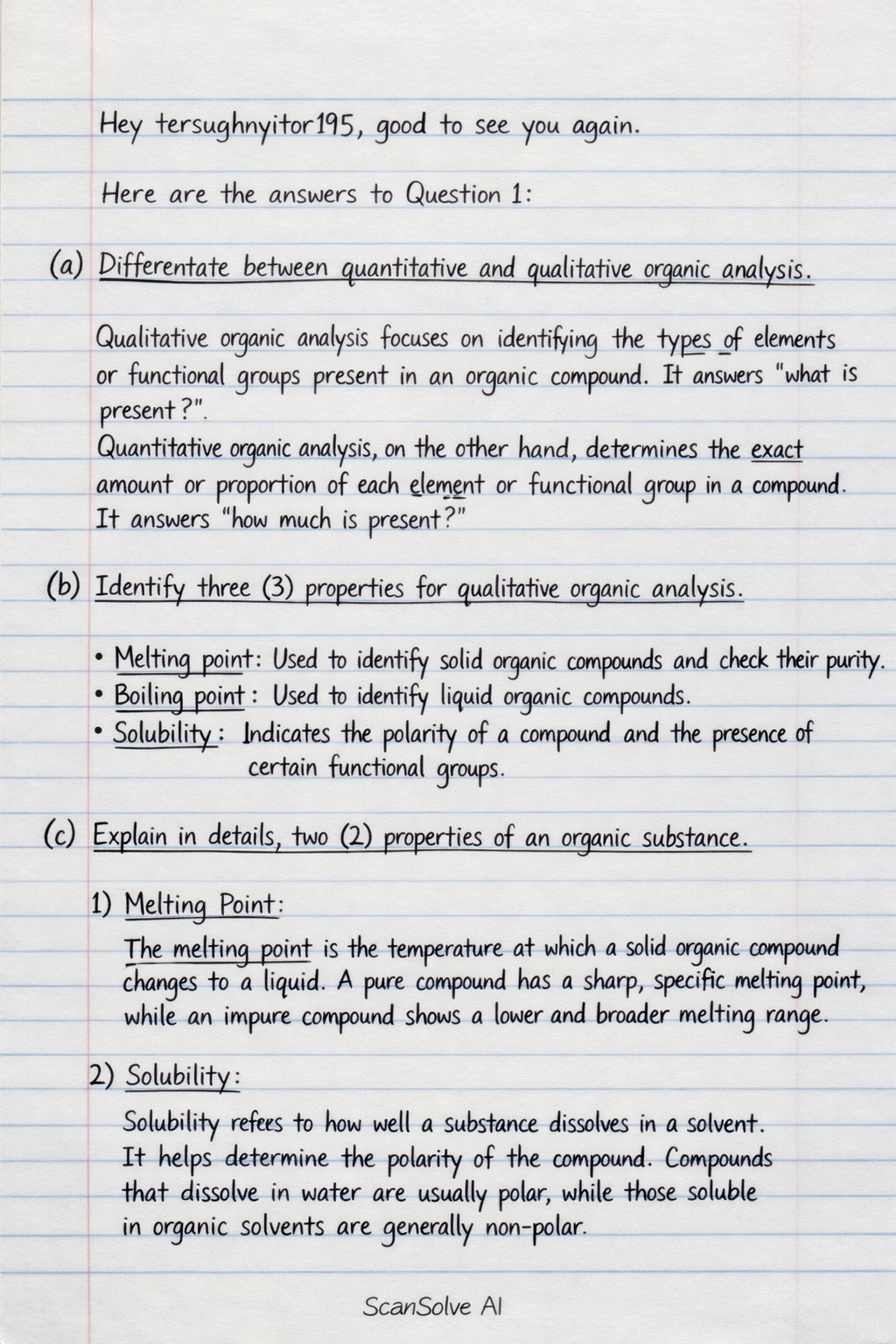
Here are the answers to Question 1:
a) Differentiate between quantitative and qualitative organic analysis.
Qualitative organic analysis focuses on identifying the types of elements or functional groups present in an organic compound. It answers "what is present?". Quantitative organic analysis, on the other hand, determines the exact amount or proportion of each element or functional group in a compound. It answers "how much is present?".
b) Identify three (3) properties for qualitative organic analysis.
Three properties used for qualitative organic analysis are:
- Melting point: Used to identify solid organic compounds and check their purity.
- Boiling point: Used to identify liquid organic compounds.
- Solubility: Indicates the polarity of a compound and the presence of certain functional groups.
c) Explain in details, two (2) properties of an organic substance.
Here are two properties of an organic substance:
- Melting Point: This is the temperature at which a solid organic substance changes into a liquid state. It is a characteristic physical property that can be used to identify a pure compound, as impurities typically lower and broaden the melting point range.
- Solubility: This refers to the ability of an organic substance to dissolve in a particular solvent. The solubility of an organic compound is primarily determined by its polarity and its ability to form intermolecular forces (like hydrogen bonds) with the solvent, following the "like dissolves like" principle.
d) State three (3) each of the physical and chemical properties of elements in the periodic table.
Three physical properties of elements:
- Atomic Radius: The distance from the center of the nucleus to the outermost electron shell.
- Melting Point: The temperature at which an element changes from a solid to a liquid state.
- Electrical Conductivity: The ability of an element to conduct electric current.
Three chemical properties of elements:
- Reactivity: The tendency of an element to undergo chemical reactions.
- Valency: The combining capacity of an element, typically determined by the number of electrons in its outermost shell.
- Electronegativity: The measure of an atom's ability to attract electrons in a chemical bond.
Still stuck on this one?
Ask a follow-up, and the answer starts from this question.
More Chemistry Questions
Handwritten Step-by-Step Solution
Get this as a handwritten image on WhatsApp — like a tutor wrote it for you.
Try on WhatsApp