
We read your photo as:
ATTEMPT ANY TWO (2) QUESTIONS
ScanSolve AI Answer
Step-by-step solution
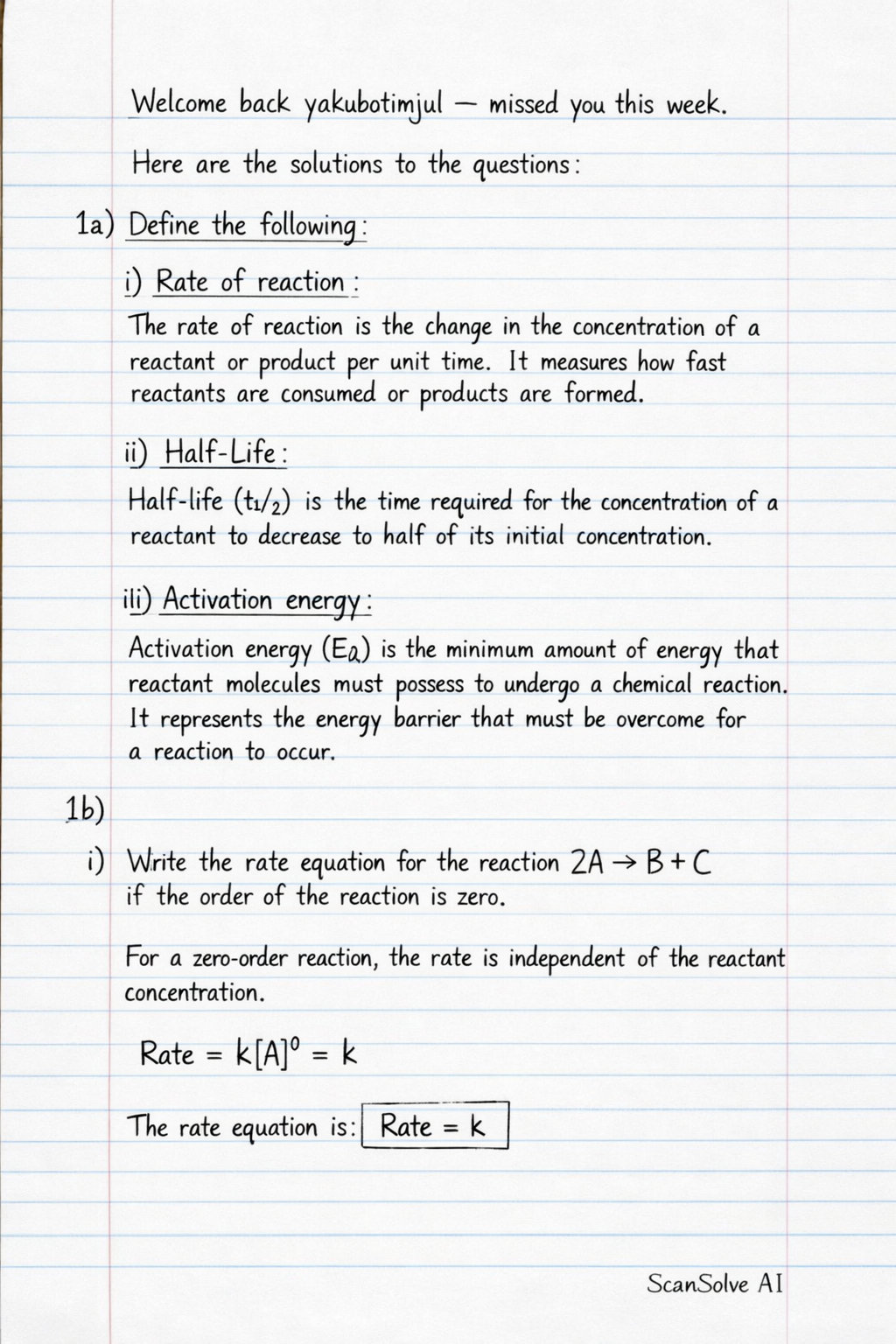
3 stepsHere are the solutions to the questions:
1a) Define the following:
i) Rate of reaction:
The rate of reaction is the change in the concentration of a reactant or product per unit time. It measures how fast reactants are consumed or products are formed.
ii) Half-Life:
Half-life () is the time required for the concentration of a reactant to decrease to half of its initial concentration.
iii) Activation energy:
Activation energy () is the minimum amount of energy that reactant molecules must possess to undergo a chemical reaction. It represents the energy barrier that must be overcome for a reaction to occur.
1b)
i) Write the rate equation for the reaction if the order of the reaction is zero.
For a zero-order reaction, the rate is independent of the reactant concentration.
The rate equation is .
ii) For a chemical reaction , it is found that the rate of reaction doubles when the concentration of is increased four times. The order of the reaction is:
Let the rate law be .
If is increased by 4 times, the rate doubles.
To solve for , we can write .
The order of the reaction is .
iii) For a reaction , half-life () is observed to be independent of the initial concentration of reactants. What is the order of reaction?
For a first-order reaction, the half-life is independent of the initial concentration (). For other orders, it depends on the initial concentration.
The order of reaction is .
1c)
pieces are placed in a flask and is added. Immediately a balloon is placed over the top of the flask and the balloon starts to inflate.
i) Explain why the balloon inflates.
The reaction between calcium carbonate () and hydrochloric acid () produces carbon dioxide gas (). This gas accumulates inside the flask, increasing the pressure and causing the balloon to inflate.
ii) If the same mass of in a powdered form is used, the balloon inflates faster. Explain why using collision theory.
Using powdered increases the surface area available for the reaction. According to collision theory, a larger surface area leads to more frequent effective collisions between the reactant particles ( and ), thus increasing the rate of reaction and producing gas faster, which inflates the balloon more quickly.
iii) Suggest two other ways to make the balloon inflate faster.
- Increase the concentration of : A higher concentration of means more reactant particles per unit volume, leading to more frequent effective collisions and a faster reaction rate.
- Increase the temperature: Raising the temperature increases the kinetic energy of the reactant molecules, causing them to move faster and collide more frequently and with greater energy, leading to a higher proportion of effective collisions and a faster reaction rate.
1d) Consider the following reactions. Predict and arrange the reactions as they occur from the most rapidly at room conditions to the slowest.
The general principles for reaction rates are:
- Ionic reactions in solution are typically very fast.
- Reactions involving gases or complex molecules, especially those requiring significant bond breaking and forming, tend to be slower.
- Decomposition reactions can vary but are often slow without catalysts.
Let's analyze each reaction:
i) (Combustion/oxidation of glucose) - This is a complex organic reaction involving many bond rearrangements. It is generally slow at room temperature without initiation.
ii) (Oxidation of iron(II) to iron(III) oxide) - This is a redox reaction involving a gas () and ions. While faster than complex organic reactions, it's typically slower than simple ionic reactions in solution.
iii) (Decomposition of hydrogen peroxide) - This reaction is relatively slow at room temperature without a catalyst.
iv) (Redox reaction between ions) - This is a reaction between ions in solution, which typically occurs very rapidly due to minimal bond breaking and strong electrostatic attractions.
Arranging from most rapidly to slowest:
- iv) (Fastest - ionic reaction)
- ii) (Moderately fast - redox, but involves gas)
- iii) (Slow - decomposition without catalyst)
- i) (Slowest - complex organic reaction)
The order from most rapidly to slowest is:
2a) A substance dissociates through a first-order reaction with a half-life of 32 min. If the initial concentration of the substance is molecules/L, what will be the concentration 2.24 h later?
Calculate the rate constant () from the half-life ().
For a first-order reaction:
Convert the total time to minutes.
Use the integrated rate law for a first-order reaction to find the concentration at time .
The concentration 2.24 h later will be .
2b)
i) Express the rate of the following reaction in terms of the formation of ammonia:
The rate of reaction can be expressed in terms of the change in concentration of reactants and products, divided by their stoichiometric coefficients. For the formation of ammonia:The rate of reaction in terms of the formation of ammonia is .
ii) For the reaction , reactant is found to disappear at the rate of .
xiii) What is the rate of disappearance of the reactant ?
The relationship between the rates of disappearance of and is given by their stoichiometric coefficients:We are given .
The rate of disappearance of reactant is .
xiv) What is the rate of appearance for the product ?
The relationship between the rate of disappearance of and the rate of appearance of is:We are given .
The rate of appearance for product is .
Still stuck on this one?
Ask a follow-up, and the answer starts from this question.
More Chemistry Questions
Handwritten Step-by-Step Solution
Get this as a handwritten image on WhatsApp — like a tutor wrote it for you.
Try on WhatsApp