
We read your photo as:
PHY102: General Physics 11 ASSIGNMENT TO BE SUBMITTED ON THE EXAM DAY
ScanSolve AI Answer
Answer
Step-by-step solution
41 stepsRecall the definition of electromotive force (e.m.f.).
The electromotive force (e.m.f.) of a cell is the potential difference across its terminals when no current is flowing through the external circuit (i.e., when the circuit is open). This is the maximum potential difference the cell can provide.
The correct option is (B).
The potential difference between the terminals of a cell when the cell is not delivering current to a circuit is referred to as .State the relationship between RMS value and peak value for AC current.
For a sinusoidal alternating current, the root mean square (RMS) value () is related to the peak value () by the formula:
Substitute the given peak value and calculate the RMS value.
Given :
Round the result and select the closest option.
Rounding to two decimal places, .
The correct option is (A) or (C), as they are identical.
The r.m.s. value of an a.c. whose peak value is 5 A is .Understand how e.m.f.s add in series.
When cells are connected in series, their individual electromotive forces (e.m.f.s) add up to give the total effective e.m.f. of the combination.
Calculate the total effective e.m.f.
Given three cells, each with an e.m.f. of :
The correct option is (B).
The effective e.m.f. is .State the formula for capacitive reactance.
The capacitive reactance () of a capacitor is given by:
where is the frequency and is the capacitance.
Rearrange the formula to solve for frequency ().
Substitute the given values and calculate the frequency.
Given and :
The correct option is (B).
The frequency at which a 20 µF capacitor will have a reactance of 500 Ω is .Recall the properties of magnets.
The magnetic force exerted by a magnet is strongest at its ends. These regions are called the poles of the magnet.
The correct option is (C).
The ends of a magnet where its attracting power is greatest are called .State Ohm's Law.
Ohm's Law relates potential difference (), current (), and resistance () as:
Substitute the given values and calculate the potential difference.
Given and :
The correct option is (C).
The potential difference across the terminals of the conductors is .State the formula for capacitance.
The capacitance () of a capacitor is defined as the ratio of the charge () stored on it to the potential difference () across its plates:
Substitute the given values and calculate the capacitance.
Given and :
Convert the capacitance to microfarads (µF) and select the closest option.
Since :
Rounding to one decimal place, .
The correct option is (A).
The capacitance of the capacitor is .Compare the given AC voltage relation with the general form.
The general equation for an alternating voltage is:
where is the peak voltage and is the angular velocity.
Identify the angular velocity from the given equation.
Given the relation , by comparing it to the general form, we can see that:
The correct option is (D).
The angular velocity of the voltage is .Recall the terminology related to magnetism.
The process of a magnet losing its magnetic properties is known as demagnetization.
The correct option is (A).
The process by which a magnet loses its magnetism is known as .State the formula for resistance in terms of resistivity.
The resistance () of a wire is given by:
where is the resistivity, is the length, and is the cross-sectional area.
Rearrange the formula to solve for resistivity ().
Calculate the cross-sectional area ().
Given diameter .
The radius is .
The cross-sectional area of a circular wire is :Substitute the values and calculate the resistivity.
Given and :
Round the result and select the closest option.
Rounding to one significant figure, .
The correct option is (D).
The resistivity of the material is .State the formula for electrical energy consumed.
The total electrical energy () consumed by an appliance is given by:
where is the voltage, is the current, and is the time.
Substitute the given values and calculate the energy in Joules.
Given , , and :
Convert the energy to kilojoules (KJ) and select the closest option.
Since :
The correct option is (D).
The total energy consumed by the cooker is .Recall the definitions of common electrical components.
A variable resistor used to control current in a circuit is called a rheostat.
The correct option is (D).
A variable resistor which is used to adjust the current flowing in a circuit is called a .Recall the definitions related to magnetism.
The process of making a magnetic material magnetic by bringing a magnet near it is called magnetic induction, or inducing magnetism.
The correct option is (B).
is the process of magnetizing an object made of magnetic material simply by bringing a magnetic near.State the formula for the resonant frequency of an LC circuit.
The resonant frequency () of a series LC circuit is given by:
where is the inductance and is the capacitance.
Substitute the given values and calculate the resonant frequency.
Given and . Use .
Round the result and select the closest option.
Rounding to the nearest whole number, . The closest option is (A).
The correct option is (A).
The frequency at which the circuit will resonate is .State the formula for equivalent resistance of parallel resistors.
For resistors connected in parallel, the reciprocal of the equivalent resistance () is the sum of the reciprocals of the individual resistances:
Substitute the given values and calculate the equivalent resistance.
Given , , , and :
Round the result and select the closest option.
Rounding to two decimal places, .
The correct option is (A).
The value of the net resistance is .State the formula for equivalent resistance of parallel resistors.
For resistors connected in parallel, the reciprocal of the equivalent resistance () is the sum of the reciprocals of the individual resistances:
Substitute the given values and calculate the equivalent resistance.
Given , , and :
Compare the result with the given options.
The calculated equivalent resistance is . None of the options (A) , (B) , (C) , (D) match this value. There might be an error in the options provided.
Based on the calculation, the resistance in the circuit is .
Note: This calculated value does not match any of the given multiple-choice options, indicating a potential error in the question's parameters or the options themselves.State the formula relating power, voltage, and resistance.
The power () dissipated by a resistor is related to the voltage () across it and its resistance () by the formula:
Rearrange the formula to solve for voltage ().
Substitute the given values and calculate the voltage.
Given and :
The correct option is (A).
The main voltage for which the lamp is best suited is .Recall the definition of charge per unit area.
Charge per unit area of a surface is known as surface charge density.
The options are missing, but the definition is:
Charge per unit area of a surface is known as .
Try one yourself
A new problem that tests the same skill.
Still stuck on this one?
Ask a follow-up, and the answer starts from this question.
More Physics Questions
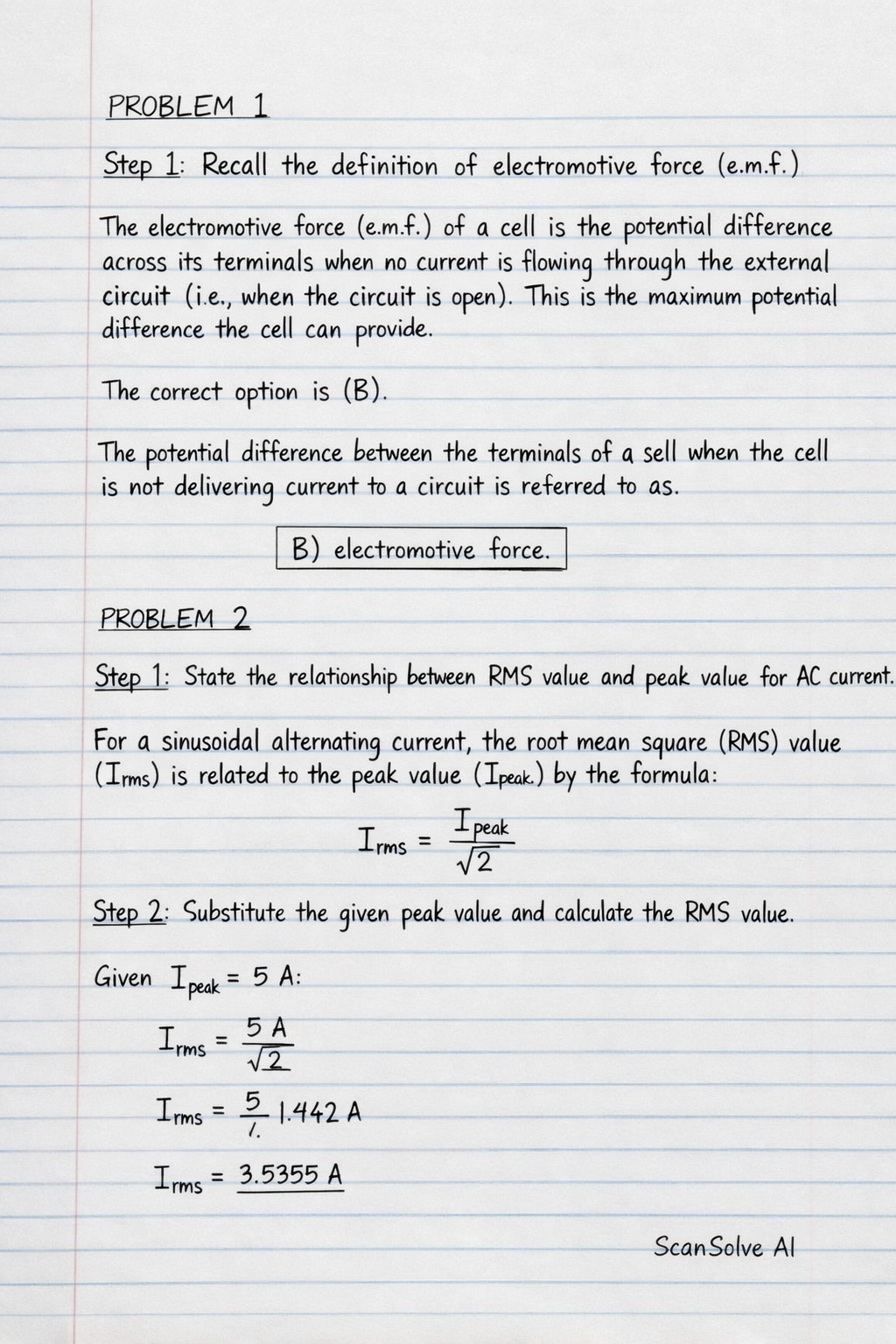
Handwritten Step-by-Step Solution
Get this as a handwritten image on WhatsApp — like a tutor wrote it for you.
Try on WhatsApp