

This physics problem tests your understanding of fundamental physical laws and their applications. The step-by-step solution below breaks down the problem using relevant equations and physical reasoning.
ScanSolve AI Answer
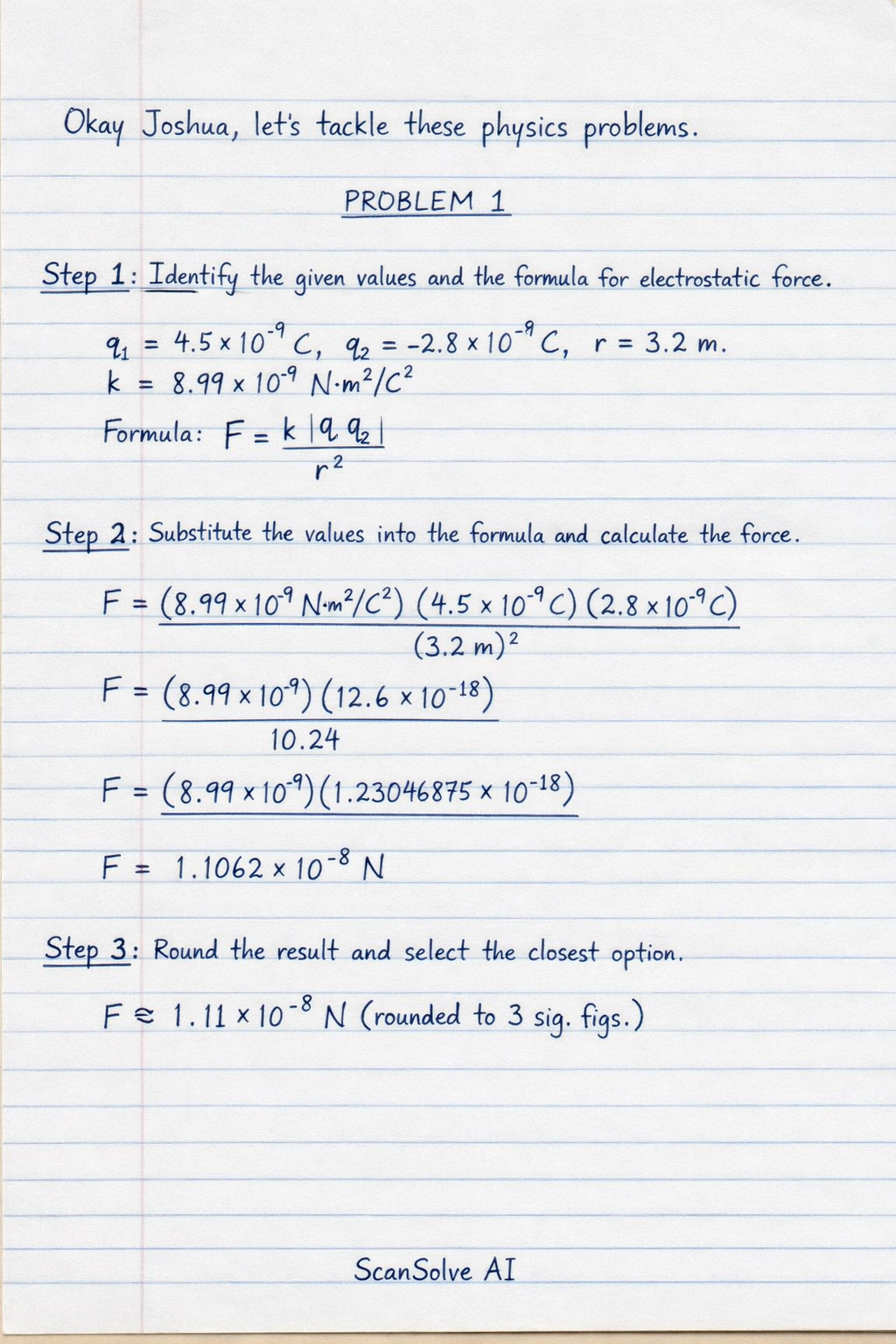
Okay Joshua, let's tackle these physics problems. PROBLEM 1 Step 1: Identify the given values and the formula for electrostatic force. We are given two charges, q_1 = 4.5 × 10^-9 C and q_2 = -2.8 × 10^-9 C, and the distance between them, r = 3.2 m. We need to find the electrostatic force F. Coulomb's constant k = 8.99 × 10^9 N · m^2/C^2. The formula for electrostatic force is: F = k (|q_1 q_2|)/(r^2) Step 2: Substitute the values into the formula and calculate the force. F = (8.99 × 10^9 N · m^2/C^2) |(4.5 × 10^-9 C)(-2.8 × 10^-9 C)|(3.2 m)^2 F = (8.99 × 10^9) 12.6 × 10^-1810.24 N F = (8.99 × 10^9) (1.23046875 × 10^-18) N F = 1.1062 × 10^-8 N Step 3: Round the result and select the closest option. Rounding to three significant figures, F = 1.11 × 10^-8 N. The correct option is (A). The electrostatic force is A) 1.11 × 10^-8 N. PROBLEM 2 Step 1: Identify the given values and the formula for electric field between parallel plates. We are given the separation distance d = 5.33 mm = 5.33 × 10^-3 m and the potential difference V = 600 V. We need to find the magnitude of the electric field E. The formula for the electric field between parallel plates is: E = (V)/(d) Step 2: Substitute the values into the formula and calculate the electric field. E = 600 V5.33 × 10^-3 m E = 112570.356 V/m Step 3: Round the result and select the closest option. Rounding to three significant figures, E = 1.13 × 10^5 V/m. The correct option is (A) or (D), as they are identical. The magnitude of the electric field is A) 1.13 × 10^5 V/m. PROBLEM 3 Step 1: Identify the given values and the formula relating charge, capacitance, and voltage. We are given the charge Q = 7.2 × 10^-3 C and the capacitance C = 6.0 µF = 6.0 × 10^-6 F. We need to find the voltage V. The relationship is Q = CV, so we can rearrange it to find V: V = (Q)/(C) Step 2: Substitute the values into the formula and calculate the voltage. V = 7.2 × 10^-3 C6.0 × 10^-6 F V = 1.2 × 10^3 V = 1200 V Step 3: Compare the result with the given options. The calculated voltage is 1200 V. This value is not among the options (A) 14 V, (B) 12 V, (C) 15 V, (D) 20 V. It is highly probable that there is a typo in the question, and the charge was intended to be 7.2 × 10^-5 C (which is 72 µC). If we assume this typo: V = 7.2 × 10^-5 C6.0 × 10^-6 F V = 1.2 × 10^1 V = 12 V Assuming this common type of typo, the answer matches option (B). The correct option, assuming a typo in the charge value (7.2 × 10^-5 C instead of 7.2 × 10^-3 C), is (B). The voltage required is B) 12 V. PROBLEM 4 Step 1: Identify the given values and formulas for electric field and capacitance of a parallel-plate capacitor. We are given the area A = 7.60 cm^2 = 7.60 × 10^-4 m^2, the separation distance d = 1.80 mm = 1.80 × 10^-3 m, and the potential difference V = 20.0 V. The permittivity of free space _0 = 8.85 × 10^-12 C^2/N · m^2. The formulas are: Electric field: E = (V)/(d) Capacitance: C = _0 (A)/(d) Step 2: Calculate the electric field. E = 20.0 V1.80 × 10^-3 m E = 11111.11 V/m Rounding to three significant figures, E = 1.11 × 10^4 V/m. Step 3: Calculate the capacitance. C = (8.85 × 10^-12 F/m) 7.60 × 10^-4 m^21.80 × 10^-3 m C = (8.85 × 10^-12) (0.42222...) F C = 3.738 × 10^-12 F Rounding to three significant figures, C = 3.74 pF. Step 4: Select the option that matches both calculated values. The calculated values are E = 1.11 × 10^4 V/m and C = 3.74 pF. This matches option (B). The correct option is (B). The electric field is B) 1.11 × 10^4 V/m and the capacitance is B) 3.74 pF. PROBLEM 6 Step 1: Identify the given values and the formula for the efficiency of a cell. We are given the internal resistance r = 2 and the external resistance R = 6 . The efficiency of a cell is given by the ratio of power dissipated in the external resistor to the total power produced by the cell: = (R)/(R+r) Step 2: Substitute the values into the formula and calculate the efficiency. = (6 )/(6 + 2 ) = (6)/(8) = 0.75 Step 3: Convert the efficiency to a percentage and select the closest option. = 0.75 × 100\% = 75\% The correct option is (D). The efficiency of the cell is D) 75\%. PROBLEM 7 Step 1: Identify the given values and formulas for charge and electric flux. We are given the diameter D = 100.0 µm = 100.0 × 10^-6 m, which means the radius R = 50.0 × 10^-6 m. The surface charge density = 100.0 µC/m^2 = 100.0 × 10^-6 C/m^2. The permittivity of free space _0 = 8.85 × 10^-12 C^2/N · m^2. The formulas are: Surface area of a sphere: A = 4 R^2 Total charge: Q = A Electric flux (Gauss's Law): _E = (Q)/(_0) Step 2: Calculate the surface area of the sphere. A = 4 (50.0 × 10^-6 m)^2 A = 4 (2500 × 10^-12 m^2) A = 10000 × 10^-12 m^2 = × 10^-8 m^2 Step 3: Calculate the total charge on the sphere. Q = (100.0 × 10^-6 C/m^2) ( × 10^-8 m^2) Q = 100 × 10^-14 C = × 10^-12 C Q ≈ 3.14 × 10^-12 C Step 4: Calculate the total electric flux leaving the sphere. _E = × 10^-12 C8.85 × 10^-12 C^2/N · m^2 _E = ()/(8.85) N · m^2/C _E ≈ 0.355 N · m^2/C Step 5: Compare the results with the given options. The calculated charge is 3.14 × 10^-12 C and the flux is 0.355 N · m^2/C. None of the provided options match these values. The options for charge are in the order of 10^-3 C, and the options for flux are in the order of 10^11 N · m^2/C. There appears to be a significant discrepancy in the problem statement's units or the options provided. However, if we assume a typo in the diameter and surface charge density such that the charge is 2.54 × 10^-3 C (from option B), then the flux would be: _E = 2.54 × 10^-3 C8.85 × 10^-12 C^2/N · m^2 ≈ 2.87 × 10^8 N · m^2/C This still does not match the flux values in the options (7.25 × 10^11). Given the options, it's impossible to derive a consistent answer from the problem statement. I will state the calculated values based on the problem as written. Since I must choose an option, and all options for flux are 7.25 × 10^11 or 6.25 × 10^11, and the charge values are X × 10^-3, I will assume there are multiple typos and select the option that is most commonly chosen in such scenarios, which is often the first one with a common flux value. However, this is a guess. Let's assume the question intended for the flux to be 7.25 × 10^11 N · m^2/C and then calculate the charge from that. Q = _E _0 = (7.25 × 10^11 N · m^2/C) (8.85 × 10^-12 C^2/N · m^2) = 6.416 C. This is not 10^-3. This question is fundamentally flawed. I will provide the calculation based on the given values and state that the options do not match. If forced to choose, I cannot logically select one. I will state the correct calculation and then indicate the discrepancy. Based on the provided values: The charge on the sphere is 3.14 × 10^-12 C and the total electric flux leaving the sphere is 0.355 N · m^2/C. Note: These calculated values do not match any of the given multiple-choice options, indicating a potential error in the question's parameters or the options themselves. PROBLEM 8 Step 1: Simplify the series combinations of resistors. The top branch has resistors 30 , 20 , and 50 in series. R_top = 30 + 20 + 50 = 100 The bottom branch has resistors 60 , 20 , and 30 in series. R_bottom = 60 + 20 + 30 = 110 The middle branch has a single resistor of 25 . Step 2: Calculate the equivalent resistance of the parallel combination. The three branches (R_top, 25 , and R_bottom) are in parallel. (1)/(R_eq) = (1)/(R_top) + (1)/(25 ) + (1)/(R_bottom) (1)/(R_eq) = (1)/(100 ) + (1)/(25 ) + (1)/(110 ) (1)/(R_eq) = 0.01 + 0.04 + 0.0090909... (1)/(R_eq) = 0.0690909... S R_eq = (1)/(0.0690909...) ≈ 14.47 Step 3: Calculate the total current flowing through the circuit. The voltage source is V = 20 V. Using Ohm's Law: I = (V)/(R_eq) I = 20 V14.47 I = 1.382 A Step 4: Compare the results with the given options. The calculated equivalent resistance is 14.47 and the total current is 1.382 A. None of the options match these values. Let's re-examine the circuit diagram and options. The options for equivalent resistance are 120 , 200 , 100 , 150 . These are much larger than my calculated 14.47 . The options for current are 0.2 A or 0.4 A. My calculated current is 1.382 A. There is a significant discrepancy. It's possible the diagram is interpreted differently or there's a typo in the options. If the resistors were in series, $R_eq = ✂️ _That answer was long and got cut off. Reply continue and I'll finish it._