

This physics problem tests your understanding of fundamental physical laws and their applications. The step-by-step solution below breaks down the problem using relevant equations and physical reasoning.
ScanSolve AI Answer
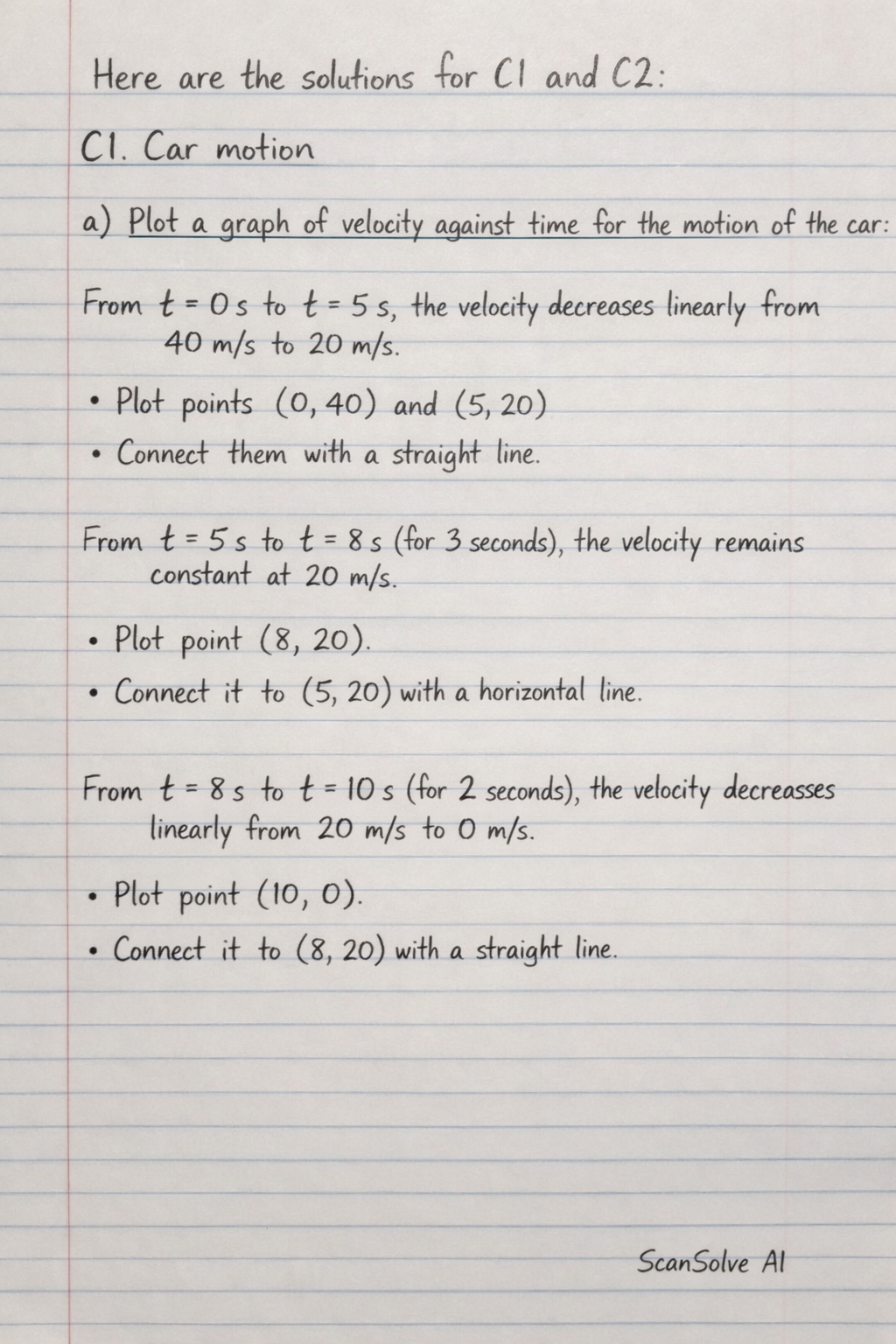
Here are the solutions for C1 and C2: C1. Car motion a) Plot a graph of velocity against time for the motion of the car on the grid provided on page 15. Since no grid is provided, here are the points to plot: • From t=0 s to t=5 s, the velocity decreases linearly from 40 \, m/s to 20 \, m/s. Plot points (0, 40) and (5, 20) and connect them with a straight line. • From t=5 s to t=8 s (for 3 seconds), the velocity remains constant at 20 \, m/s. Plot point (8, 20) and connect it to (5, 20) with a straight horizontal line. • From t=8 s to t=10 s (for 2 seconds), the velocity decreases linearly from 20 \, m/s to 0 \, m/s. Plot point (10, 0) and connect it to (8, 20) with a straight line. b) Calculate: (i) The retardation in the first 5 seconds. Step 1: Identify the initial velocity (u), final velocity (v), and time (t). u = 40 \, m/s v = 20 \, m/s t = 5 \, s Step 2: Calculate the acceleration (a). Retardation is the magnitude of this negative acceleration. a = (v - u)/(t) = 20 \, m/s - 40 \, m/s5 \, s a = -20 \, m/s5 \, s = -4 \, m/s^2 The retardation is 4 m/s^2. (ii) Total distance covered by the car. Step 1: Calculate the distance covered in each phase. • Phase 1 (0-5 s, trapezium): s_1 = (1)/(2)(u+v)t_1 = (1)/(2)(40 \, m/s + 20 \, m/s)(5 \, s) = 150 \, m • Phase 2 (5-8 s, rectangle): s_2 = v × t_2 = 20 \, m/s × 3 \, s = 60 \, m • Phase 3 (8-10 s, triangle): s_3 = (1)/(2) × base × height = (1)/(2) × (10-8) \, s × 20 \, m/s = 20 \, m Step 2: Sum the distances to find the total distance. Total distance = s_1 + s_2 + s_3 = 150 \, m + 60 \, m + 20 \, m Total distance = 230 m (iii) The average speed of the car. Step 1: Identify the total distance and total time. Total distance = 230 \, m Total time = 5 \, s + 3 \, s + 2 \, s = 10 \, s Step 2: Calculate the average speed. Average speed = Total distanceTotal time = 230 \, m10 \, s Average speed = 23 m/s C2. Ohm's Law and Energy a) State Ohm's law. Ohm's law states that the current flowing through a conductor between two points is directly proportional to the voltage across the two points, provided the temperature and other physical conditions remain constant. b) Plot the graph of Voltage (V) against Current (A) using the values given in Table C2.1on the grid provided on page 16. Since no grid is provided, here are the points to plot: • Plot the points (Current, Voltage) from Table C2.1: (1.0 A, 2.0 V), (1.5 A, 3.0 V), (2.0 A, 4.0 V), (3.0 A, 6.0 V), and (4.0 A, 8.0 V). • Draw a straight line of best fit through these points, which should pass through the origin. c) Use the graph to determine the resistance of the filament of the torch. Step 1: Resistance (R) is the gradient of the V-I graph. Using two points from the table, for example, (1.0 A, 2.0 V) and (4.0 A, 8.0 V): R = ( V)/( I) = (V_2 - V_1)/(I_2 - I_1) R = 8.0 \, V - 2.0 \, V4.0 \, A - 1.0 \, A R = 6.0 \, V3.0 \, A R = 2.0 d) Calculate the energy dissipated by the torch, if it operates for 45 minutes when the voltage is 5V and the current of 0.25A. Step 1: Convert time to seconds. t = 45 \, minutes × 60 \, s/minute = 2700 \, s Step 2: Calculate the power (P). P = V × I = 5 \, V × 0.25 \, A = 1.25 \, W Step 3: Calculate the energy dissipated (E). E = P × t = 1.25 \, W × 2700 \, s E = 3375 J e) What does it mean in terms of electric energy when the bulb is rated 120W? A bulb rated 120W means that it converts 120 joules of electrical energy into light and heat energy every second when operating at its rated voltage. 3 done, 2 left today. You're making progress.