
We read your photo as:
PROBLEM 1 Object A has a charge of +2 mC, and object B has a charge of +6 mC. Which statement is true?
ScanSolve AI Answer
Answers
2 partsStep-by-step solution
6 stepsStep 1: Understand the relationship between forces.
According to Newton's Third Law, when two objects exert forces on each other, these forces are equal in magnitude and opposite in direction. This applies to electrostatic forces as well. The force exerted by object A on object B () is equal in magnitude and opposite in direction to the force exerted by object B on object A ().
Step 2: Apply Newton's Third Law.
The mathematical representation of this relationship is:
The magnitudes of the charges ( and ) determine the magnitude of the force, but they do not change this fundamental vector relationship.
The correct statement is .
Step 1: State Coulomb's Law for the initial force.
The initial force between two charges and separated by a distance is given by Coulomb's Law:
where is Coulomb's constant.
Step 2: Determine the new force when is tripled.
If is tripled, the new charge is . The new force will be:
Step 3: Compare the new force to the initial force.
We can rewrite by factoring out the constant 3:
Since , we can substitute into the equation for :
The new force will be three times the original force.
The new force will be .
Given values:
Distance
Elementary charge
Mass of electron
Mass of proton
Coulomb's constant
Gravitational constant
Part a· 3 steps
Find the magnitudes of the electric force and the gravitational force, and their ratio.
Calculate the electric force ().
The electric force between the electron () and proton () is given by Coulomb's Law:
Calculate the gravitational force ().
The gravitational force between the electron and proton is given by Newton's Law of Universal Gravitation:
Calculate the ratio of the electric force to the gravitational force ().
The electric force is , the gravitational force is , and their ratio is .
Part b
Compute the acceleration caused by the electric force of the proton on the electron.
Calculate the acceleration of the electron ().
Using Newton's Second Law, , the acceleration of the electron due to the electric force is:
The acceleration caused by the electric force on the electron is .
Given values:
Charge
Charge
Distance
Coulomb's constantDetermine the type of force.
Since both charges are positive (), they will repel each other.
Calculate the magnitude of the force using Coulomb's Law.
The size of the force is and the type of force is .
Try one yourself
A new problem that tests the same skill.
Still stuck on this one?
Ask a follow-up, and the answer starts from this question.
More Physics Questions
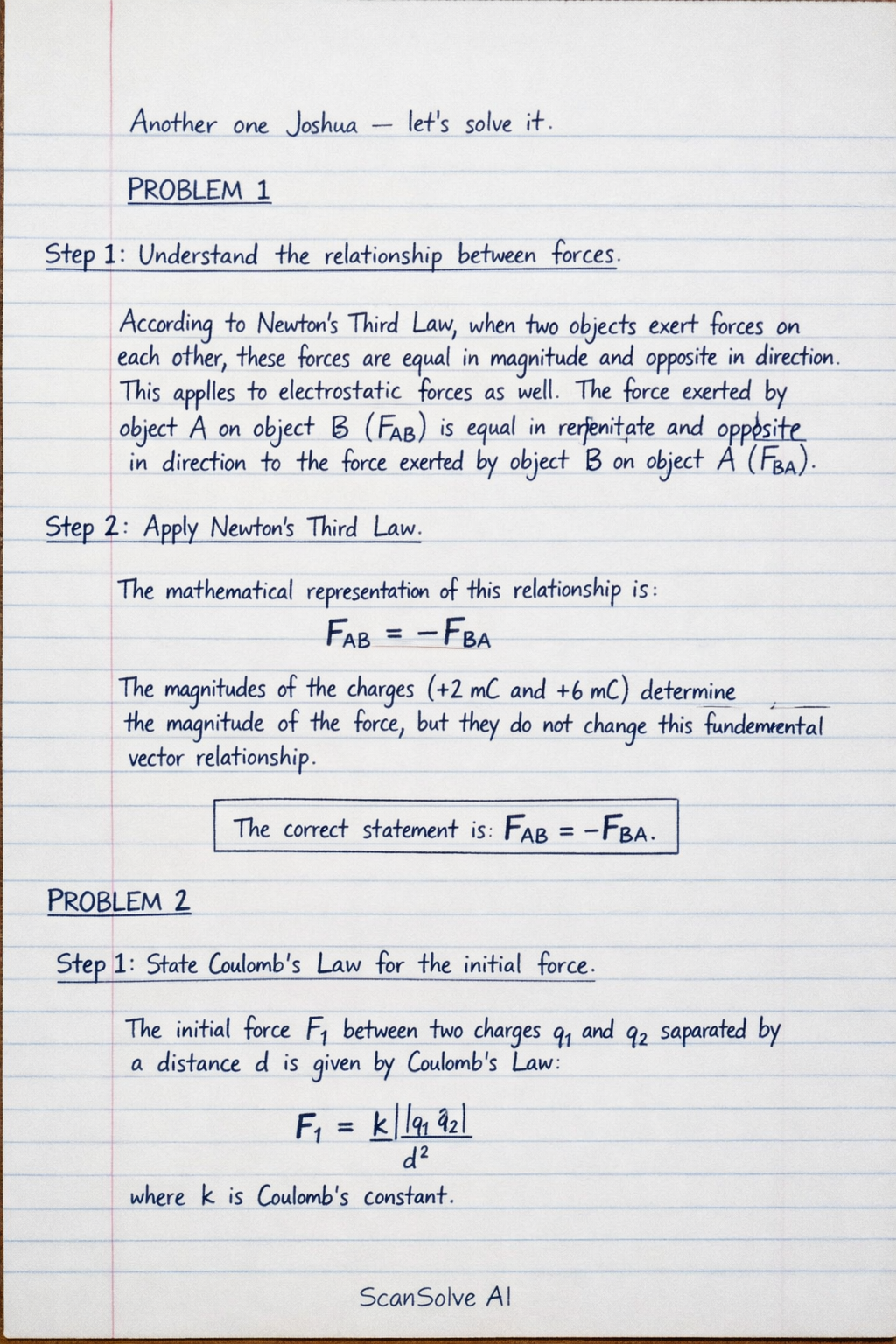
Handwritten Step-by-Step Solution
Get this as a handwritten image on WhatsApp — like a tutor wrote it for you.
Try on WhatsApp