
We read your photo as:
Two small charged spheres, A and B, are placed on insulated stands, 0,2 m apart, as shown in the diagram below. They carry charges of -4 x 10⁻⁶ C and +3 x 10⁻⁶ C respectively.
ScanSolve AI Answer
Step-by-step solution
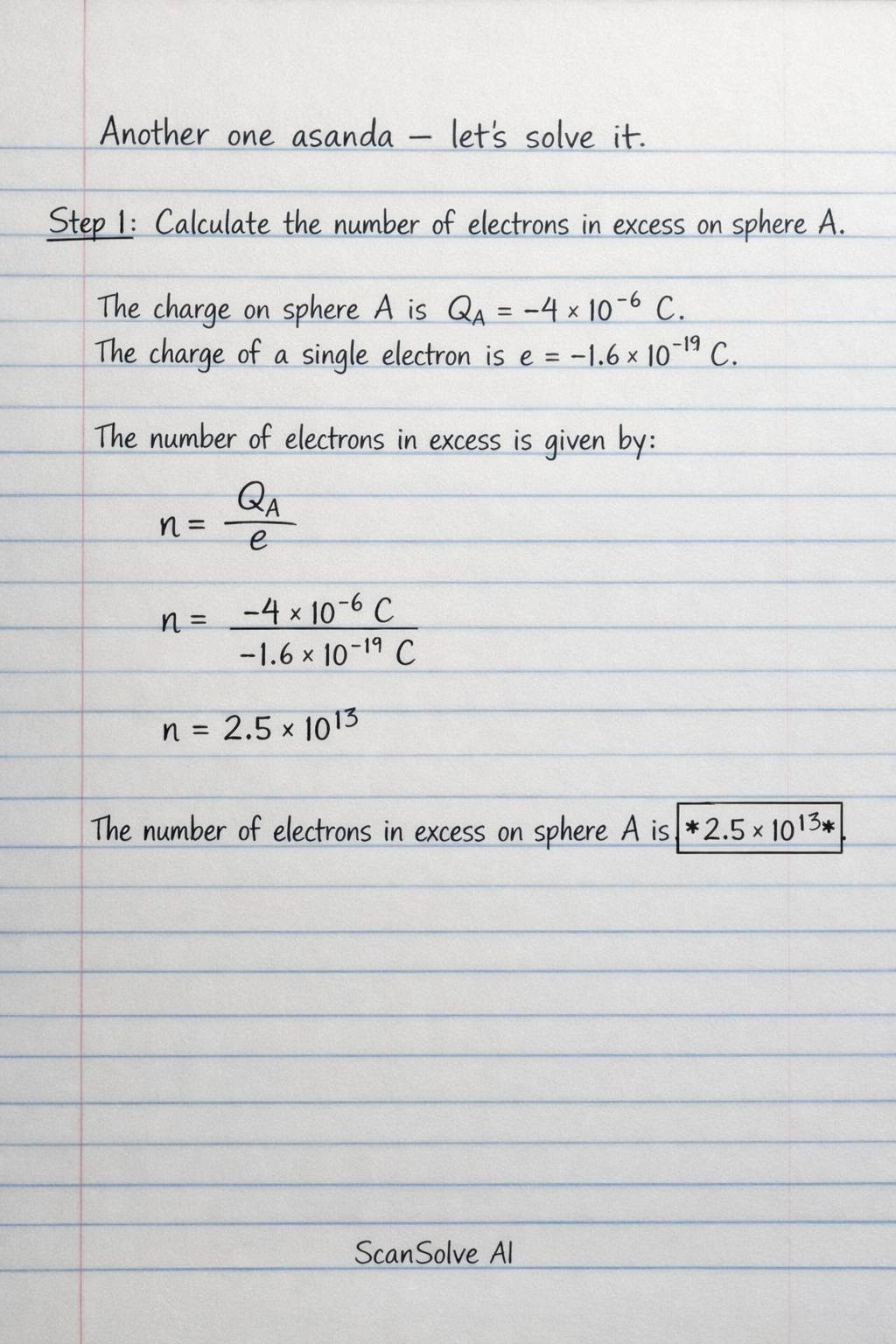
6 stepsCalculate the number of electrons in excess on sphere A.
The charge on sphere A is C. The charge of a single electron is C.
The number of electrons in excess is given by:The number of electrons in excess on sphere A is .
Calculate the magnitude of the electrostatic force exerted by sphere A on sphere B.
The charges are C and C. The distance between them is m. Coulomb's constant is .
The magnitude of the electrostatic force is given by Coulomb's Law:The magnitude of the electrostatic force is .
Describe the term electric field.
An electric field is a region around a charged particle or object within which a force would be exerted on other charged particles or objects. It is defined as the electrostatic force per unit positive charge.
Calculate the magnitude of the net electric field at point M.
Point M is 0.1 m to the right of sphere B.
The distance from A to M is m.
The distance from B to M is m.
The electric field due to sphere A at M () is:Since is negative, points towards A (to the left).
The electric field due to sphere B at M () is:
Since is positive, points away from B (to the right).
The net electric field at M is the vector sum of and . Since they are in opposite directions, we subtract their magnitudes. Let's take right as positive:
The magnitude of the net electric field at point M is .
Determine if the charge on sphere D is POSITIVE or NEGATIVE.
Sphere A has a negative charge ( C). Sphere B has a positive charge ( C).
The force exerted by B on A () is attractive, so it points to the right (positive x-direction).
The net electrostatic force experienced by sphere A is 7.69 N in the direction shown, which has both a positive x-component and a positive y-component.
The force exerted by D on A () acts along the y-axis because D is located vertically above A.
Since the net force on A has an upward (positive y) component, the force must be directed upwards.
For a negative charge A to experience an upward force from D, D must repel A. This means D must also be a negative charge.
Therefore, the charge on sphere D is .Calculate the magnitude of the charge on sphere D.
The x-component of the net force on A is solely due to sphere B, as D is on the y-axis relative to A.
From Step 2, the magnitude of the force is 2.7 N. This is the x-component of the net force on A.The magnitude of the net force on A is N.
We can find the y-component of the net force using the Pythagorean theorem:This y-component of the net force is the force exerted by D on A, .
The distance between A and D is m.
Using Coulomb's Law for :We can rearrange to solve for :
The magnitude of the charge on sphere D is .
Still stuck on this one?
Ask a follow-up, and the answer starts from this question.
More Physics Questions
Handwritten Step-by-Step Solution
Get this as a handwritten image on WhatsApp — like a tutor wrote it for you.
Try on WhatsApp