
We read your photo as:
The diagram below shows a small sphere X with a charge of +1,5 x 10⁻¹⁶ C and two points A and B at different distances from the sphere X. Where electrons REMOVED or ADDED to sphere X in order to acquire a charge of +1,5 x 10⁻¹⁶ C?
ScanSolve AI Answer
Answer
Step-by-step solution
4 stepsPart 4.1
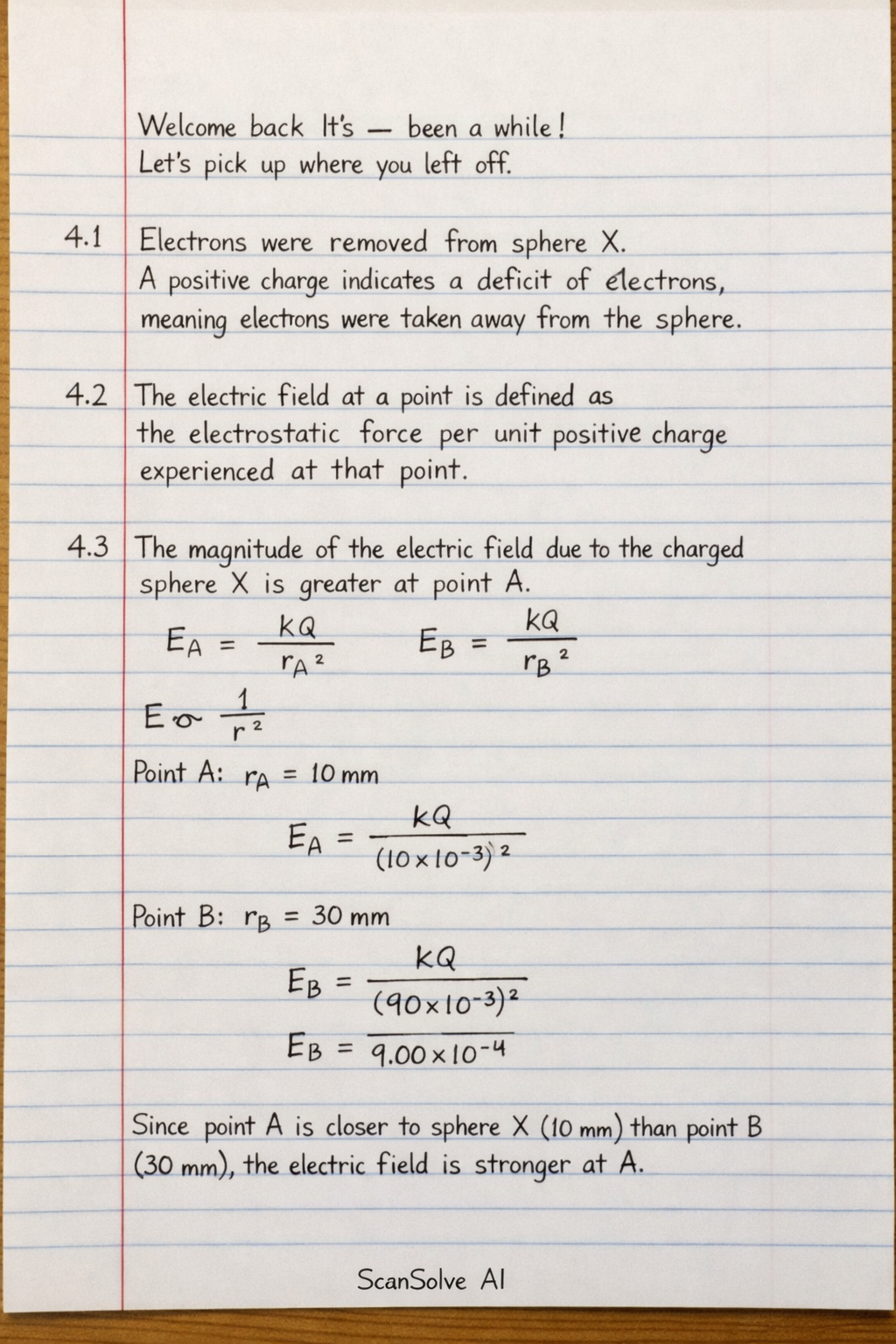
Electrons were removed from sphere X.
A positive charge indicates a deficit of electrons, meaning electrons were taken away from the sphere.
Part 4.2
The electric field at a point is defined as the electrostatic force per unit positive test charge experienced at that point.
Part 4.3
The magnitude of the electric field due to the charged sphere X is greater at point A.
The electric field strength () is inversely proportional to the square of the distance () from the charge (). Since point A is closer to sphere X (10 mm) than point B (30 mm), the electric field is stronger at A.
Part 4.4
Here is a description of the labelled vector diagram:
- Draw sphere X at the center.
- Draw point Z to the left of X, 10 mm away.
- Draw point Y to the right of X, 30 mm away.
- Sphere X has a positive charge ( C).
- Point charge Z has a positive charge ( C). Since X and Z are both positive, they repel. The force exerted by Z on X () will be directed away from Z, which is to the right.
- Point charge Y has a negative charge ( C). Since X is positive and Y is negative, they attract. The force exerted by Y on X () will be directed towards Y, which is to the right.
- Therefore, both force vectors ( and ) originate from X and point to the right.
Part 4.5
Identify the given values and convert units.
Charge of sphere X, C
Charge of point Z, C
Charge of point Y, C
Distance between X and Z,
Distance between X and Y,
Coulomb's constant,Calculate the electrostatic force on X due to Z ().
Since both charges are positive, the force is repulsive, directed to the right.
Calculate the electrostatic force on X due to Y ().
Since X is positive and Y is negative, the force is attractive, directed to the right.
Calculate the net electrostatic force on sphere X.
Since both forces are in the same direction (to the right), we add their magnitudes.
The net electrostatic force on sphere X is .
Try one yourself
A new problem that tests the same skill.
Still stuck on this one?
Ask a follow-up, and the answer starts from this question.
More Physics Questions
Handwritten Step-by-Step Solution
Get this as a handwritten image on WhatsApp — like a tutor wrote it for you.
Try on WhatsApp