We read your photo as:

Electric charge occurs only in separate parcels . A. of ± 1.6 x 10⁻¹⁹ c B. of ± 1 c C. whose value is proportional to the mass of the particle carrying the charge D. that are different from positive and negative particles

Physics

ScanSolve AI Answer

Answer

A

Step-by-step solution

9 steps

Part 10

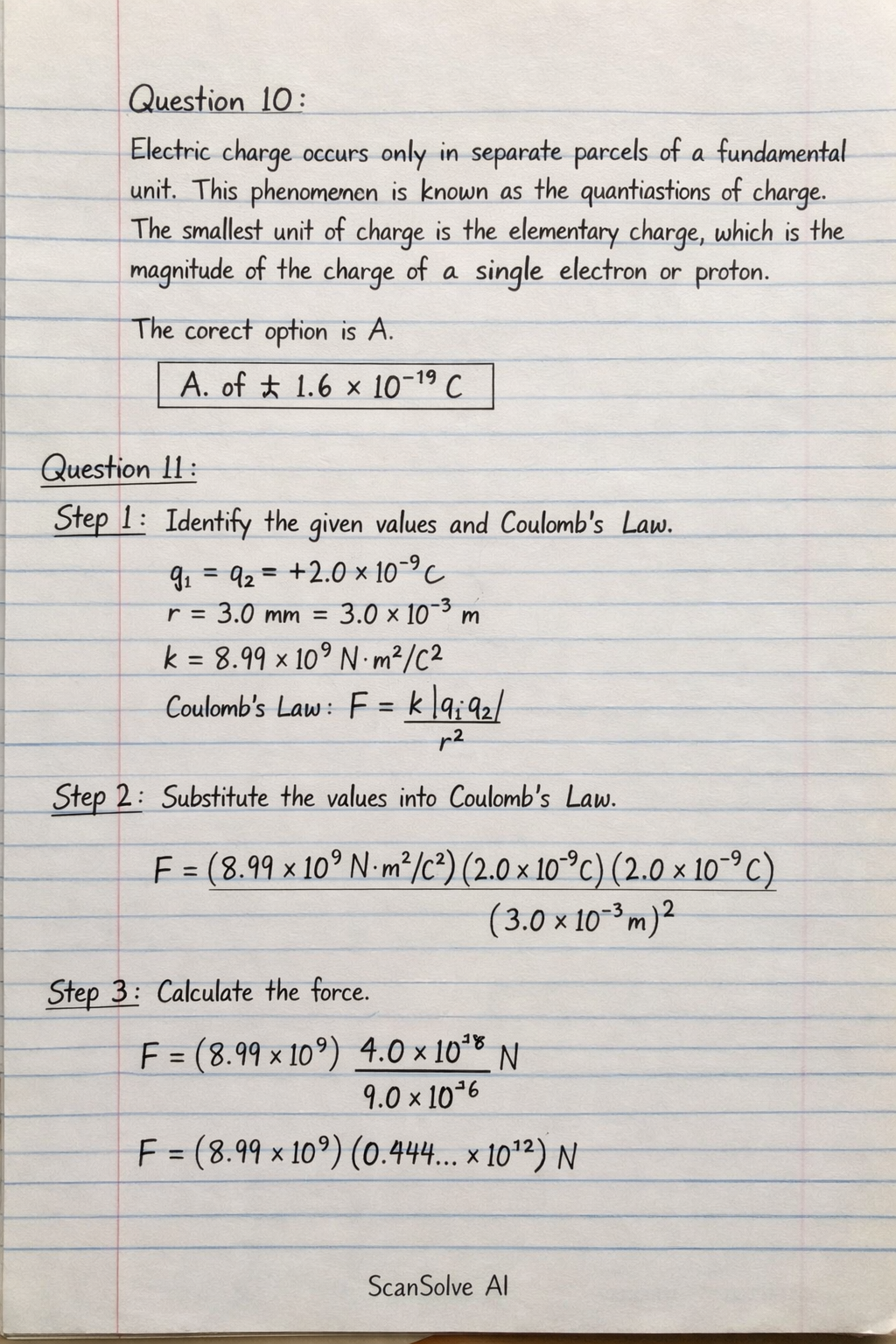
Electric charge occurs only in separate parcels of a fundamental unit. This phenomenon is known as the quantization of charge. The smallest unit of charge is the elementary charge, which is the magnitude of the charge of a single electron or proton.
The correct option is A.

A. of ±1.6×10⁻¹⁹ C\boxed{\text{A. of } \pm 1.6 \times 10^{-19} \text{ C}}

Part 11· 3 steps

  1. Identify the given values and Coulomb's Law.

    We are given two charges q1=q2=+2.0×10⁻⁹ Cq_1 = q_2 = +2.0 \times 10^{-9} \text{ C} and the distance between them r=3.0 mm=3.0×10⁻³ mr = 3.0 \text{ mm} = 3.0 \times 10^{-3} \text{ m}. Coulomb's constant is k=8.99×10⁹ N⋅m2/C2k = 8.99 \times 10^9 \text{ N}\cdot\text{m}^2/\text{C}^2.
    Coulomb's Law states F=k∣q1q2∣r2F = k \frac{|q_1 q_2|}{r^2}.

  2. Substitute the values into Coulomb's Law.

    F=(8.99×10⁹ N⋅m2/C2)(2.0×10−9 C)(2.0×10⁻⁹ C)(3.0×10⁻³ m)2F = (8.99 \times 10^9 \text{ N}\cdot\text{m}^2/\text{C}^2) \frac{(2.0 \times 10^{-9} \text{ C})(2.0 \times 10^{-9} \text{ C})}{(3.0 \times 10^{-3} \text{ m})^2}
  3. Calculate the force.

    F=(8.99×10⁹)4.0×10−189.0×10⁻⁶ NF = (8.99 \times 10^9) \frac{4.0 \times 10^{-18}}{9.0 \times 10^{-6}} \text{ N} F=(8.99×10⁹)(0.444...×10−12) NF = (8.99 \times 10^9) (0.444... \times 10^{-12}) \text{ N} F≈4.0×10⁻³ NF \approx 4.0 \times 10^{-3} \text{ N}

    The correct option is B.

    B. 4×10⁻³ N\boxed{\text{B. } 4 \times 10^{-3} \text{ N}}

Part 12· 3 steps

  1. Identify the given values and relevant formulas.

    We are given the electric force F=1.0×10⁻⁵ NF = 1.0 \times 10^{-5} \text{ N}, the charge q=5.0×10⁻¹⁰ Cq = 5.0 \times 10^{-10} \text{ C}, and the distance between the plates d=4.0 mm=4.0×10⁻³ md = 4.0 \text{ mm} = 4.0 \times 10^{-3} \text{ m}.
    The electric field EE is given by E=FqE = \frac{F}{q}.
    For parallel plates, the potential difference VV is given by V=EdV = Ed.

  2. Calculate the electric field EE.

    E=1.0×10⁻⁵ N5.0×10−10 CE = \frac{1.0 \times 10^{-5} \text{ N}}{5.0 \times 10^{-10} \text{ C}} E=2.0×10⁴ N/CE = 2.0 \times 10^4 \text{ N/C}
  3. Calculate the potential difference VV.

    V=(2.0×10⁴ N/C)×(4.0×10−3 m)V = (2.0 \times 10^4 \text{ N/C}) \times (4.0 \times 10^{-3} \text{ m}) V=80 VV = 80 \text{ V}

    The correct option is C.

    C. 80 V\boxed{\text{C. } 80 \text{ V}}

Part 13· 3 steps

  1. Recall the relationship between electric field and distance for a point charge.

    The electric field EE due to a point charge is inversely proportional to the square of the distance rr from the charge, i.e., E∝1r2E \propto \frac{1}{r^2}.

  2. Set up a ratio for the electric fields at two different distances.

    We are given E1=10 kV/mE_1 = 10 \text{ kV/m} at r1=10 mmr_1 = 10 \text{ mm}. We need to find E2E_2 at r2=20 mmr_2 = 20 \text{ mm}.

    E2E1=r12r22\frac{E_2}{E_1} = \frac{r_1^2}{r_2^2}
  3. Substitute the given values and solve for E2E_2.

    E210 kV/m=(10 mm)2(20 mm)2\frac{E_2}{10 \text{ kV/m}} = \frac{(10 \text{ mm})^2}{(20 \text{ mm})^2} E210 kV/m=100 mm2400 mm2\frac{E_2}{10 \text{ kV/m}} = \frac{100 \text{ mm}^2}{400 \text{ mm}^2} E210 kV/m=14\frac{E_2}{10 \text{ kV/m}} = \frac{1}{4} E2=14×10 kV/mE_2 = \frac{1}{4} \times 10 \text{ kV/m} E2=2.5 kV/mE_2 = 2.5 \text{ kV/m}

    The correct option is A.

    A. 2.5 kV/m\boxed{\text{A. } 2.5 \text{ kV/m}}

Part 14

For capacitors connected in parallel, the potential difference (voltage) across each individual capacitor is the same as the total potential difference across the entire parallel combination.
The correct option is C.

C. potential difference across each capacitor\boxed{\text{C. potential difference across each capacitor}}
Was this helpful?

Try one yourself

A new problem that tests the same skill.

Still stuck on this one?

Ask a follow-up, and the answer starts from this question.

Got a different question?Ask your own question
Handwritten step-by-step solution preview

Handwritten Step-by-Step Solution

Get this as a handwritten image on WhatsApp — like a tutor wrote it for you.

Try on WhatsApp