
We read your photo as:
1.2 What is the charge of the electrons? A. Positive B. Negative C. Neutral D. Nucleus
ScanSolve AI Answer
Answer
Step-by-step solution
3 stepsHere are the answers to the questions:
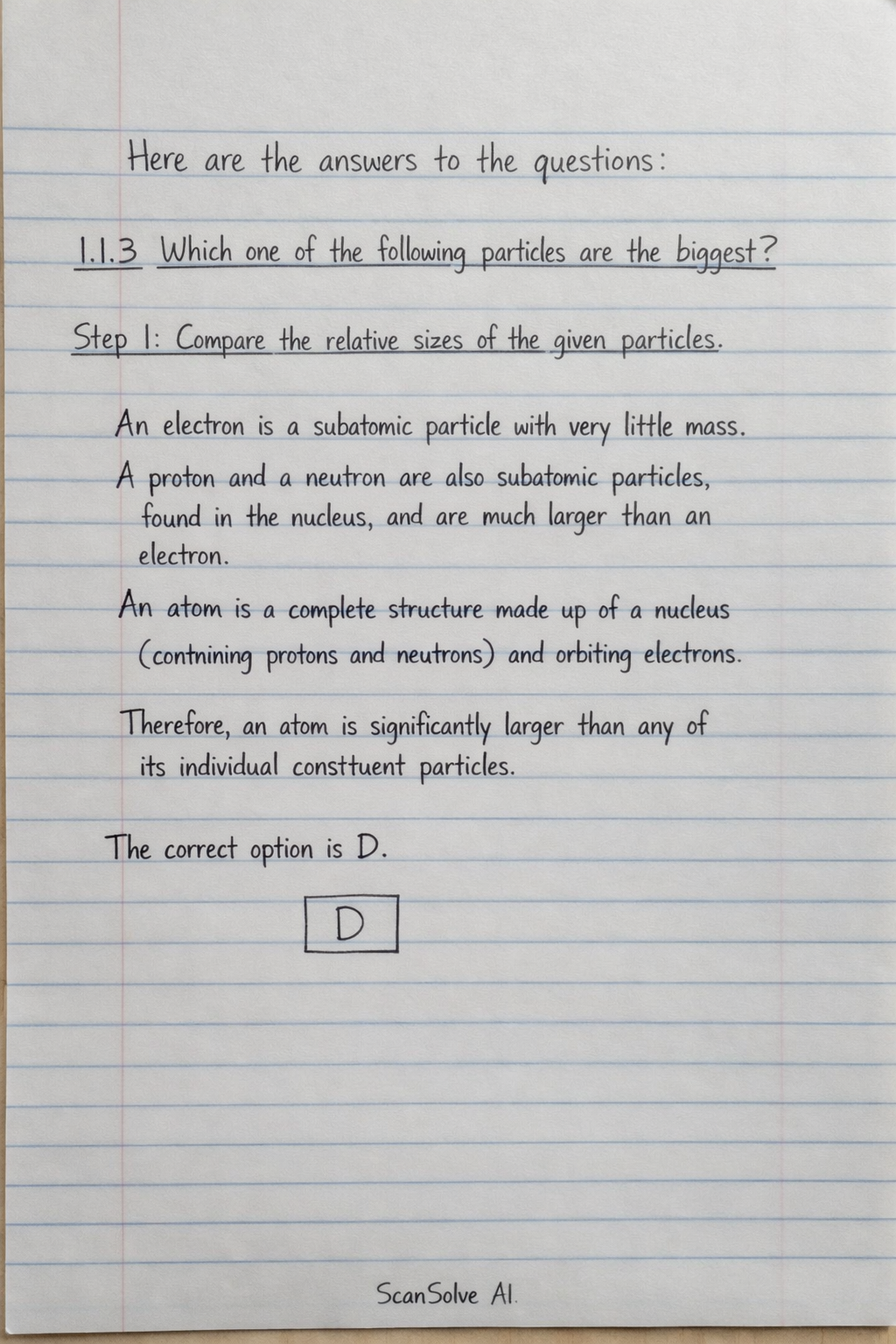
1.1.3 Which one of the following particles are the biggest?
Compare the relative sizes of the given particles.
An electron is a subatomic particle with very little mass. A proton and a neutron are also subatomic particles, found in the nucleus, and are much larger than an electron. An atom is a complete structure made up of a nucleus (containing protons and neutrons) and orbiting electrons. Therefore, an atom is significantly larger than any of its individual constituent particles.
The correct option is D.1.1.4 The following particle is NOT found inside an atom:
Identify which of the visible options are found inside an atom.
A. Proton: Protons are found in the nucleus of an atom.
B. Electron: Electrons orbit the nucleus of an atom.Determine the answer based on the visible options.
Since both protons and electrons are fundamental components found inside an atom, the correct answer must be one of the options C or D, which are not visible in the image. Therefore, a definitive answer cannot be provided without seeing all options.
Try one yourself
A new problem that tests the same skill.
Still stuck on this one?
Ask a follow-up, and the answer starts from this question.
More Physics Questions
Handwritten Step-by-Step Solution
Get this as a handwritten image on WhatsApp — like a tutor wrote it for you.
Try on WhatsApp