
We read your photo as:
1.5 The..... is a particle inside the nucleus that has no charge. A. Protons B. Electrons C. Hydrogen D. Neutrons 1.2 Choose a description from column B that best fits the term Write down the number of the term in column A followed by the description in column B eg 1.2.1 C
ScanSolve AI Answer
Answer
Step-by-step solution
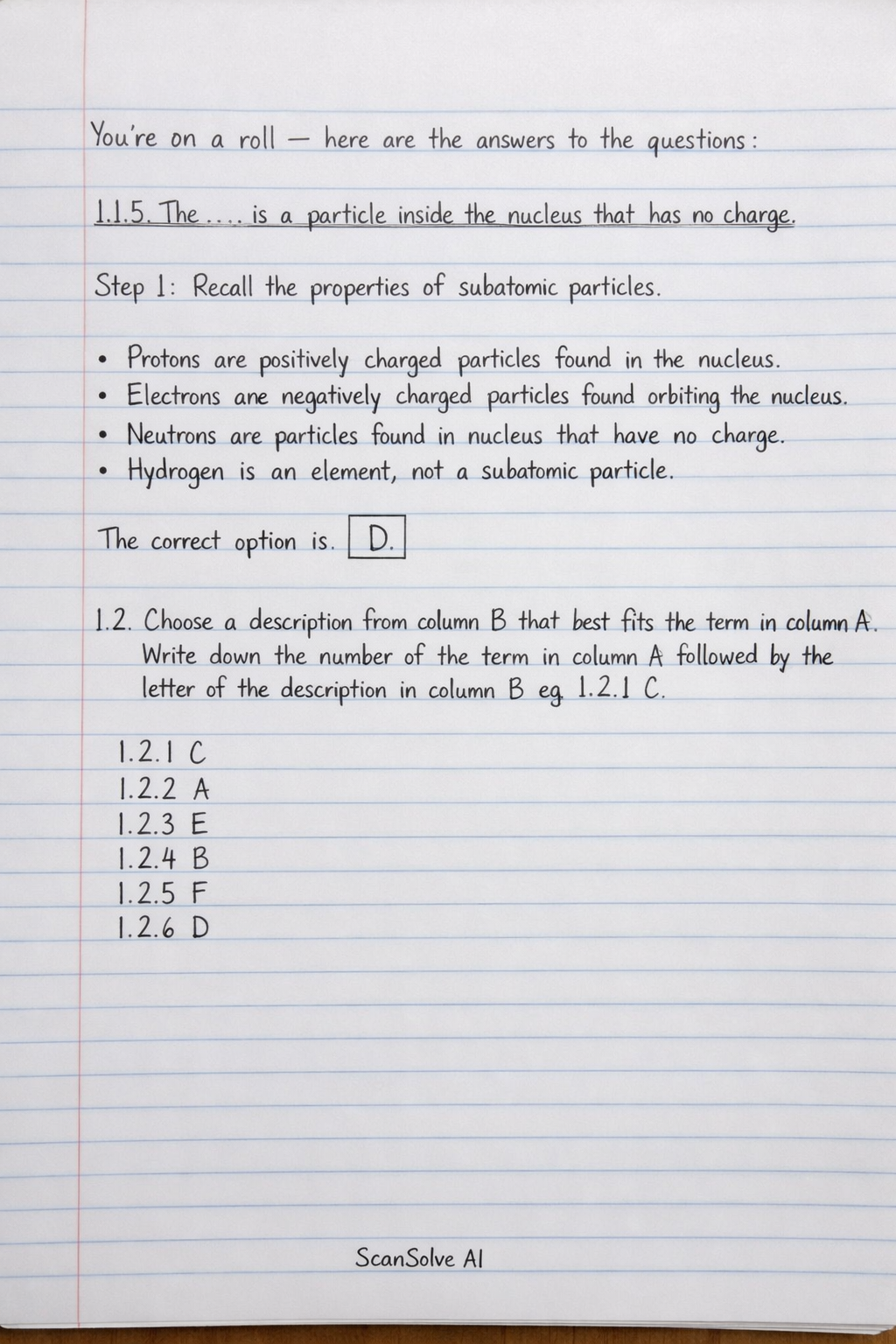
7 stepshere are the answers to the questions:
1.1.5 The..... is a particle inside the nucleus that has no charge.
Recall the properties of subatomic particles.
Protons are positively charged particles found in the nucleus. Electrons are negatively charged particles found orbiting the nucleus. Neutrons are particles found in the nucleus that have no charge. Hydrogen is an element, not a subatomic particle.
The correct option is D.1.2 Choose a description from column B that best fits the term in column A. Write down the number of the term in column A followed by the letter of the description in column B eg 1.2.1 C
1.2.1 Compound
Define a compound.
A compound is a substance formed when two or more different chemical elements are chemically bonded together.
Match with Column B.
From the visible options, "Made up of a..." (Option A) is incomplete, but it likely refers to being made up of different elements. "Table salt" (Option D) is a common example of a compound (NaCl). Without the full text of option A, D is the most fitting complete description. Assuming D is "Table salt" as an example of a compound.
1.2.2 Elements
Define an element.
An element is a pure substance consisting only of atoms that all have the same numbers of protons in their atomic nuclei.
Match with Column B.
The visible options in Column B are "Made up of a..." (A), "Negatively c..." (B), "Particles th..." (C), and "Table salt" (D). None of these fully describe an element based on the visible text. However, if option A refers to "Made up of only one type of atom", it would be correct. Without the full text, a definitive match is difficult.
1.2.3 Electrons
Define electrons.
Electrons are subatomic particles that carry a negative electrical charge and orbit the nucleus of an atom.
Match with Column B.
Option B states "Negatively c...", which strongly suggests "Negatively charged particles". This fits the description of electrons.
Try one yourself
A new problem that tests the same skill.
Still stuck on this one?
Ask a follow-up, and the answer starts from this question.
More Chemistry Questions
Handwritten Step-by-Step Solution
Get this as a handwritten image on WhatsApp — like a tutor wrote it for you.
Try on WhatsApp