
We read your photo as:
The magnitude of the charge on an electron is approximately: A) 1023 ext C B) 10⁻²¹ ext C C) 1019 ext C D) 10⁻¹⁹ ext C
ScanSolve AI Answer
Answer
Step-by-step solution
8 stepsHere are the detailed solutions for the questions:
Part 1· 2 steps
The magnitude of the charge on an electron is approximately
Recall the standard value for the elementary charge.
The magnitude of the charge on a single electron is a fundamental physical constant, known as the elementary charge. Its value is approximately Coulombs (C).
Compare this value with the given options.
We are looking for an approximation, specifically the correct order of magnitude.
- is incorrect.
- is incorrect.
- is incorrect.
- matches the correct order of magnitude.
The final answer is .
Part 2· 4 steps
The total negative charge on the electrons in 1 mol of helium (atomic number 2, molar mass 4) is
Determine the number of electrons per helium atom.
Helium (He) has an atomic number of 2. In a neutral atom, the number of electrons is equal to the atomic number. Therefore, each helium atom has 2 electrons.
Calculate the total number of electrons in 1 mol of helium.
One mole of any substance contains Avogadro's number () of particles.
Since each helium atom has 2 electrons, the total number of electrons in 1 mol of helium is:
Calculate the total negative charge.
The charge of a single electron () is approximately .
The total negative charge is the product of the total number of electrons and the charge of one electron:Compare the calculated value with the given options.
- A)
- B)
- C)
- D)
The calculated value is closest to .
The final answer is .
Part 3· 2 steps
An electrical insulator is a material
Understand the definition of an electrical insulator.
An electrical insulator is a material that resists the flow of electric current. This means that electrons within the material are not free to move easily from atom to atom.
Evaluate each option based on this definition.
- A) containing no electrons: All matter contains electrons. This statement is incorrect.
- B) through which electrons do not flow easily: This accurately describes an electrical insulator. The electrons are tightly bound to their atoms and require a large amount of energy to become mobile.
- C) cannot be a pure chemical element: Many pure chemical elements, such as sulfur or phosphorus, are excellent insulators. Diamond (a form of carbon) is also an insulator. This statement is incorrect.
- D) must be a crystal: Insulators can be amorphous (non-crystalline) solids, such as glass or rubber. This statement is incorrect.
The final answer is .
Try one yourself
A new problem that tests the same skill.
Still stuck on this one?
Ask a follow-up, and the answer starts from this question.
More Physics Questions
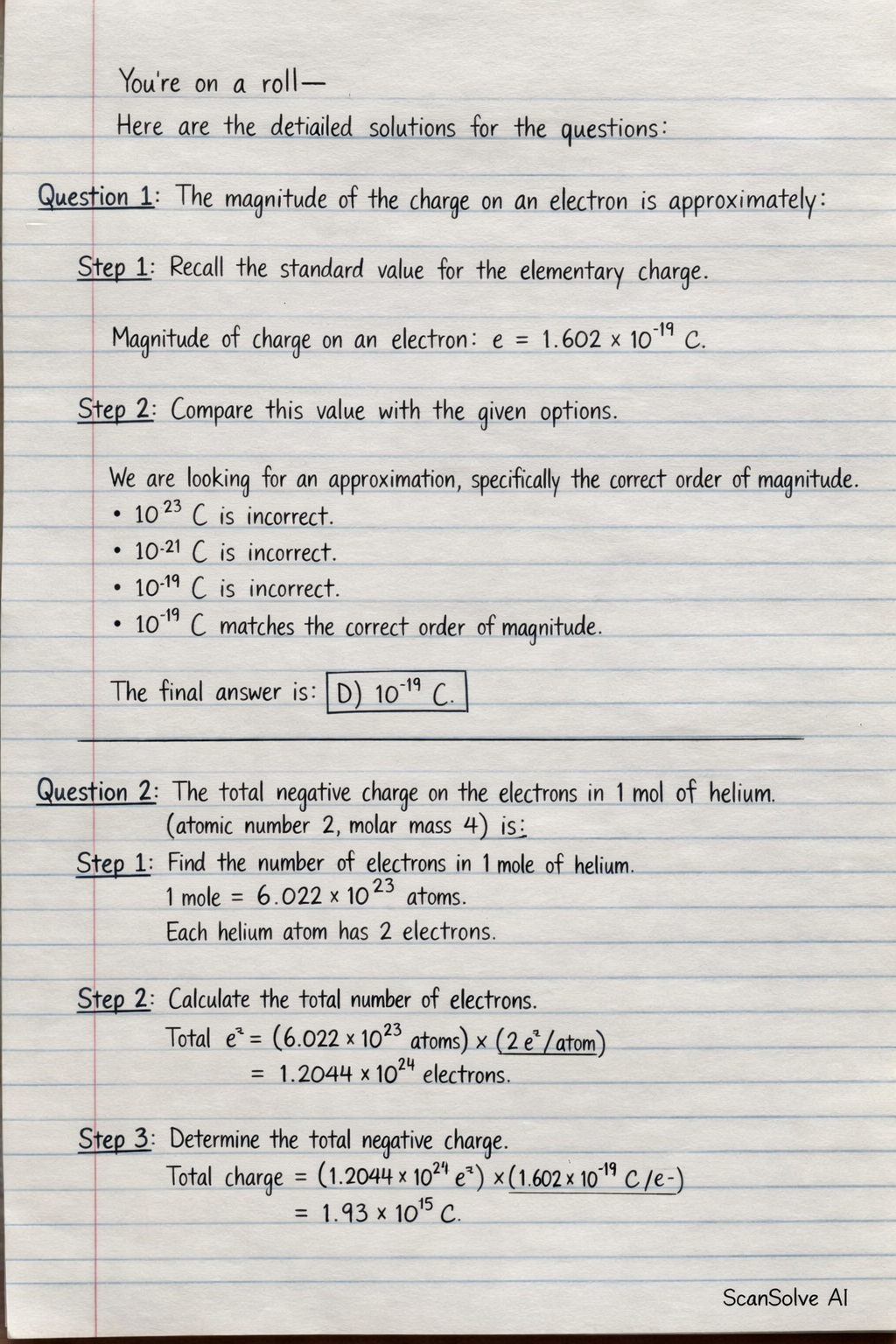
Handwritten Step-by-Step Solution
Get this as a handwritten image on WhatsApp — like a tutor wrote it for you.
Try on WhatsApp