
We read your photo as:
What is the magnitude of the charge of an electron, and which of the following options correctly represents it?
Physics
ScanSolve AI Answer
Answer
Step-by-step solution
2 stepsIdentify the fundamental charge of an electron.
The charge of a single electron is a fundamental constant in physics, known as the elementary charge. Its magnitude is approximately Coulombs (C).
Compare this value with the given options.
- Option A:
- Option B: (The exponent is positive, which is incorrect for an electron's charge magnitude.)
- Option C: (This value is the approximate mass of an electron, not its charge, and the unit is incorrect for mass.)
- Option D: (This value and exponent are incorrect.)
The correct magnitude for the charge on an electron is given by option A.
The final answer is .
Was this helpful?
Try one yourself
A new problem that tests the same skill.
Still stuck on this one?
Ask a follow-up, and the answer starts from this question.
Got a different question?Ask your own question
More Physics Questions
QThe magnitude of the charge on an electron is approximately: A) 1023 ext C B) 10⁻²¹ ext C C) 1019…QMass of the electron is calculated from charge and charge-to-mass ratio values of the electron.QCalculate the magnitude of the electrostatic force between an electron and a proton separated by 1…Q1.2 What is the charge of the electrons? A. Positive B. Negative C. Neutral D. NucleusQElectric charge occurs only in separate parcels . A. of ± 1.6 × 10⁻¹⁹ c B. of ± 1 c C. whose value…
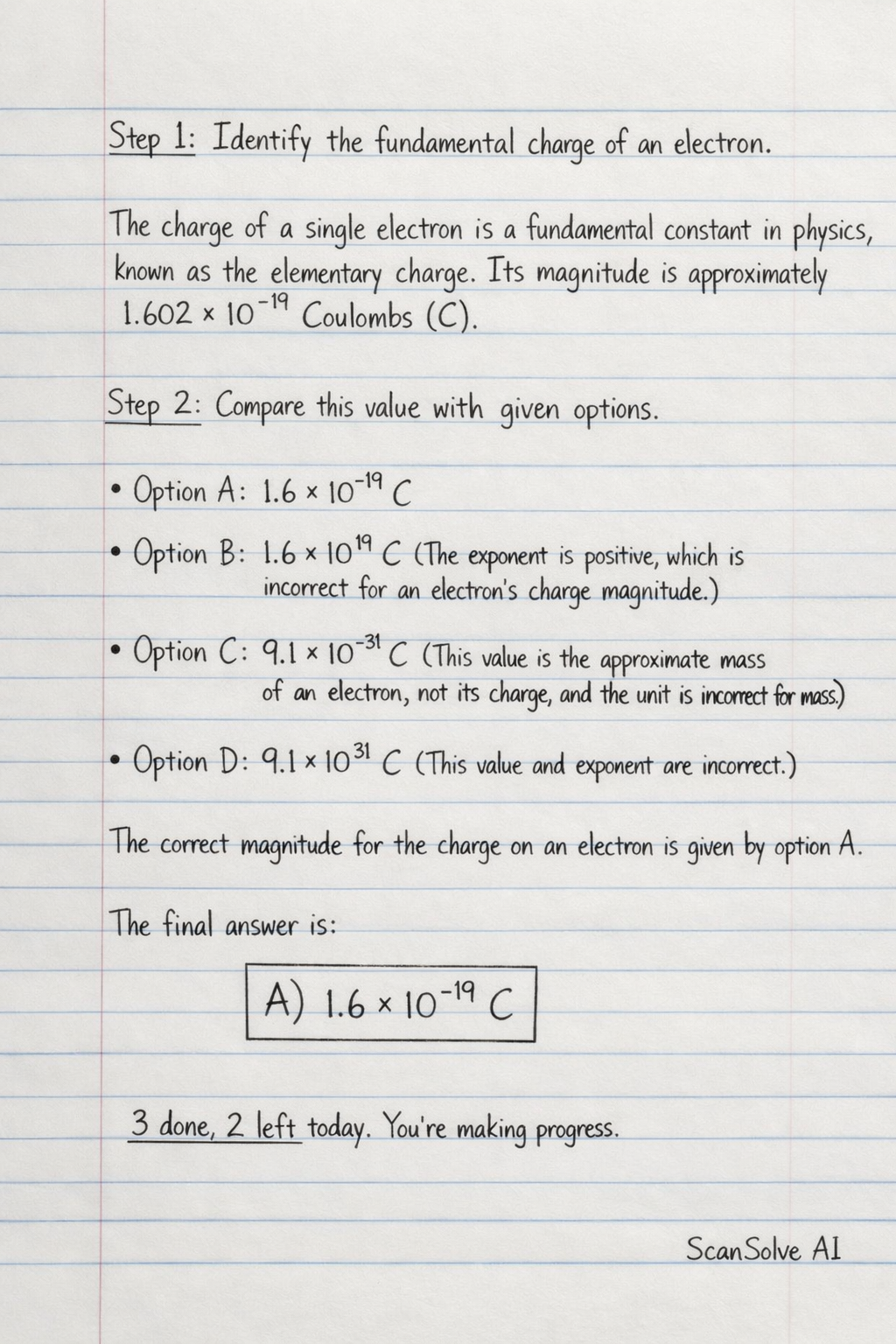
Handwritten Step-by-Step Solution
Get this as a handwritten image on WhatsApp — like a tutor wrote it for you.
Try on WhatsApp