
We read your photo as:
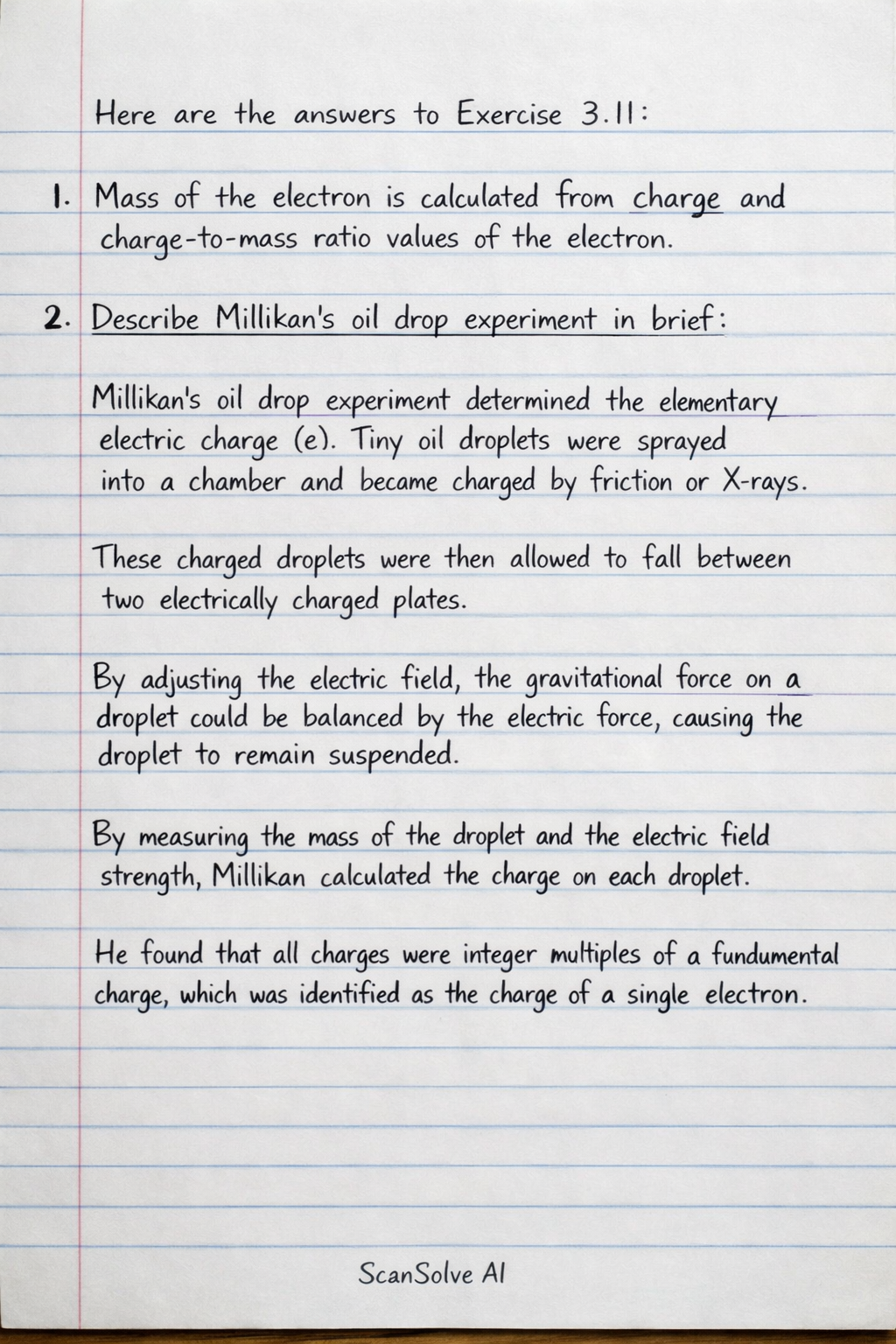
Mass of the electron is calculated from charge and charge-to-mass ratio values of the electron.
ScanSolve AI Answer
Here are the answers to .11:
-
Mass of the electron is calculated from charge and charge-to-mass ratio values of the electron.
-
Describe Millikan's oil drop experiment in brief. Millikan's oil drop experiment determined the elementary electric charge (). Tiny oil droplets were sprayed into a chamber and became charged by friction or X-rays. These charged droplets were then allowed to fall between two electrically charged plates. By adjusting the electric field, the gravitational force on a droplet could be balanced by the electric force, causing the droplet to remain suspended. By measuring the mass of the droplet and the electric field strength, Millikan calculated the charge on each droplet. He found that all charges were integer multiples of a fundamental charge, which was identified as the charge of a single electron.
-
Describe J. J. Thomson's Atomic Model. J. J. Thomson's Atomic Model, also known as the "plum pudding model," proposed that an atom is a sphere of uniform positive charge, with negatively charged electrons embedded within it, similar to plums in a pudding. The total positive charge was equal to the total negative charge, making the atom electrically neutral.
-
According to J. J. Thomson's Atomic Model, the charges in an atom are arranged like the pulp and seeds of a watermelon.
Still stuck on this one?
Ask a follow-up, and the answer starts from this question.
More Physics Questions
Handwritten Step-by-Step Solution
Get this as a handwritten image on WhatsApp — like a tutor wrote it for you.
Try on WhatsApp