
We read your photo as:
Two subatomic particles and their respective electric charges are:
ScanSolve AI Answer
Answers
4 partsa)
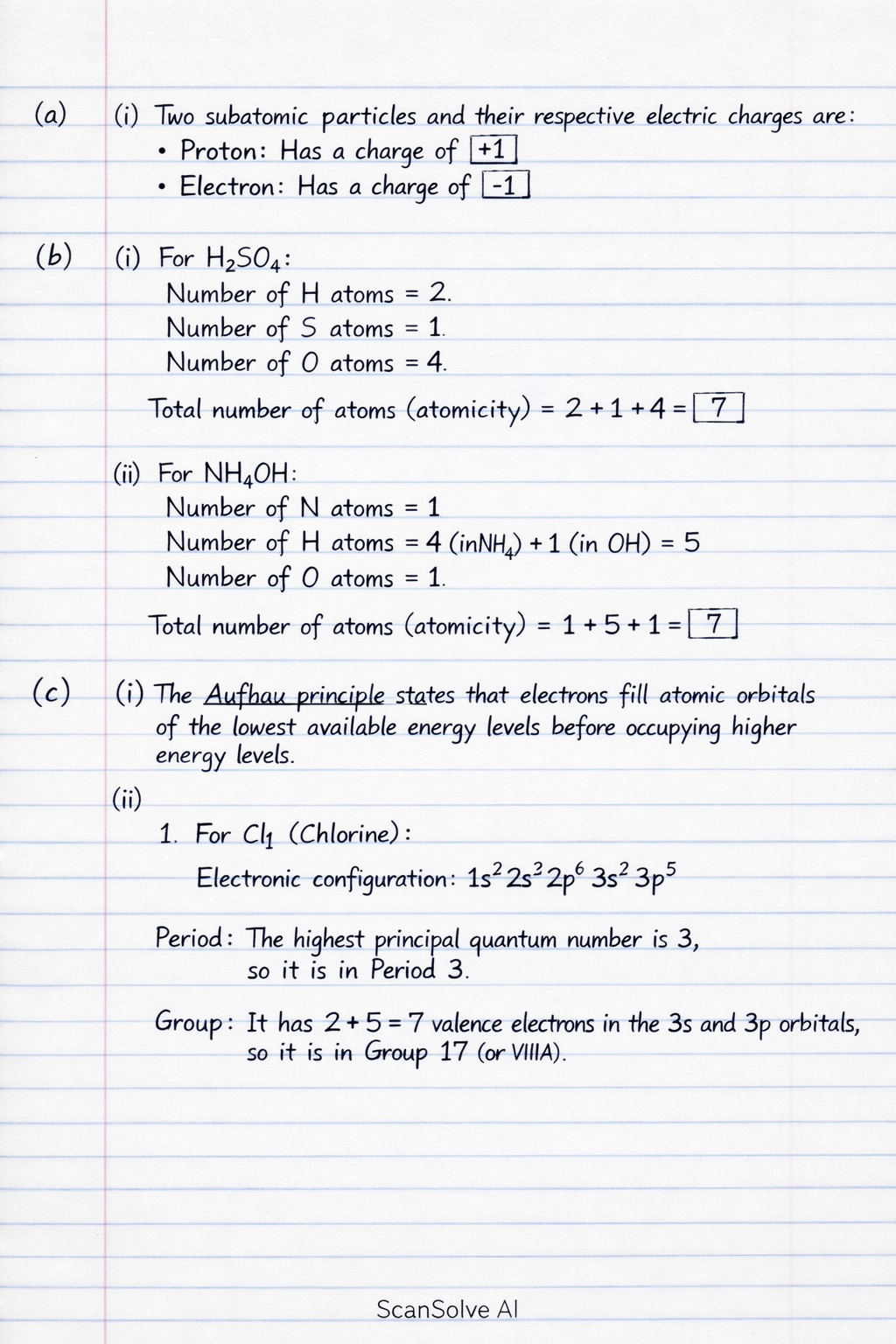
(i) Two subatomic particles and their respective electric charges are:
- Proton: Has a charge of .
- Electron: Has a charge of .
b)
(i) For :
Number of H atoms = 2
Number of S atoms = 1
Number of O atoms = 4
Total number of atoms (atomicity) =
(ii) For :
Number of N atoms = 1
Number of H atoms = 4 (in ) + 1 (in OH) = 5
Number of O atoms = 1
Total number of atoms (atomicity) =
c)
(i) The Aufbau principle states that electrons fill atomic orbitals of the lowest available energy levels before occupying higher energy levels.
(ii)
-
For (Chlorine): Electronic configuration: Period: The highest principal quantum number is 3, so it is in Period 3. Group: It has valence electrons in the and orbitals, so it is in Group 17 (or VIIA).
-
For (Magnesium): Electronic configuration: Period: The highest principal quantum number is 3, so it is in Period 3. Group: It has 2 valence electrons in the orbital, so it is in Group 2 (or IIA).
d)
(i)
This is a combination reaction (or synthesis reaction), where two or more reactants combine to form a single product.
(ii)
This is a decomposition reaction, where a single compound breaks down into two or more simpler substances.
Still stuck on this one?
Ask a follow-up, and the answer starts from this question.
More Physics Questions
Handwritten Step-by-Step Solution
Get this as a handwritten image on WhatsApp — like a tutor wrote it for you.
Try on WhatsApp