

This physics problem tests your understanding of fundamental physical laws and their applications. The step-by-step solution below breaks down the problem using relevant equations and physical reasoning.
ScanSolve AI Answer
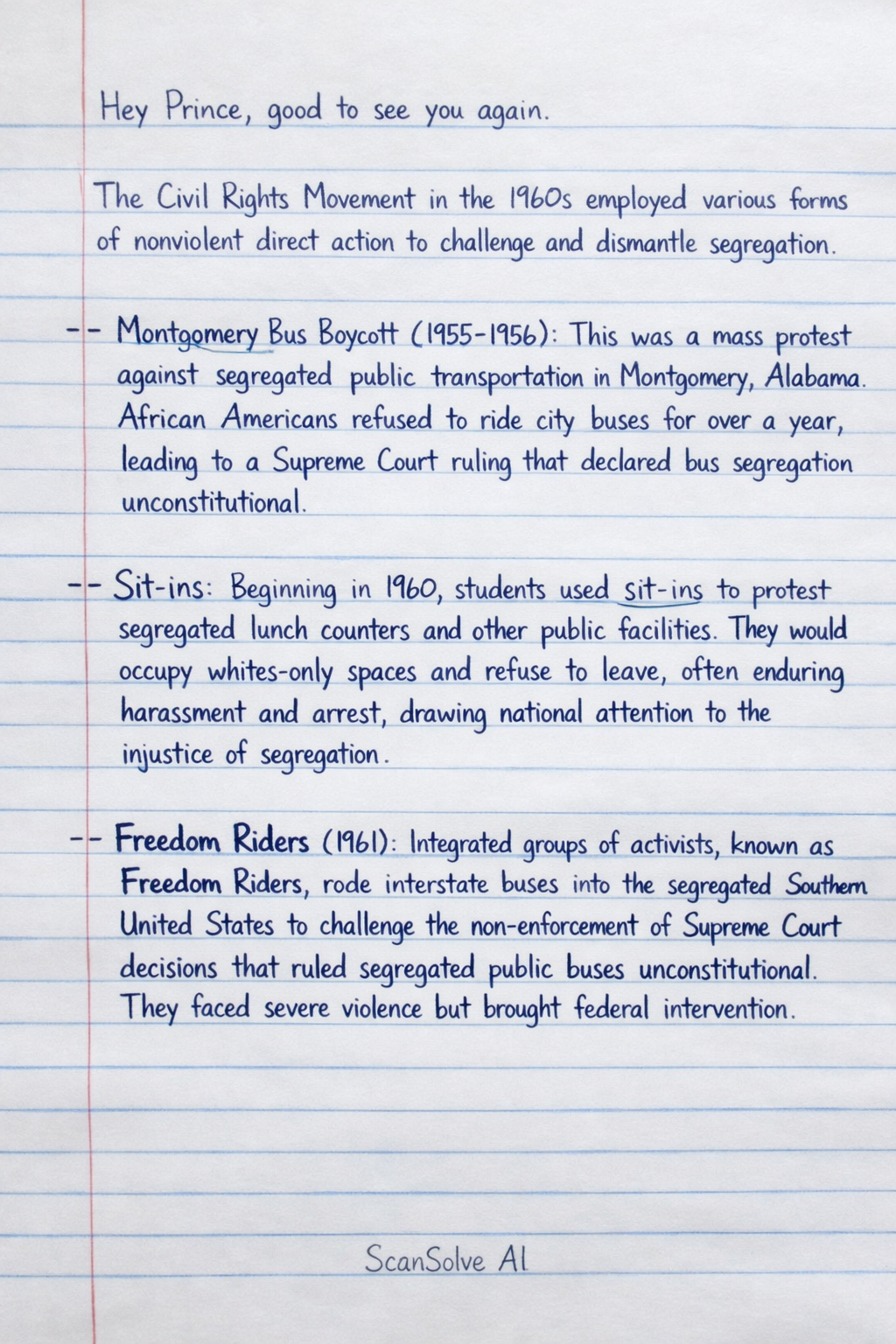
The Civil Rights Movement in the 1960s employed various forms of nonviolent direct action to challenge and dismantle segregation. Montgomery Bus Boycott (1955-1956): This was a mass protest against segregated public transportation in Montgomery, Alabama. African Americans refused to ride city buses for over a year, leading to a Supreme Court ruling that declared bus segregation unconstitutional. Sit-ins: Beginning in 1960, students used sit-ins* to protest segregated lunch counters and other public facilities. They would occupy whites-only spaces and refuse to leave, often enduring harassment and arrest, drawing national attention to the injustice of segregation. Freedom Riders (1961): Integrated groups of activists, known as Freedom Riders*, rode interstate buses into the segregated Southern United States to challenge the non-enforcement of Supreme Court decisions that ruled segregated public buses unconstitutional. They faced severe violence but brought federal intervention. Birmingham Campaign (1963): This was a series of nonviolent protests against segregation in Birmingham, Alabama, led by Martin Luther King Jr. The brutal response by local authorities, including the use of police dogs and high-pressure water hoses on peaceful demonstrators, garnered widespread media coverage and shocked the nation, increasing support for civil rights legislation. March on Washington for Jobs and Freedom (1963): Hundreds of thousands of people marched on Washington D.C. to advocate for the civil and economic rights of African Americans. This massive demonstration culminated in Martin Luther King Jr.'s iconic "I Have a Dream" speech, putting immense pressure on Congress to pass comprehensive civil rights legislation. Selma-Montgomery March (1965): A series of marches from Selma to Montgomery, Alabama, were organized to protest discriminatory voting practices. The violent attacks on peaceful marchers, particularly on "Bloody Sunday," highlighted the need for federal protection of voting rights and directly contributed to the passage of the Voting Rights Act of 1965. Send me the next one 📸