

This physics problem tests your understanding of fundamental physical laws and their applications. The step-by-step solution below breaks down the problem using relevant equations and physical reasoning.
ScanSolve AI Answer
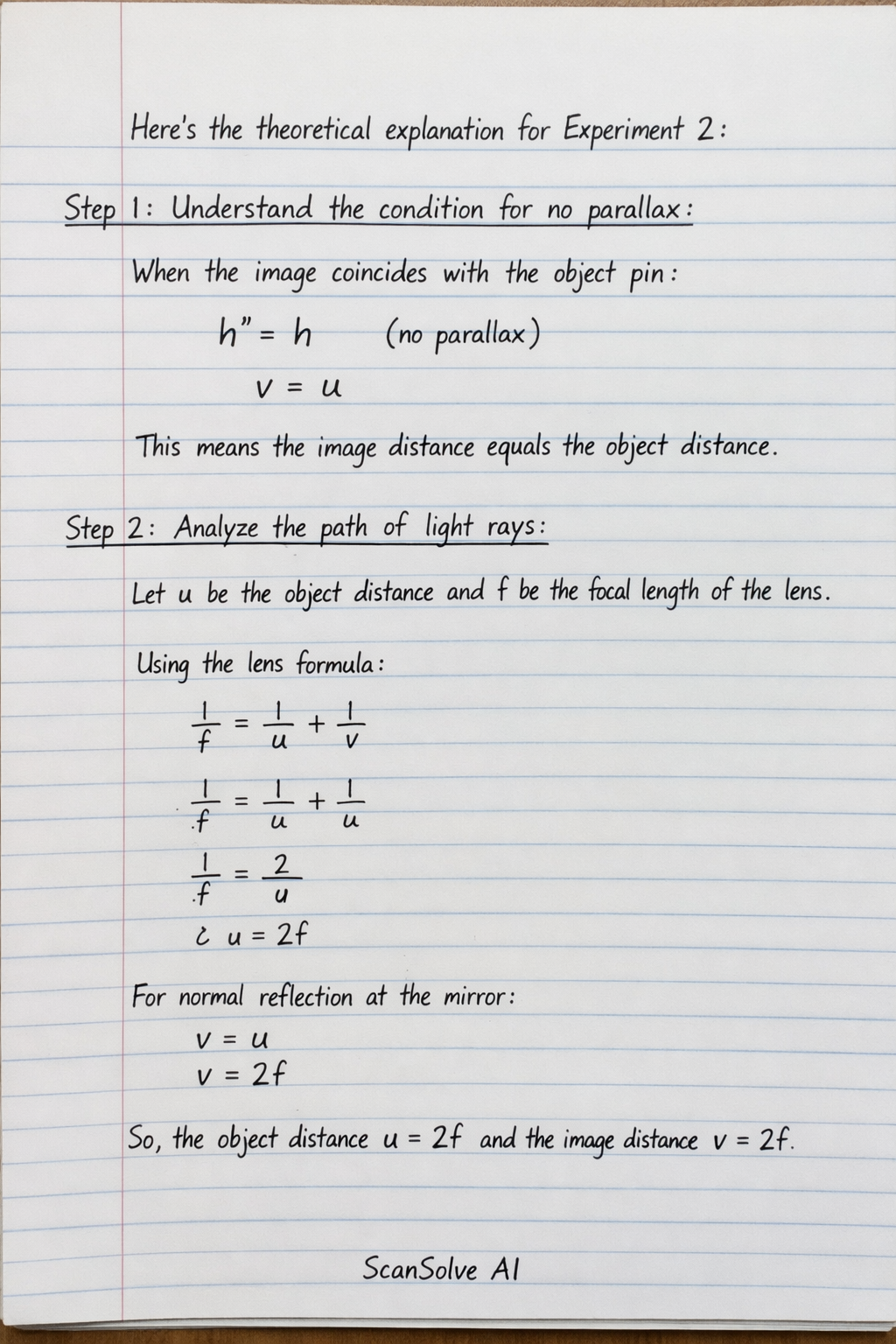
Here's the theoretical explanation for Experiment 2: Step 1: Understand the condition for no parallax. In this experiment, a convex lens is placed on a plane mirror. An object pin is adjusted until its image, formed by the lens-mirror combination, coincides with the pin itself. This condition, known as "no parallax," signifies that the final image is formed at the exact location of the object. Step 2: Analyze the path of light rays. For the final image to coincide with the object, the light rays originating from the object pin, after passing through the convex lens, must strike the plane mirror normally (perpendicularly). If rays strike a plane mirror normally, they retrace their path after reflection. Step 3: Relate normal incidence to the lens's properties. For light rays to strike the plane mirror normally after passing through the convex lens, they must emerge from the lens parallel to its principal axis. This is a fundamental property of a convex lens: when an object is placed at its principal focus, the rays of light, after refraction through the lens, become parallel to the principal axis. Step 4: Conclude the relationship. Since the rays from the object pin become parallel after passing through the lens (so they can strike the mirror normally and retrace their path), the object pin must be positioned at the principal focus of the convex lens. Therefore, the measured distance between the object pin and the optical center of the lens, when no parallax is observed, is the focal length (f) of the convex lens. Theoretically, the distance measured between the pin and the optical centre of the lens is: The focal length of the lens Send me the next one 📸