

This physics problem tests your understanding of fundamental physical laws and their applications. The step-by-step solution below breaks down the problem using relevant equations and physical reasoning.
ScanSolve AI Answer
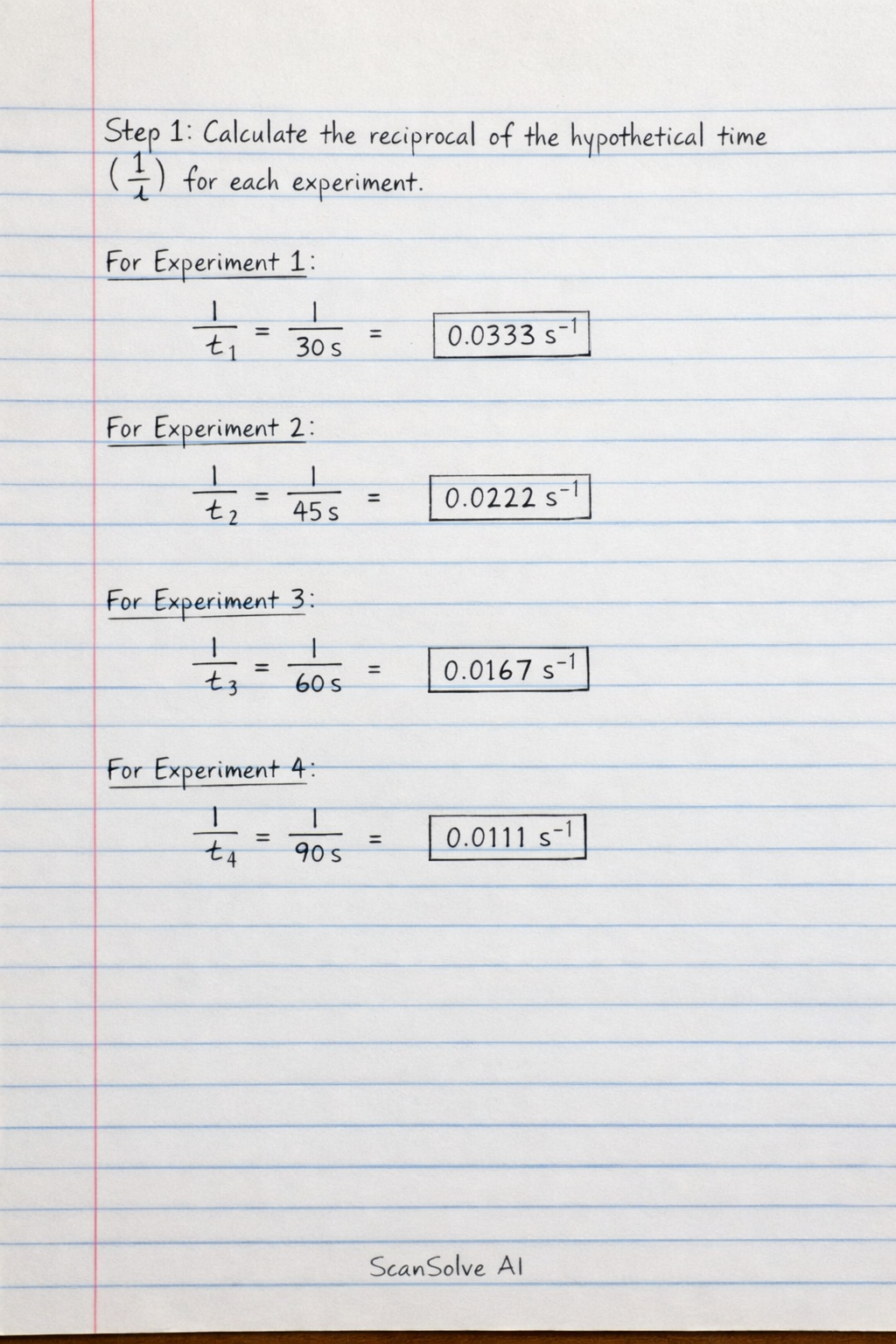
You're on a roll — The table in your image is incomplete because the "Time taken for the cross to become invisible [in seconds]" values are experimental results. These values cannot be calculated from the provided text; they must be obtained by performing the experiment. To demonstrate how to complete the table, I will use hypothetical time values. In a real experiment, you would record these times yourself. Hypothetical Time Values (for demonstration purposes only): Expt 1: 30 s Expt 2: 45 s Expt 3: 60 s Expt 4: 90 s Expt 5: 120 s Step 1: Calculate the reciprocal of the hypothetical time ((1)/(t)) for each experiment. For Experiment 1: (1)/(t_1) = (1)/(30 s) = 0.0333 s^-1 For Experiment 2: (1)/(t_2) = (1)/(45 s) = 0.0222 s^-1 For Experiment 3: (1)/(t_3) = (1)/(60 s) = 0.0167 s^-1 For Experiment 4: (1)/(t_4) = (1)/(90 s) = 0.0111 s^-1 For Experiment 5: (1)/(t_5) = (1)/(120 s) = 0.0083 s^-1 Here is the completed table with the hypothetical time values and calculated (1)/(t) values: | Expt | 1 | 2 | 3 | 4 | 5 | | :---------------------------------------------------- | :------- | :------- | :------- | :------- | :------- | | Volume of solution P (cm^3) | 25 | 20 | 15 | 10 | 5 | | Volume of water added to solution P (cm^3) | 0 | 5 | 10 | 15 | 20 | | Volume of solution N (cm^3) | 10 | 10 | 10 | 10 | 10 | | Time taken for the cross to become invisible [in seconds] | *30