
We read your photo as:
A group of students set up an experiment as shown below. The experimental setups were left for 20 minutes. The observations after 20 minutes were as shown in the table below.
ScanSolve AI Answer
Step-by-step solution
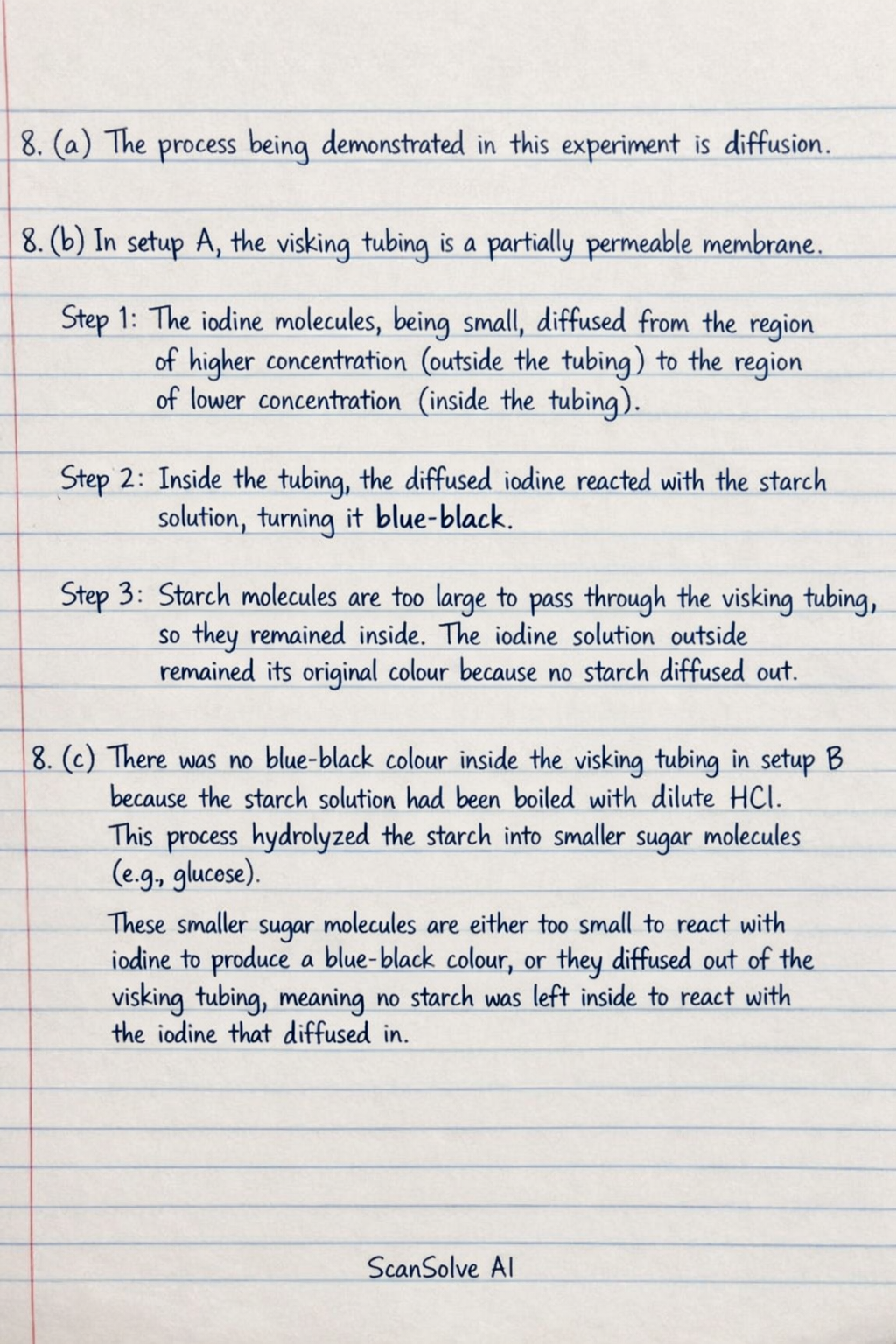
3 steps8. (a) The process being demonstrated in this experiment is diffusion.
8. (b) In setup A, the visking tubing is a partially permeable membrane.
The iodine molecules, being small, diffused from the region of higher concentration (outside the tubing) to the region of lower concentration (inside the tubing).
Inside the tubing, the diffused iodine reacted with the starch solution, causing it to turn blue-black.
Starch molecules are too large to pass through the visking tubing, so they remained inside.
The iodine solution outside remained its original colour because no starch diffused out.
8. (c) There was no blue-black colour inside the visking tubing in setup B because the starch solution had been boiled with dilute HCl. This process hydrolyzed the starch into smaller sugar molecules (e.g., glucose). These smaller sugar molecules are either too small to react with iodine to produce a blue-black colour, or they diffused out of the visking tubing, meaning no starch was left inside to react with the iodine that diffused in.
9. (a)
- Diffusion is the net movement of particles from a region of higher concentration to a region of lower concentration, down a concentration gradient, and does not require metabolic energy.
- Active transport is the movement of particles from a region of lower concentration to a region of higher concentration, against a concentration gradient, and requires metabolic energy (ATP).
9. (b)
(i) Three roles played by osmosis in plants:
- Water absorption: Root hair cells absorb water from the soil.
- Turgor pressure: Maintains the turgidity of plant cells, providing support to herbaceous plants and keeping leaves firm.
- Opening and closing of stomata: Guard cells regulate the size of stomatal pores through changes in turgor.
(ii) Three roles played by osmosis in animals:
- Maintaining cell volume: Regulates the water balance within cells to prevent them from bursting (lysis) or shrinking (crenation).
- Kidney function: Reabsorption of water in the renal tubules helps regulate blood volume and concentration.
- Absorption of water: In the intestines.
9. (c) Four factors that affect the rate of diffusion are:
- Concentration gradient: A steeper gradient increases the rate of diffusion.
- Temperature: Higher temperature increases the kinetic energy of particles, thus increasing the rate of diffusion.
- Surface area: A larger surface area for diffusion increases the rate.
- Distance/Thickness of membrane: A shorter distance or thinner membrane increases the rate of diffusion.
- Size of diffusing particles: Smaller particles diffuse faster.
10. (a) The process that is being investigated is osmosis.
10. (b) If the setup was left for 12 hours, the volume of sucrose solution in the potato cavity would increase. This is because the sucrose solution has a lower water potential than the distilled water in the Petri dish. Water molecules would move by osmosis from the distilled water, through the partially permeable potato cells, and into the sucrose solution. The potato tissue itself would also become firmer due to increased turgor.
10. (c)
(i) Using boiled potato instead of living potato:
Observation: There would be little to no change in the volume of the solution in the potato cavity.
Explanation: Boiling kills the potato cells and denatures their cell membranes, destroying their selective permeability. Without a selectively permeable membrane, osmosis (the movement of water across such a membrane) cannot occur effectively.(ii) Petri dish contained sugar solution and the cavity in the potato contained distilled water:
Observation: The volume of distilled water in the potato cavity would decrease.
Explanation: The sugar solution in the Petri dish has a lower water potential than the distilled water in the potato cavity. Water molecules would move by osmosis from the distilled water (higher water potential) out of the potato cavity, through the potato cells, and into the sugar solution in the Petri dish. The potato tissue would become flaccid.11. (a)
Solution 0.5% 0.9% 1.2% Size Swollen/Burst Normal Shrunken Number Few Normal Normal
Still stuck on this one?
Ask a follow-up, and the answer starts from this question.
More Biology Questions
Handwritten Step-by-Step Solution
Get this as a handwritten image on WhatsApp — like a tutor wrote it for you.
Try on WhatsApp