
We read your photo as:
Classify Jonas's HIV status according to WHO clinical staging criteria. Substantiate your answer with evidence from the scenario.
ScanSolve AI Answer
Here are the answers to Workbook activity 12:
-
Classify Jonas's HIV status according to WHO clinical staging criteria. Substantiate your answer with evidence from the scenario. Jonas's HIV status is classified as WHO Clinical Stage 4.
- Substantiation:
- His CD4 count is 150 cells/mm³, which is below the 200 cells/mm³ threshold for Stage 4.
- He is diagnosed with Pulmonary TB, which is a Stage 3 defining illness, but in the presence of a CD4 count below 200 cells/mm³, it indicates advanced disease, often considered Stage 4.
- He has significant weight loss (65kg to 59kg), and his clothes no longer fit, indicating HIV wasting syndrome or severe weight loss, which is a Stage 3 or 4 criterion.
- He has thrush on the foreskin and head of his penis (candidal balanitis), and is diagnosed with Balanitis, which is a form of mucocutaneous candidiasis, often seen in advanced stages (oral candidiasis is Stage 3).
- Substantiation:
-
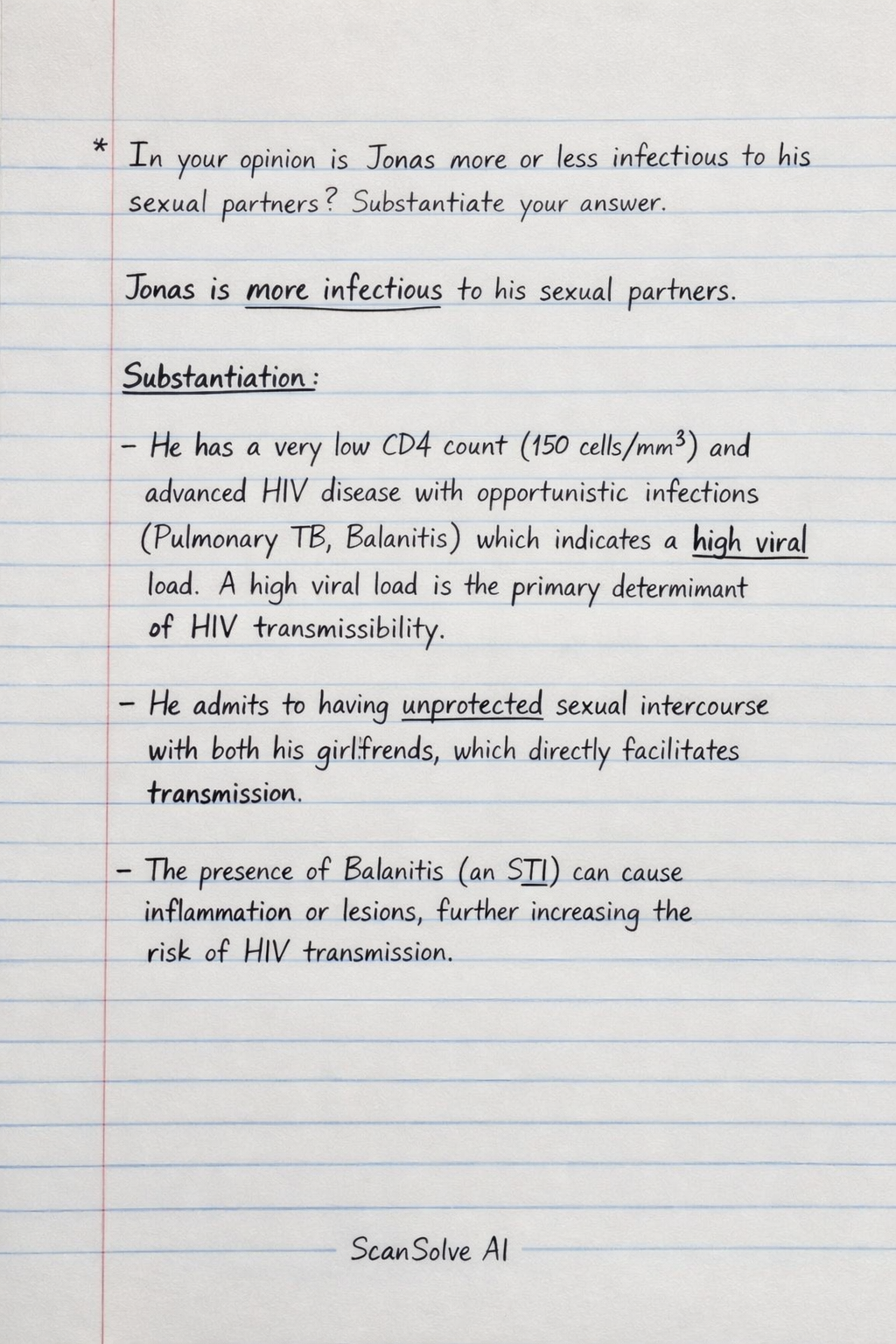
In your opinion is Jonas more or less infectious to his sexual partners? Substantiate your answer. Jonas is more infectious to his sexual partners.
- Substantiation:
- He has a very low CD4 count (150 cells/mm³) and advanced HIV disease with opportunistic infections (Pulmonary TB, Balanitis), which indicates a high viral load. A high viral load is the primary determinant of HIV transmissibility.
- He admits to having unprotected sexual intercourse with both his girlfriends, which directly facilitates transmission.
- The presence of Balanitis (an STI) can cause inflammation or lesions, further increasing the risk of HIV transmission.
- Substantiation:
-
Highlight to Jonas why it is important that he is initiated on ART as soon as possible with reference to the goals of antiretroviral therapy. It is crucial for Jonas to start Antiretroviral Therapy (ART) immediately because:
- To suppress the virus: ART will reduce his viral load, preventing further damage to his immune system.
- To restore immune function: It will help his CD4 count increase, allowing his body to fight off infections more effectively.
- To treat and prevent opportunistic infections: ART will help treat his current Pulmonary TB and Balanitis, and prevent new opportunistic infections and HIV-related complications.
- To improve health and prolong life: ART will significantly improve his overall health, quality of life, and life expectancy.
- To prevent transmission: Achieving an undetectable viral load through ART means he cannot sexually transmit HIV to his partners (Undetectable = Untransmittable, U=U).
-
Identify the Antiretroviral therapy (ART) that will be prescribed for Jonas. A common first-line Antiretroviral Therapy (ART) regimen for Jonas, especially considering his co-diagnosis of Pulmonary TB, would typically be a fixed-dose combination containing:
- Two Nucleoside Reverse Transcriptase Inhibitors (NRTIs) such as Tenofovir Disoproxil Fumarate (TDF) or Tenofovir Alafenamide (TAF) and Lamivudine (3TC) or Emtricitabine (FTC).
- One Integrase Strand Transfer Inhibitor (INSTI) such as Dolutegravir (DTG).
- Therefore, a likely regimen would be TDF/3TC/DTG or TAF/FTC/DTG. If Rifampicin (for TB) is co-administered, the dose of Dolutegravir might need to be adjusted (e.g., 50mg twice daily).
-
Highlight any possible barrier(s) to Jonas's ART adherence? Possible barriers to Jonas's ART adherence include:
- Fear of disclosure and stigma: He has not yet informed his partners, indicating fear of judgment or rejection.
- Pill burden and complexity: He will be on multiple medications for HIV, TB, and Balanitis, which can be overwhelming.
- Poor health status and symptoms: His current symptoms (cough, fever, weight loss, itchy penis) and general ill-health might affect his motivation or ability to adhere.
- Lack of understanding: He might not fully grasp the critical importance of consistent ART adherence.
- Side effects: Potential side effects of ART could discourage him from continuing treatment.
-
What will you put in place to prevent the abovementioned barrier(s) to Jonas's ART adherence? To prevent barriers to Jonas's ART adherence, I would implement the following:
- Comprehensive counseling: Provide in-depth education on HIV, ART benefits, side effects, and the importance of adherence. Offer support for disclosure and address stigma.
- Simplified regimen: Advocate for fixed-dose combination (FDC) ART to reduce pill burden.
- Adherence support tools: Provide pill organizers, set up medication reminders (e.g., phone alarms), and offer adherence counseling.
- Management of co-infections and symptoms: Aggressively treat his Pulmonary TB and Balanitis, and manage other symptoms to improve his overall well-being and motivation.
- Psychosocial support: Link him to support groups, mental health services if needed, and encourage involvement of trusted family/friends (with his consent).
- Regular follow-up: Schedule frequent appointments to monitor adherence, manage side effects, and provide ongoing support and education.
Still stuck on this one?
Ask a follow-up, and the answer starts from this question.
More Biology Questions
Handwritten Step-by-Step Solution
Get this as a handwritten image on WhatsApp — like a tutor wrote it for you.
Try on WhatsApp