
We read your photo as:
The ram of a shaping machine has a mass of 200 kg. It moves in slides with a coefficient of friction of 0.07 between the ram and the slides. Calculate: 1.1 The horizontal force required to move the ram. 1.2 The coefficient of friction if the force to move the ram is increased by 30%.
ScanSolve AI Answer
Answers
2 partsStep-by-step solution
4 stepsHere are the calculations for the forces related to the shaping machine ram:
Given:
- Mass of the ram,
- Coefficient of friction,
- Acceleration due to gravity, (standard value)
Part 1.1· 2 steps
The horizontal force required to move the ram.
Calculate the normal force ().
The normal force is equal to the weight of the ram, as it's moving horizontally.
Calculate the horizontal force ().
The horizontal force required to move the ram is equal to the force of friction ().
The horizontal force required to move the ram is:
Part 1.2
The coefficient of friction if the force to move the ram is increased by 30%.
Calculate the new horizontal force ().
The force is increased by 30% from the original force calculated in 1.1.
Calculate the new coefficient of friction ().
The normal force () remains the same.
Rearrange to solve for :
The new coefficient of friction is:
Try one yourself
A new problem that tests the same skill.
Still stuck on this one?
Ask a follow-up, and the answer starts from this question.
More Physics Questions
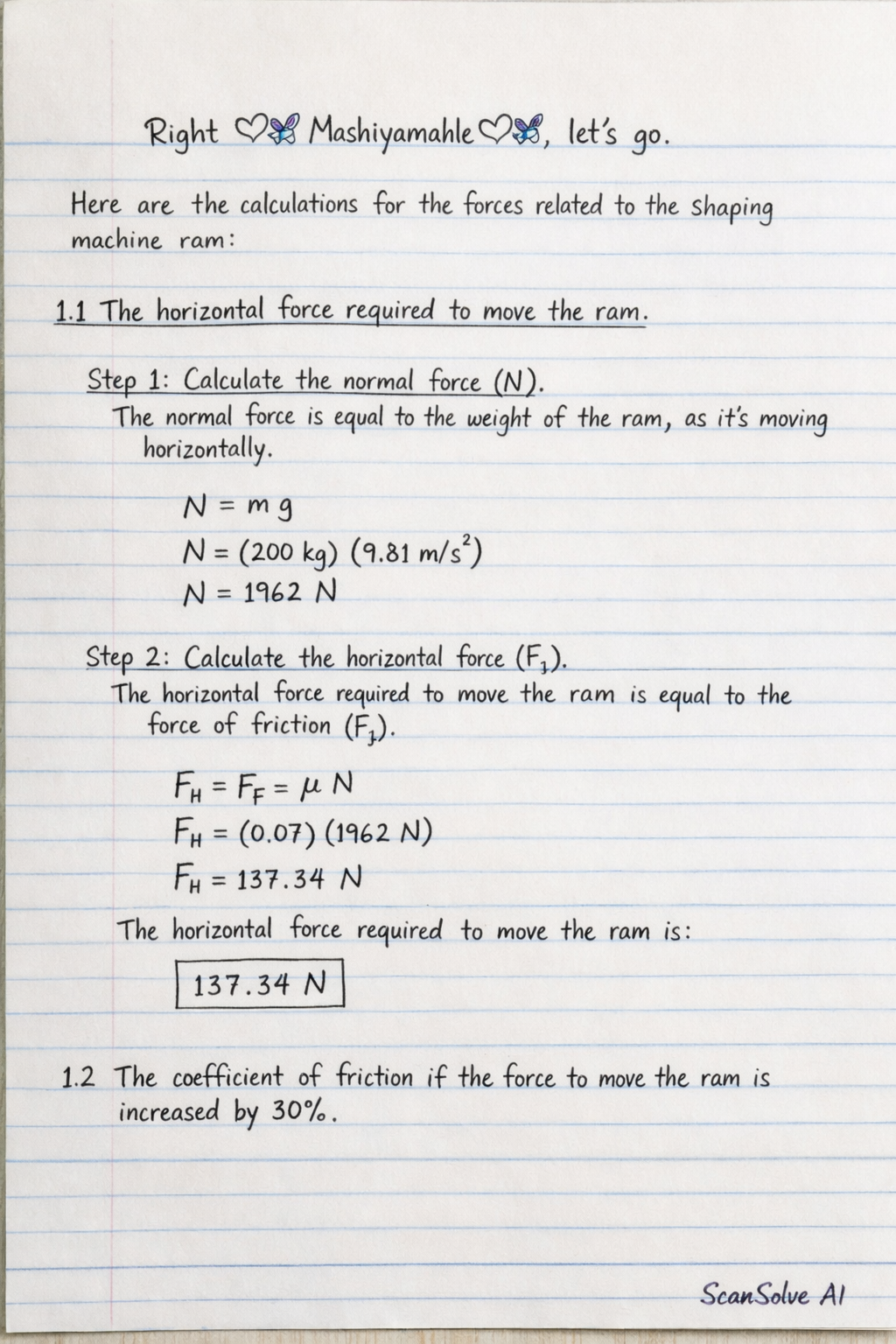
Handwritten Step-by-Step Solution
Get this as a handwritten image on WhatsApp — like a tutor wrote it for you.
Try on WhatsApp